.svg&w=384&q=75 "GoalGist logo")
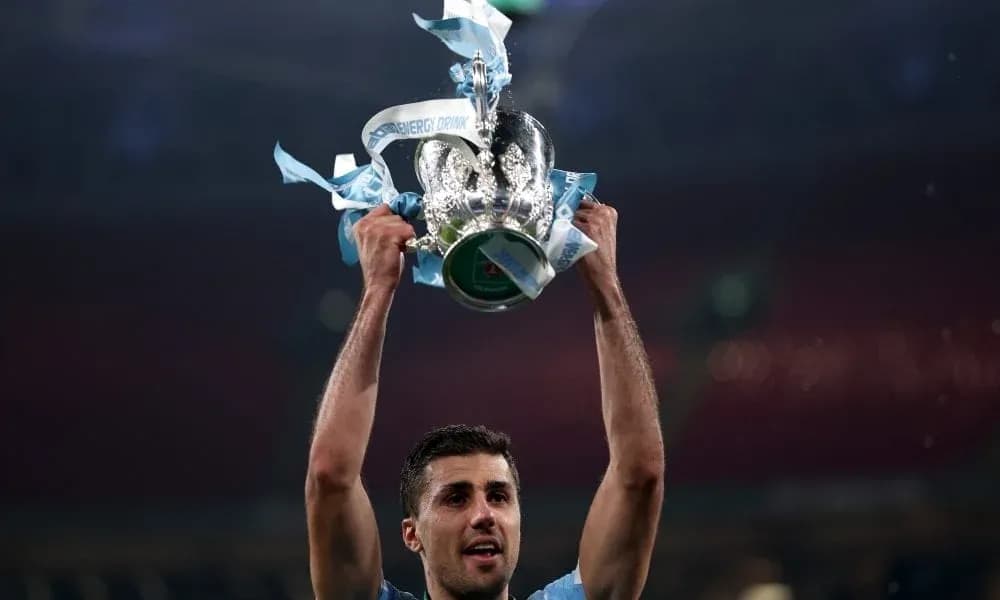
Barcelona's Firm Stance on Rodri Transfer
Barcelona shut the door on Rodri – for now, and for several reasons.
The Manchester City midfielder has dominated the summer conversation in Spain, his performances with the national team pushing his name to the top of every wish list. On paper, he looks like the perfect heir to the great Barcelona pivots of the past. In reality, the Camp Nou offices are not even opening the file.
From the first days of the window, Deco and Hansi Flick have been aligned: no big-money move for a central midfielder. Not Rodri. Not anyone. The message inside the club has been blunt – there are already too many midfielders.
That stance has had immediate consequences. Marc Casado, one of La Masia’s most polished young midfielders, has been encouraged to look for minutes elsewhere. It is a clear sign of how crowded the engine room is and how little appetite there is to add another high-profile name to the mix.
De Jong’s injury doesn’t move the needle
Frenkie de Jong’s latest setback might have been the perfect excuse to change course. It has not.
As soon as news of the Dutchman’s injury broke, the rumour mill accelerated. Outside the club, the logic was simple: De Jong out, Rodri in. Inside, the reaction was almost the opposite. Executives and coaching staff have stuck to their line – no panic, no rush, no major outlay.
They still trust what they have. De Jong’s absence is seen as a problem to be managed, not a trigger for a €70 million solution. Barcelona do not want to reshape their transfer plan around a temporary issue, especially when they believe the answers are already in the dressing room.
Rodri’s name has surged mostly because of his commanding displays with Spain, but at Barcelona the admiration has not turned into action. There is respect, not pursuit.
Two walls between Barça and Rodri
Even if the sporting department suddenly changed its mind, two obstacles loom large.
The first is the fee. Rodri is expected to command around €70 million. For a club juggling financial constraints and squad needs, that figure is simply out of sync with their priorities. Attackers and defenders sit higher on the list. A luxury midfielder does not.
The second barrier is more emotional, and perhaps more decisive: the widespread belief that, if Rodri ever leaves Manchester City, Real Madrid would be his natural landing spot. Barcelona see little sense in entering a race they suspect is already tilted towards their greatest rival.
A bidding war is off the table. They are not interested in driving up the price for a player they do not expect to land.
Other fires to fight
Barcelona’s transfer strategy points elsewhere.
The front line remains the main concern. The club want more punch, more goals, more variety in attack. At the back, they are also looking for reinforcements to tighten a defence that has shown too many cracks in recent seasons.
That leaves central midfield, paradoxically, as the most crowded and least urgent area of the squad. Flick can already call on Pedri, Marc Bernal, Gavi, Fermin Lopez and Dani Olmo to occupy the three midfield berths. All offer different profiles, all expect serious minutes.
There is more. Eric García and Andreas Christensen can both step forward from the back and operate in midfield when required, a tactical wrinkle that gives Flick extra options without spending a cent.
Behind them, La Masia continues to push. Tommy Marques, Brian Farinas and Orian Goren are knocking, each one another reminder that the club’s traditional production line in the middle of the pitch is still alive.
In that context, signing an expensive stand-in just to cover De Jong’s injury has never sounded realistic in the corridors of power. It would clog pathways, compress minutes, and strain a budget that has other battles to fight.
So the stance is firm. Barcelona do not expect to sign Rodri. They do not expect to sign any midfielder before the window closes. Only a major twist – a long-term setback for De Jong or a serious injury to another key midfielder – would force them back to the market.
Until then, the message from Barcelona is as clear as it is defiant: the midfield is already built. The real question is not who arrives, but whether this group can prove the club right when the season’s pressure starts to bite.

