.svg&w=384&q=75 "GoalGist logo")
Australia Faces USA: A Tense Encounter at Enmore's Golden Barley
The roar inside Enmore’s Golden Barley had barely settled into a steady hum when the air went out of the room.
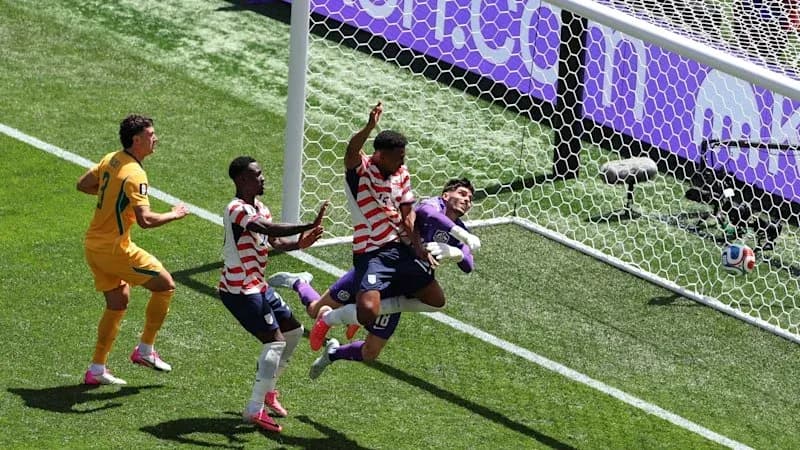
Cameron Burgess, of all people, struck early for the USA and you could suddenly hear every muttered curse, every clink of glass. Hundreds of Sydneysiders, who had spent the build‑up jeering every glimpse of US manager Mauricio Pochettino on the big screen and loudly deriding the pre‑match military flyover, were silenced in an instant.
The mood flipped. The early bravado, the gallows humour, the wall of noise – all of it smothered by the reality unfolding on screen. The USA had the ball, and they kept it. Australia chased shadows.
When the second American goal arrived, the place erupted again, but not in celebration. The decision that led to it went down like a lead balloon. Controversial, if you asked anyone with a beer in hand. Arms flew up, heads were thrown back, and one punter announced to no one in particular that he was going home.
He didn’t move.
Because half-time came, and with it the familiar rituals that keep belief alive: fresh pints, steaming party pies, a rush to the bathrooms and back to the same spot at the bar, as if that might somehow help. This crowd has seen enough football to know when a game is slipping away, but they also know what 45 minutes and one electric teenager can do.
Nestory Irankunda. The name alone kept people in their seats.
“It’s not over yet,” another fan declared, almost daring anyone to contradict him.
Wise words. Play on.
Popovic rolls the dice
The restart brought exactly what so many had demanded. Last weekend’s scorers, Irankunda and Connor Metcalfe, stepped off the bench, joined by Jason Geria. Toure, Velupillay and Burgess made way. On paper, it was a simple shuffle: Mathew Leckie slid across to the left, Metcalfe took up residence on the right.
In reality, it was a statement. Tony Popovic knew his side needed more than structure now – they needed spark, legs, and a reason for the USA back line to glance over their shoulders.
From the Australian bench, the diagnosis had already been blunt.
“Conceding so early wasn’t ideal,” assistant coach Paul Okon told SBS, summing up what every fan in Enmore and beyond had been thinking. The conditions hadn’t helped either. “It’s hot out there. We struggled a little bit in the heat. We’re not getting our line high enough to put pressure on the ball. But it’s difficult.”
The heat, the early blow, the relentless American possession – it had all combined to drag Australia deeper and deeper. The temptation in that situation is to abandon shape and simply chase. Okon was adamant they couldn’t afford that.
“What we don’t want to do is fall out of our structure and start chasing the ball. We need to stay compact as much as possible and obviously try and have enough legs that once we get the ball we can hurt them.
“We’ll see some fresh legs in the second half, a bit of speed to hurt them once we have the ball.”
Those fresh legs were now on the pitch. The theory was clear. The execution, against this USA side, was another matter entirely.
Fed Square refuses to fold
Across the country, in Melbourne’s Fed Square, the story felt much the same on the pitch but very different off it.
If the Golden Barley was tense, Fed Square was stubbornly festive. Fans had queued from 2am just to get in, staking out their spots in the famous concrete amphitheatre and refusing to let the weather or the scoreline dictate their mood. Rain came and stayed. So did they.
Flares hissed, a beach ball bobbed its way across ponchos and scarves, and the green and gold washed over the square in a defiant blur. This wasn’t a crowd that needed a scoreboard to tell them when to sing.
Mel, a regular here for two decades, turned up in a Socceroos jersey and a Donald Trump costume designed to look like he was being carried on the former president’s shoulders. It was ridiculous, theatrical and absolutely in keeping with the occasion. Asked who would win, he didn’t hesitate: “Aussies of course.”
Nearby, Madison Cambora was living a very different kind of first. Her first time waking in the dead of night to get to Fed Square. Her first time standing in the rain, watching her team trail, and still calling it worth it.
“I hope they come back from this,” she said. “I’m hoping all good things, but it’s not looking good.”
She wasn’t wrong.
Outmuscled, outthought, outplayed
On the field, the gap between the teams was brutal in its clarity.
The Americans were better in every department. They hit harder in the duels, thought quicker in possession, and used the ball with a technical authority that never really allowed Australia to breathe. Every 50‑50 seemed to fall their way. Every loose touch in green and gold was punished by a swarm of navy shirts.
Mistakes crept into Australia’s play and then multiplied. Passes went astray, clearances lacked conviction, and the USA simply grew stronger. They looked, in all the ways that matter at this level, like a complete side.
For Popovic, the equation heading into the second half was harsh and simple. His team had to attack. They had no choice. But opening up the game risked giving the USA exactly what they wanted: space to run, room to combine, chances to turn a solid lead into a statement win.
At an absolute minimum, Irankunda had to start the half. He did. He had to give the Americans something to think about, some sense that the contest still had a twist in it.
Because for long stretches, the truth was unavoidable.
Right now, the USA had nothing to worry about. The question is whether Australia can change that in time to salvage more than just pride from nights like this.