.svg&w=384&q=75 "GoalGist logo")
Australia Advances in FIFA World Cup but Attacking Concerns Linger
The Socceroos are through, but the alarm bells are ringing.
A gritty 0-0 draw with Paraguay booked Australia’s place in the round of 32 at the FIFA World Cup, a result that on paper ticks every box. Clean sheet. Knockout football secured. Job done.
Yet the story of the night was a defender – Jordan Bos – and that, according to two former Socceroos, is exactly the problem.
Bos shines while the forwards stall
Jacob Italiano’s late withdrawal forced Tony Popovic into a reshuffle that many had been waiting to see. Bos came in on the right, with Melbourne City’s Aziz Behich sliding across to fill the vacancy on the left.
The gamble worked. Bos was electric, aggressive with and without the ball, and quickly became Australia’s most dangerous outlet in wide areas. For a young defender thrust into a World Cup cauldron, he didn’t just cope. He drove the team forward.
That, for Scott McDonald and Robbie Slater, said as much about Australia’s attacking issues as it did about Bos’ emergence.
“Up front is a bit of a worry when we’re looking at Jordy Bos as one of the most threatening (for Australia),” Slater said on Stan Sport’s Added Time, cutting straight to the point.
The forwards were meant to own this stage. Instead, they watched a full-back steal the spotlight.
No.9 conundrum exposes lack of trust
McDonald, a former international striker, didn’t hide his concern. In his eyes, this was supposed to be Mo Toure’s or Nestory Irankunda’s platform.
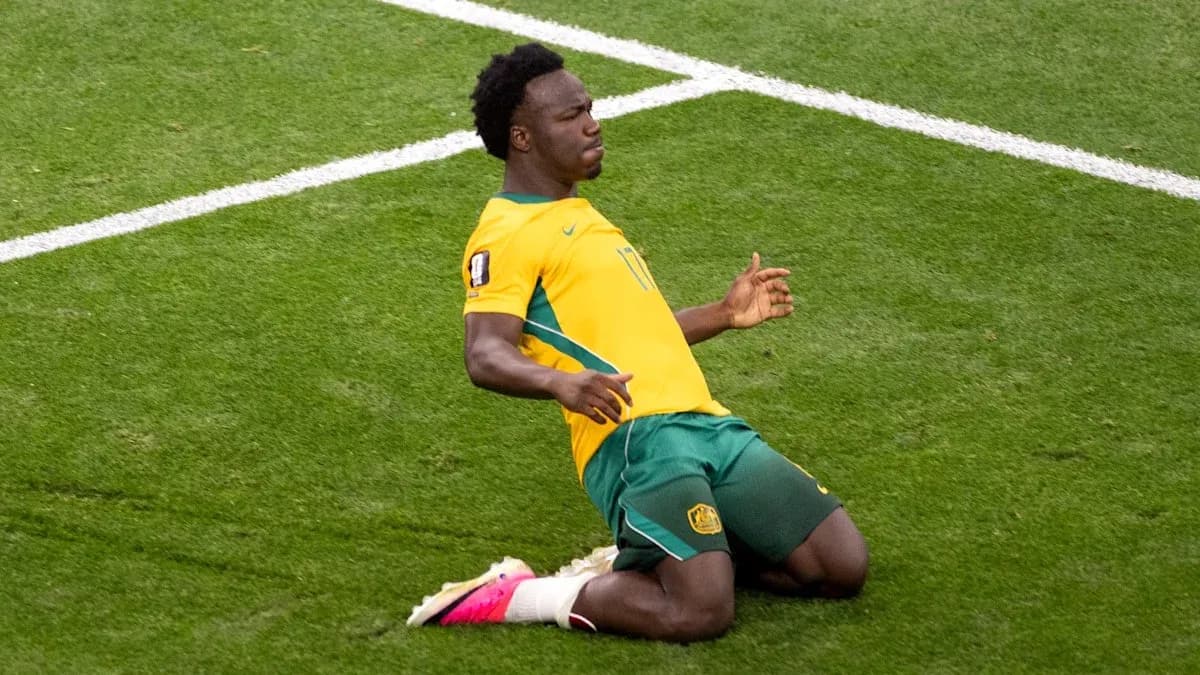
Toure stayed on the bench. Irankunda, usually a winger, was pushed into the role of Australia’s No.9 – and McDonald cannot see that as any kind of long-term answer.
“There is a problem in terms of the No.9. Not bringing (Mo) Toure on instead of Tete Yengi tells me today that there’s no trust there,” he said.
The implication was brutal. If your natural striker is overlooked in a game crying out for a focal point, what does that say about his standing with the coach?
“Does he go and start him (Toure) out of the blue in the next game? You just can’t tell with Tony. But as a striker, being Toure, I don’t like that. That doesn’t fill me with confidence that my coach trusts me.”
Forwards live on belief. Doubt drains them. And right now, McDonald sees doubt everywhere in that No.9 role.
Irankunda’s struggle in an unnatural role
On Friday, Irankunda battled. He chased, he pressed, he tried to make runs off shoulders. But he fed on scraps.
“No matter who we put up there, it’s a thankless task up there,” McDonald said. “Look at Nestory (on Friday), he had very little and was living off scraps.”
The tactical trade-off was obvious. With Irankunda pinned centrally, Australia lost a natural box outlet. Bos, again, stepped into the void.
“But also when he plays up top, we don’t have a box outlet. Jordy Bos playing on the right-hand side was brilliant and it gave us that outlet.”
McDonald has sympathy for Irankunda, still only 20, being asked to lead the line or even float as a No.10 in a World Cup knockout race. Those roles demand craft, timing, and a kind of patience that usually comes with years of repetition in that position.
“Look, he’s gotta hold it up a little bit better,” McDonald added. “I think at times he struggled because it’s not his natural game.”
Paraguay made sure it stayed uncomfortable. A back three sat deep and tight, closing the channels where Irankunda normally explodes.
“With the way Paraguay were set up as well with the back three, it is very hard for him to get down the sides of the opposition. There was no space.
“They were aware of his threat also, with three taking care of him. But he probably sometimes needs to be more in central positions and wait for things to happen.”
That is the cold reality of playing as a No.9 at this level. You often suffer through long spells of anonymity, then live or die on one moment.
Lessons from the best – and a blunt Australian truth
McDonald pointed to the modern template.
“As we see the best strikers in the world – like Erling Haaland – they’re not interested any more. They just get into the right areas and allow others and trust others to do the dirty work then get on the end of things.”
Irankunda, he believes, still thinks like a winger.
“That’s not naturally probably where (Irankunda) thinks. He wants to be the guy creating that and doing things, getting on the edge of the box and having shots. So if you’re gonna play that role, you just need to play it a little bit more smarter and be a bit more patient.”
McDonald even admitted he never loved that kind of lone-forward grind himself.
“I didn’t like it either. I mean, for the majority of my career it was always you played off the big man or whatever.”
Then came the line that cuts to the heart of Australia’s long-running search for a reliable No.9.
“But I’ve always said it, if you can head it, you’ve got a better chance of being a No.9 for the Socceroos. It’s as simple as that.”
Through to the knockouts – but at what attacking cost?
Australia march on, and World Cup campaigns are rarely judged harshly while the team is still alive. Bos has burst onto the scene as the unexpected gem of this side, a defender playing with the swagger of a winger and the courage of a veteran.
Yet as the stakes rise and the opponents sharpen, the question lingers over Popovic’s team: can a World Cup run really be built on the back of a flying full-back, while the No.9 role remains a revolving door?