.svg&w=384&q=75 "GoalGist logo")
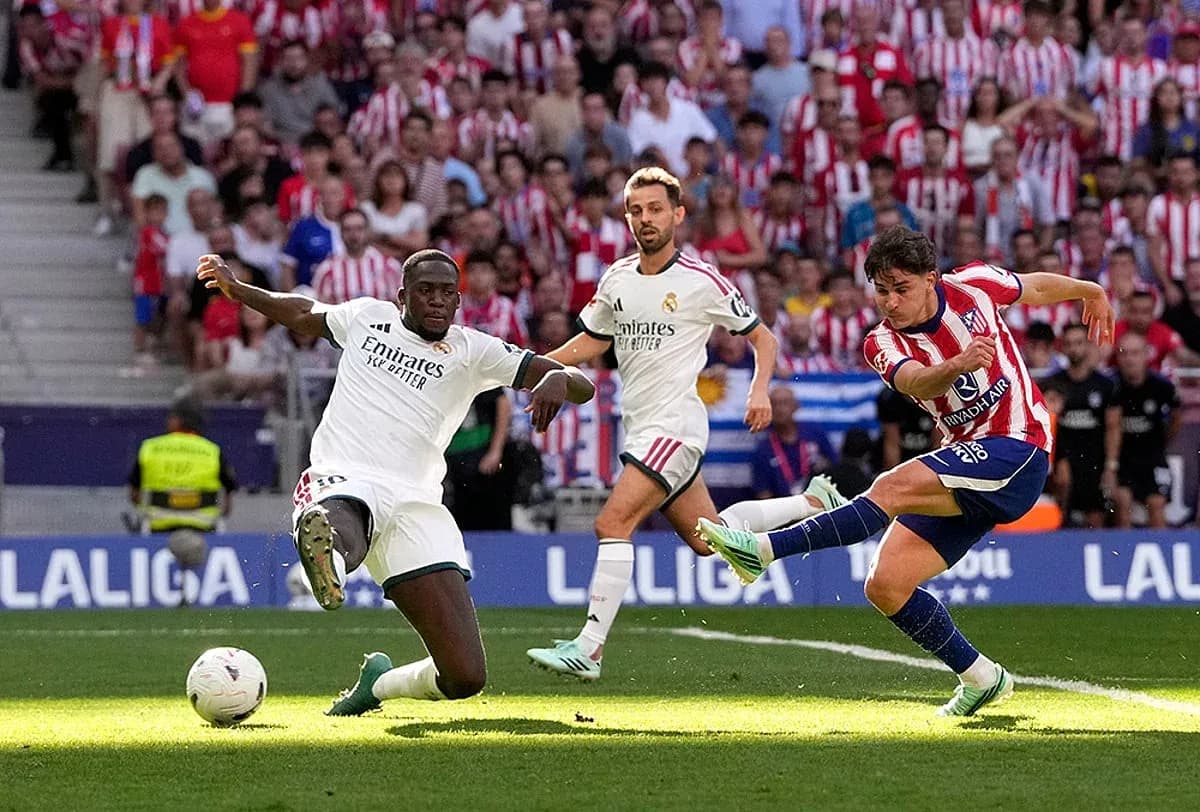
Atletico Madrid's Tactical Masterclass Against Real Madrid
Under the late-afternoon lights of the Riyadh Air Metropolitano, Atletico Madrid’s 2–1 victory over Real Madrid felt like more than three points. It was a statement that this version of Diego Simeone’s side, sitting 2nd in La Liga on 16 points after 7 matches, can go toe-to-toe with a Real Madrid team that arrived 4th with 15 points and one of the most explosive attacks in the league.
I. The Big Picture – Two Identities Collide
Heading into this game, the numbers framed a classic clash of styles. Atletico’s season has been built on controlled aggression and balance: overall they had scored 16 goals and conceded 7, for a goal difference of 9. At home they had been close to flawless – 4 matches, 3 wins, 1 draw, 10 goals for and only 3 against, averaging 2.5 goals scored and 0.8 conceded per home game.
Real Madrid, under José Mourinho, arrived with a different type of menace. Overall they had 18 goals scored and 8 conceded, a goal difference of 10. At the Bernabéu they were devastating – 12 goals in 3 home games – but on their travels they were more human: 4 away matches, 2 wins and 2 defeats, 6 scored and 6 conceded, averaging 1.5 goals for and 1.5 against away.
The final 2–1 scoreline in favour of Atletico fits that statistical tension: a side that rarely loses at home suffocating a team that can be vulnerable on their travels, even with Kylian Mbappé and Jude Bellingham in full flow.
II. Tactical Voids – Who Was Missing, What Changed
Both squads came in with notable absences that subtly reshaped the tactical landscape.
Atletico were without P. Barrios and A. Sorloth, both sidelined by muscle injuries. The absence of Sorloth removed a classic target-man option, nudging Simeone further towards mobility and interchange in the front line. It made the choice of a 4‑4‑2 with Lee Kang-In and J. David up front even more significant: less about long diagonals to a towering nine, more about quick combinations and pressing from the front.
Real Madrid’s absentees were equally structural. Eder Militao (hamstring), F. Mendy (hip) and Rodrygo (knee) all missed out. Without Militao and Mendy, Mourinho leaned on a back four of D. Dumfries, I. Konaté, D. Huijsen and Marc Cucurella. That meant two ball-playing centre-backs and an attacking left-back, but also a back line that, away from home, had already conceded 6 goals in 4 league trips. The loss of Rodrygo removed a vertical runner from the right, concentrating creative and scoring responsibility even more on Mbappé, Vinícius Júnior and Bellingham.
Disciplinary trends also cast a shadow over the contest. Atletico’s season card profile showed a spiky first half, with 30.77% of their yellows coming between 31–45 minutes and a late-game flashpoint of red at 76–90 minutes. Real Madrid, by contrast, tended to collect yellows after the break – 25.00% in both the 46–60 and 61–75 ranges – and had already seen a red card in that 46–60 window this season. Within that context, the presence of high-card-risk defenders like Konaté (3 yellows so far) and red-carded Huijsen added an undercurrent of jeopardy every time Atletico attacked.
III. Key Matchups – Hunter vs Shield, Engine Room Battles
The headline duel was always going to be Mbappé against Atletico’s defensive structure. Mbappé came into the derby as one of La Liga’s most lethal forwards: 7 goals and 2 assists in 7 appearances, 32 shots with 22 on target, and 39 dribbles attempted with 23 completed. He had also won and taken penalties, scoring 1 but missing 1, a reminder that Real’s spot-kick record this season is far from perfect.
Simeone responded with a back four of Marc Pubill, C. Romero, D. Hancko and Álex Grimaldo in front of J. Oblak. The plan was clear: compress space centrally and funnel Mbappé and Vinícius into crowded wide channels where Atletico’s midfield line could double up. With Atletico conceding only 3 goals at home all season before this match, the shield held more often than not, limiting Real to a single goal.
If Mbappé was the hunter, Atletico had their own weapons. Álex Baena, already on 4 league goals and 1 assist, offered a creative spark from midfield, with 14 key passes and 13 shots (7 on target) heading into the game. His tendency to drift inside from the left and combine with Marcos Llorente and J. Cardoso gave Atletico a technical triangle to play through Real’s double pivot of F. Valverde and A. Tchouaméni.
On the right, G. Simeone’s role was less about pure flair and more about work: 2 goals, 2 assists, 15 tackles and 6 interceptions this season underline how he stitches Simeone’s pressing scheme together. Against a Real side that wants to build through Bellingham and Arda Güler between the lines, his ability to drop and form a compact 4‑5‑1 out of possession was crucial in disrupting Real’s rhythm.
In the “engine room” duel, Bellingham stood as Real’s all-phase fulcrum: 3 goals, 2 assists, 17 key passes, 12 tackles and 3 interceptions. He is both playmaker and enforcer. Atletico’s answer was collective rather than individual – Cardoso anchoring, Llorente’s box-to-box running, Baena’s pressing from the front. The derby’s 2–1 outcome suggests that Atletico’s midfield screen succeeded in forcing Bellingham to receive under pressure, rarely letting him dictate the tempo for long spells.
IV. Statistical Verdict – Why the 2–1 Makes Sense
From a season-long perspective, this result sits neatly within the numbers. Atletico’s overall scoring rate of 2.3 goals per game and defensive average of 1.0 conceded aligned almost perfectly with a 2–1 home win. Real Madrid’s total averages of 2.6 goals for and 1.1 against, combined with their away tendency to both score and concede (1.5 each), pointed towards a high-level but balanced contest rather than an away rout.
Add in Atletico’s 3 home clean sheets in 4 prior home matches and Real’s lack of away clean sheets so far, and a scenario where Simeone’s side found a way to breach Courtois twice while limiting Mbappé and company to a single reply felt statistically coherent.
Following this result, Atletico reinforce their identity as a ruthless home machine with tactical flexibility in a 4‑4‑2 that can morph into a pressing 4‑5‑1. Real Madrid, for all their individual brilliance and Mbappé’s elite numbers, are reminded that away from the Bernabéu, defensive fragility and disciplinary risk can still tilt even the finest margins of a derby.