.svg&w=384&q=75 "GoalGist logo")
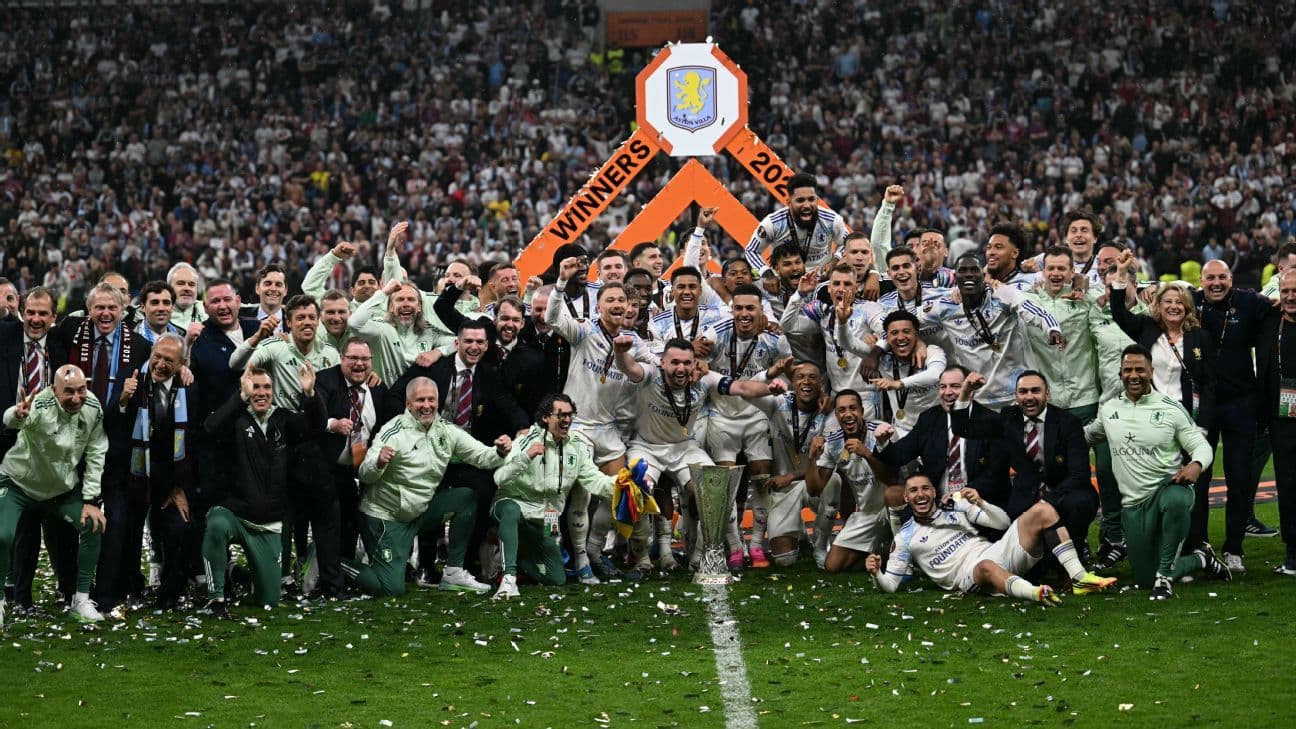
Aston Villa Triumphs in Europa League Final
Aston Villa’s long road back to Europe’s summit ended in a blur of claret and blue in Istanbul, a 44–year wait finally snapped by a coach who treats this competition like his private playground.
Unai Emery has done it again. Europa League, five times. Four different clubs. Same outcome.
On a warm night on the Bosphorus, Aston Villa dismantled Freiburg 3-0 with a cold, ruthless edge that spoke of a team – and a manager – who knew exactly what they were doing. Youri Tielemans and Emi Buendía produced the kind of goals that live in highlight reels for decades; Morgan Rogers added the third that turned a statement win into a procession.
For a club that tumbled out of the Premier League in 2016, this was not just a trophy. It was a full stop at the end of a long, chaotic sentence.
From Preston to the Bosphorus
John McGinn stood at the heart of it all, Europa League trophy raised, claret and blue scarves swirling around him. Seven years ago he was the engine in the side that dragged Villa past Derby County at Wembley and back into the Premier League. Now he is the first Scotsman to captain a team in a major European final since Barry Ferguson in 2008, and the first to do so for an English club since Graeme Souness in 1984.
The journey from midweek trips to Preston to nights like this has been written by players whose names will now sit comfortably alongside Paul McGrath and Peter Withe in Villa folklore. Some – McGinn, Tyrone Mings, Tammy Abraham – were there for that promotion push. Others – Ezri Konsa, Emi Martínez, Ollie Watkins, Matty Cash – arrived as the club tried to reassemble itself in the top flight.
They have flirted with something like this before. A Conference League semifinal in 2024. A Champions League quarterfinal last season, ended by eventual winners Paris Saint-Germain. Near misses, promising runs, a sense of a club building towards something but not quite breaking through.
In Istanbul, the door finally gave way.
Villa controlled the final with a calm authority that belied the stakes. Freiburg, below their best, were kept at arm’s length, their industry – they covered 2.5km more than Villa – reduced to a statistic rather than a threat. When the chances came, Villa didn’t blink. They punched, and they punched clean.
Emery, the Europa League specialist who won’t claim the crown
Thomas Tuchel once joked that UEFA might as well rename this trophy after Emery. Nights like this make the line feel less like a quip and more like a proposal.
On the banks of the Bosphorus, the Spaniard lifted the 47kg trophy for a fifth time, adding Aston Villa to a roll call that already included Sevilla and Villarreal. Only Carlo Ancelotti, with his five Champions League triumphs, can match that haul in major European competitions. No one else has done it with as many different clubs.
Emery insists he is not the “king” of this tournament. Try telling that to the 11,000 Villa fans packed into the claret and blue end of Beşiktaş Park, among them a future monarch in Prince William. To them, the man who has dragged their club from 17th in the Premier League to Champions League qualification and now a European trophy is something close to untouchable.
He downplayed the influence of his past finals on this one. The performance said otherwise. Villa arrived with a plan designed to stretch Freiburg physically and expose them technically. Once Tielemans detonated the opener, the result felt almost inevitable.
It is easy to forget how this season started. No wins in their first four games. No goal until late September. From that position, Emery has steered Villa to the Champions League and a major European title. His reputation as a modern coaching great no longer needs defending; nights like this do the talking.
A final decided by three clean strikes
For 40 minutes, the final refused to catch fire. Fouls broke up the rhythm. Both sides struggled to find any kind of sustained control. Villa looked oddly flat, their build-up clogged and predictable.
Then the mask slipped. Or rather, the plan revealed itself.
Emery had instructed his players to bypass Freiburg’s press, launching long balls towards Watkins and playing in the spaces behind. It wasn’t pretty, but it dragged Freiburg into uncomfortable positions and opened the game just enough for Austin MacPhee to go to work.
From a short corner, Lucas Digne played it quickly, catching Freiburg half-asleep. Rogers, given a second to look up, lifted a teasing ball into a pocket of space just inside the box. Tielemans timed his run perfectly and met it with a thumping volley that exploded past Noah Atubolu. One clean movement. One brutal finish. Villa in front.
The pressure told again just before the break.
Buendía, cutting across the edge of the area, shaped his body and whipped a left-footed shot towards the top corner. Atubolu clawed at thin air as the ball curled away from him and into the side netting. It was a goal of pure technique, the kind that silences a stadium for a split second before the noise crashes back in.
François Letexier barely let Freiburg restart. His whistle for half-time felt like an act of mercy.
The pattern of recent Europa League history held firm. The last three finals in which a team led by two at the interval have all finished 3-0 – Atlético Madrid in 2012, Atalanta in 2024, and now Villa in 2026. Once Emery’s side hit that cushion, they never looked like surrendering it.
Rogers added the third. Sharper than spectacular, but no less decisive. The 23-year-old became the youngest Englishman to score in a major UEFA final since Steven Gerrard in 2001, a neat statistical echo of another night when an English club bent a European final to its will.
This time, there was no scrappy, deflected winner, no messy scramble like last year’s Tottenham Hotspur–Manchester United decider. Villa’s goals were clean, deliberate, and utterly unforgiving.
A club back among Europe’s heavyweights
The numbers around this triumph underline its scale. Villa’s 44-year gap between major European finals is the third-longest on record, behind only Manchester City’s half-century wait and West Ham United’s 47-year hiatus. English clubs have now won the Europa League/UEFA Cup in consecutive seasons for the first time since the early 1970s, when Spurs and Liverpool set the tone.
Jadon Sancho, used to these stages, quietly carved out his own piece of history as the first player to appear in the final of three different major European competitions in three straight seasons – Champions League, Conference League, Europa League. It is the kind of record that speaks to the level Villa now move in.
The club that once stared down the barrel of permanent decline has climbed back to a place where its past and present finally feel aligned. European Cup winners in 1982. Europa League winners in 2026. Two different eras, one shared identity.
The question now is not whether this was a one-off. With Emery on the touchline, a core of players in their prime, and a fanbase that has tasted European glory again, the bar has been reset.
For Aston Villa, nights like Istanbul are no longer a memory. They are a standard.

