.svg&w=384&q=75 "GoalGist logo")
Arsenal Dominates Coventry in Premier League Opener
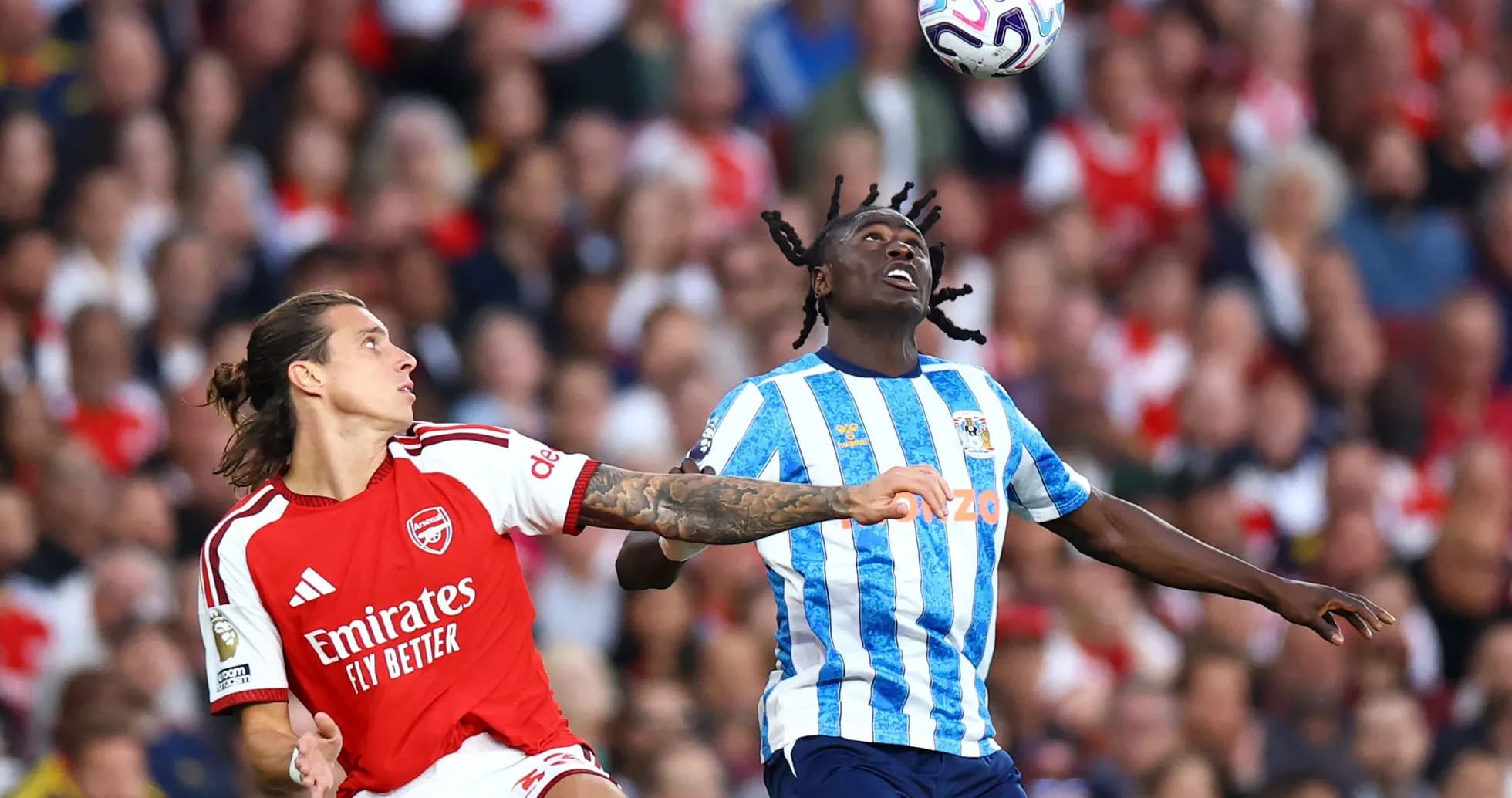
Under the Friday night lights at Emirates Stadium, Arsenal opened their 2026 Premier League campaign with a performance that felt less like a first step and more like a continuation of a long‑matured idea. A 3–0 home win over newly promoted Coventry, sealed inside 90 controlled minutes, sent Mikel Arteta’s side straight to 2nd in the table with 3 points and a goal difference of +3, while Frank Lampard’s team left London rooted in 19th, their own goal difference at -3.
I. The Big Picture – Arsenal’s structure, Coventry’s reality check
On paper it was a clash of identities as much as a clash of ranks. Arsenal, already defined by their positional play, lined up in a familiar 4‑2‑3‑1: David Raya behind a back four of Ben White, C. Mosquera, Gabriel and Riccardo Calafiori; Declan Rice paired with Myles Lewis‑Skelly at the base; Bukayo Saka, Martin Ødegaard and Christos Tzolis supporting Kai Havertz.
Coventry arrived in a 4‑1‑4‑1, C. Rushworth shielded by a line of M. van Ewijk, B. Thomas, A. Amenda and Jay Dasilva, with Matt Grimes as the single pivot. Ahead of him, L. Tchaouna, Caleb Marfo Yirenkyi, Frank Onyeka and B. Thomas‑Asante tried to knit transitions into service for Ellis Simms as the lone striker.
Following this result, Arsenal’s early‑season statistical profile is brutally clean: in total this campaign they have played 1 league match, won 1, scored 3 and conceded 0. At home that translates to 1 match, 1 win, 3 goals for and 0 against, an average of 3.0 goals scored and 0.0 conceded per home game. Coventry’s mirror image is stark: on their travels they have played 1, lost 1, failed to score and shipped 3, an away average of 0.0 goals scored and 3.0 conceded.
II. Tactical Voids – Absences and discipline
Both managers had to stitch around absences. Arsenal were without Bruno Guimaraes, W. Saliba and J. Timber, all listed as missing through injury. The spine that started, then, was a statement of trust in new and younger pieces: Mosquera stepping into Saliba’s zone, Lewis‑Skelly into the senior midfield rotation.
Coventry’s own sheet of absentees – L. Woolfenden and Haji Wright both ruled out – stripped Lampard of a centre‑back option and a powerful outlet up front. That loss of verticality showed; without Wright, Simms often found himself isolated, with little threat in behind to stretch Arsenal’s high line.
Discipline traced the game’s rhythm. Across their league season so far, Arsenal’s only yellow card has landed in the 31–45 minute window, a single caution that accounts for 100.00% of their bookings. That belongs to Gabriel Magalhães, whose blend of aggression and recovery defending remains double‑edged: 9 duels contested, 2 won, 2 fouls committed and 2 drawn. Coventry’s own card profile is equally concentrated but earlier; their only yellow of the campaign arrived between 16–30 minutes, again 100.00% of their bookings, and it fell to Yirenkyi, who committed 2 fouls in 62 minutes.
No red cards have been shown to either side in the league so far, and with neither team awarded a penalty and none missed, there is no early‑season drama from the spot to distort the underlying tactical picture.
III. Key Matchups – Hunter vs Shield, the engine room, and the wide war
The “Hunter vs Shield” duel belonged on Arsenal’s right. Saka, already among the league’s top‑rated attackers, produced a quietly ruthless 68‑minute shift: 1 goal from his only shot, 1 successful dribble, 2 key passes and 34 total passes at 88% accuracy. He repeatedly isolated Jay Dasilva and then attacked the half‑space between Dasilva and Amenda, forcing Coventry’s 4‑1‑4‑1 to tilt and over‑compensate.
Protecting Rushworth was a Coventry back line still learning each other’s habits. B. Thomas and Amenda were asked to hold a high line against a front four that constantly rotated. With Coventry conceding 3 goals in their only away game so far, that central pairing becomes the obvious “shield” that is not yet hardened enough for this level. Each time Saka or Ødegaard drifted inside, Havertz dropped out to receive, dragging a centre‑back with him and opening the channel for Calafiori or White to surge.
If the flanks were the cutting edges, the “engine room” was the true theatre of control. Rice and Lewis‑Skelly against Grimes and Onyeka set the tone of the evening. Rice’s presence allowed Ødegaard to live higher between the lines, where his numbers already underline his influence: 1 goal, 3 key passes, 56 total passes at 92% accuracy, plus 3 tackles and 4 duels won from 6. He was not just the conductor; he was also the first presser, snapping onto Coventry’s pivot whenever they tried to build.
On the other side, Grimes was tasked with being both metronome and shield. With Coventry’s goals for column still at 0 in total this campaign, and their only real creative sparks coming in snatches from Tchaouna and Thomas‑Asante, the inability of the midfield to play through Arsenal’s press was decisive. Yirenkyi’s 13 passes at 76% accuracy and 3 duels attempted show effort, but his early yellow card blunted his aggression out of possession and left Grimes exposed.
Wide, the duel between White and Tchaouna hinted at Coventry’s best route out. White’s performance as a top‑tier full‑back is already reflected in his assist, 78 passes at 94% accuracy and 4 duels won from 7. Tchaouna’s brief surges were usually met not just by White, but by Rice shuttling across, turning Coventry’s right‑sided breaks into 2‑v‑3 scenarios they were never likely to win.
IV. Statistical Prognosis – A controlled storm vs a side learning the level
Following this result, the numbers sketch a simple story. Overall, Arsenal have 1 clean sheet from 1 league game, have failed to score in 0, and have yet to concede at home. Coventry, in total this campaign, have failed to score in their only match and have yet to keep a clean sheet, with their heaviest defeat already a 3–0 scoreline on their travels.
Without explicit xG values in the data, the shot and passing profiles act as proxies. Arsenal’s key creators – Ødegaard, Saka, Havertz, Calafiori and White – each produced either a goal or an assist, and all operated with high passing accuracy. Coventry’s most involved midfielder, Yirenkyi, completed only 13 passes; their defensive metrics are defined more by survival than control.
The tactical verdict is that Arsenal’s structure is already stable enough to impose itself regardless of absentees. The 4‑2‑3‑1 is functioning as a territorial machine, pinning opponents back and starving them of clean transitions. Coventry, by contrast, are still calibrating their 4‑1‑4‑1 to Premier League tempo. Their single pivot is too exposed, their wide players too isolated, and their back four too often defending space rather than men.
If these patterns hold, Arsenal’s blend of controlled possession and ruthless occupation of the half‑spaces will keep them near the top of the table. Coventry will need to tighten their midfield distances and find a more reliable out‑ball for Simms, or their away averages – 0.0 goals scored, 3.0 conceded – will become less an opening‑day anomaly and more a defining statistic of their season.