.svg&w=384&q=75 "GoalGist logo")
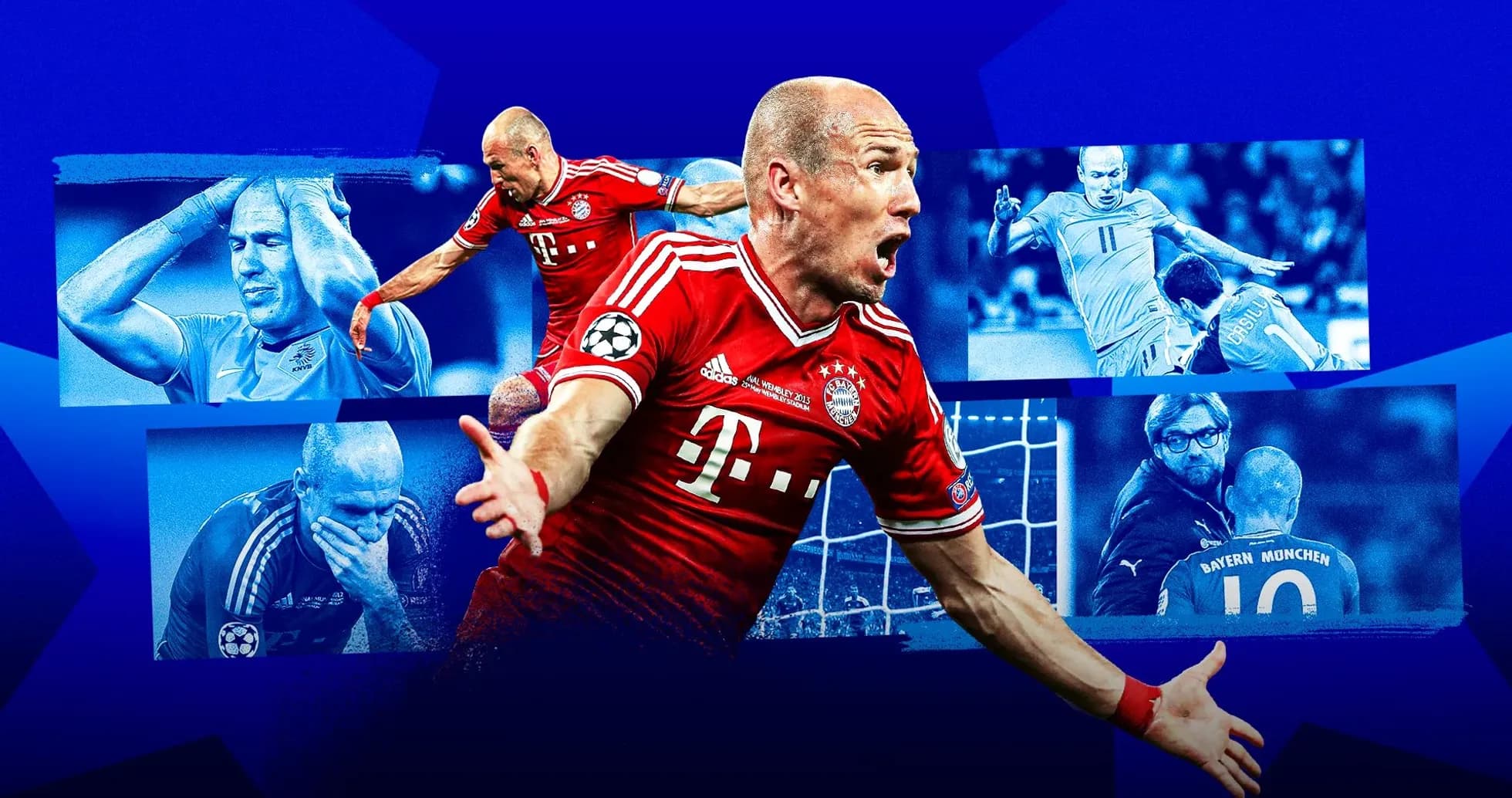
Arjen Robben: From Unstoppable Winger to Champions League Hero
Before the whispers about missed finals and broken hearts, Arjen Robben was something far simpler: unstoppable.
Everyone knew what was coming. Full-back isolated, Robben wide on the right, that familiar shuffle inside, the left foot opening up like a bow being drawn. Predictable, yes. Defendable? Hardly ever. From Manchester United to Barcelona to Borussia Dortmund, some of Europe’s grandest nights ended with Robben wheeling away, having bent another shot into the far corner.
He collected league titles across the continent – PSV, Chelsea, Real Madrid, Bayern Munich – but 2010 felt like his moment to rule Europe with Bayern. Louis van Gaal’s side, with Mario Gomez, Thomas Müller, Franck Ribéry and Bastian Schweinsteiger, had the swagger and the structure. They swept the Bundesliga and DFB-Pokal. Europe, though, made them sweat.
The soloist in red
In the Champions League last 16 against Fiorentina, Bayern were clinging on. They had a 2-1 lead from the first leg, Robben on the scoresheet from the spot, but in Florence they fell 3-1 behind. Season slipping away, tension thick, and then – the kind of intervention only he seemed to summon.
On 65 minutes, Robben picked up the ball in the middle of Fiorentina’s half, drifted, measured, then unleashed one of the finest strikes of his career. The aggregate score moved to 4-4. Away goals saved Bayern. Robben had dragged them out of the fire.
The script repeated itself against Manchester United. Robben missed the first leg through injury, but Bayern still edged a 2-1 win. At Old Trafford, they trailed 3-1, the stadium roaring for a rout. Then Ribéry swung in a corner, Robben arrived on the edge of the box and caressed a volley so pure that even he seemed momentarily stunned in celebration. Again, Bayern advanced on away goals.
He did it to Lyon as well. In the semi-final, at the Santiago Bernabéu, Robben cut loose from distance, a long-range drive that left Hugo Lloris grasping at air in a 1-0 win. Bayern were heading to the Champions League final, powered by a winger who was winning ties almost on his own.
Then came José Mourinho’s Inter at the Bernabéu, and silence. Bayern started with Ivica Olić and Thomas Müller up front, Ribéry suspended, Robben isolated. Inter were ruthless. Bayern limp. Robben, for once, powerless in a 2-0 defeat.
The story of his year was not finished.
Johannesburg: the toe that changed everything
By the time the World Cup in South Africa kicked off that summer, Robben had another label: the “Man of Glass”. Hamstring issues delayed his introduction, but when he finally stepped on the pitch, he lit up the Netherlands’ run to the final.
He scored the opener in a tight last-16 win over Slovakia. He laid on a crucial goal in the 2-1 comeback against Brazil in the quarter-finals. Against Uruguay in the semi-final, he rose to head in what proved to be the winner. Oranje were one step from immortality.
The final against Spain in Johannesburg was brutal and bitter. Nine Dutch players booked. Nigel de Jong’s karate kick into Xabi Alonso’s chest became the enduring image of their approach. Yet the defining moment belonged to Robben and Iker Casillas.
Just after the hour, Wesley Sneijder threaded a pass through the heart of Spain’s defence. Robben burst clear, alone, the world holding its breath. He waited, weighed his options, perhaps too long. As he tried to slide the ball to his left, Casillas flung out a leg, a desperate, instinctive block that nicked the ball wide.
Dutch media later called it “The toe of Casillas”. It was all it took to shatter Dutch dreams and seed the narrative that would haunt Robben for years.
Casillas later admitted that as Robben charged towards him, his only thought was to stay on his feet. He dived at the last moment, assuming Robben would glide past. “Of all the options he had,” Casillas said, “Robben chose exactly the wrong one.” He believed the final would have unfolded very differently had the ball gone in.
Instead, the Netherlands never recovered. Andrés Iniesta decided it in extra time.
“It hurts to miss such a chance,” Robben reflected four years later. “It’s part of sport, just a moment, a snapshot. But it will be part of me and part of my career for all of my life.”
There were more snapshots to come.
Penalties, pressure and the lowest point
In 2010-11, Robben’s body barely cooperated, but his numbers remained outrageous: 12 goals and eight assists in just 14 Bundesliga games. The following season, he stayed fit long enough to help Bayern back to another Champions League final.
The semi-final second leg at the Bernabéu against Real Madrid brought him back to the scene of old glories and new scars. Bayern were 2-0 down on the night within 14 minutes, 3-2 behind on aggregate. Then, in the 27th minute, came a penalty. Robben versus Casillas again.
This time, the Dutchman held his nerve. He buried it, Casillas only brushing it with a fingertip. Aggregate scores level, Bayern would go through on penalties. Robben had squared a small part of the ledger.
But the real examination waited in Munich.
The 2012 Champions League final against Chelsea, at the Allianz Arena, was supposed to be Bayern’s coronation. They dominated, yet found themselves in extra time at 1-1. Didier Drogba tripped Ribéry in the box. Another penalty. Another moment. Again, Robben stepped up.
He went low, into the corner. Petr Čech guessed right, smothered it, and the stadium froze. Bayern lost the shootout. Robben’s miss came just weeks after he had failed with a title-deciding penalty against Borussia Dortmund in the Bundesliga. The verdict on his character, in some minds, was signed and sealed.
“I can't describe how I feel with words, but it's been a terrible night,” Robben said. “Two or three times, you feel you have the cup in your hands but at the end you stand with nothing.
“It wasn't a good penalty. I wanted to shoot the ball hard and high in the goal, but the ball didn't go high enough. It was a terrible penalty kick. After that, I still played well but you have to change your mindset at that point.”
The scars were deep. The injuries kept coming. There was a real fear that the 2012-13 season, with Bayern building a juggernaut, might simply pass him by.
The comeback of a lifetime
Robben played only 16 Bundesliga games that year. Bayern crushed the league without him for long stretches. Yet when the Champions League knockout rounds arrived, he was there – fit, sharp, ruthless.
The semi-final against Barcelona turned into a demolition. Over two legs, Bayern won 7-0 on aggregate, with Robben at the heart of the wreckage. In Munich, he tormented Jordi Alba, scoring a sumptuous third goal in a 4-0 win.
At Camp Nou, he delivered the quintessential Robben moment. Early in the second half, he took down a long pass on the right, nudged it forward, then sliced inside Adriano with one devastating touch. Space opened, and he whipped a glorious shot into the top corner. Barcelona, humbled. Bayern, rampant.
“That 4-0 was my best game at the Allianz Arena,” he later told Sport Bild. “Against such a great team. With an uncharacteristic Robben goal. I broke through on the right wing with a stepover and had time to curl the ball into the far corner from a tight angle.”
He still had one more act.
Wembley: the weight of three finals on one left foot
The 2013 Champions League final at Wembley, against Borussia Dortmund, crackled from the first whistle. Jürgen Klopp’s side flew at Bayern, pressing high, forcing mistakes. In the first half, Dortmund had the edge. Bayern held.
After the break, Robben found his moment as creator, sliding the ball across for Mario Mandžukić to tap in the opener. Eight minutes later, Dortmund levelled from the spot. Tension soared again. Robben then saw what looked like an easy finish clawed away by Neven Subotić, and the old doubts resurfaced. Another final, another miss. Was the curse still alive?
Not this time.
As the clock ticked towards extra time, a looping ball dropped towards the edge of the Dortmund box. Ribéry fought for it, then produced an instinctive backheel through a crowd of yellow shirts. Robben anticipated it, burst into the gap and suddenly found the entire weight of Johannesburg and Munich bearing down on him.
Roman Weidenfeller charged out. Mats Hummels and Subotić closed in. Robben stayed calm. One touch, a glide past the defenders, then a feather-light prod with his left foot. The ball rolled, almost in slow motion, across the turf and into the net.
“When I got the ball, I was free,” Robben said afterwards. “I anticipated Franck’s movement. The only thought was: ‘I hope he puts the ball there’ because I saw the space. I took it well. My first choice was actually to go past [Weidenfeller] on the left side but then he made a move and I could put it to the other side. He was on the wrong leg.”
Bayern were champions of Europe again. Robben’s redemption was complete.
“To finally win this Champions League, that's a dream come true,” he said. “You can't describe it – so many emotions go through your head, especially because you know what it is like to lose. I think you can enjoy it even more when you win the title.
“After the disappointment of last year, and to a [lesser extent] 2010, and the World Cup for me – that's three finals and you don't want the stamp of a loser. At last we did it today, and we can forget about the other things a bit. It was a sense of ‘finally’.”
In 2025, Bayern fans voted that goal – the toe-poke past Weidenfeller – the greatest in the club’s 125-year history. Second place? Robben’s volley against Manchester United at Old Trafford.
The myth rewritten
With his final demons exorcised, Robben’s career entered a different phase. The fear was gone. In its place: freedom.
At the 2014 World Cup in Brazil, a 30-year-old Robben arrived like a man unshackled. The Netherlands’ opening game was a rematch of the 2010 final, against Spain. This time, there was no heartbreak, only humiliation – for La Roja.
In a 5-1 rout, Robben tore Spain apart. For his first goal, he plucked a long pass out of the sky, toyed with Sergio Ramos and finished with authority. His second was the stuff of legend. Sprinting from deep, he outpaced Ramos again, took down another long ball, dropped Casillas to the turf and waited, almost cruelly, before lashing the ball home while the goalkeeper flailed on his knees.
Under Van Gaal, the Netherlands punched above their weight, fighting their way to the third-place play-off. Robben was electric throughout. The old label of “big-game bottler” had been burned away. What remained was something far more accurate: a phenomenon.
At Bayern, the honours piled up. Eight Bundesliga titles. Five DFB-Pokals. Across 307 appearances, he scored 144 goals and supplied 101 assists. After the 2013 triumph, Bayern reached four more Champions League semi-finals, though Pep Guardiola never managed to reclaim the European crown.
By the time Robben said his tearful goodbye in 2019, lifting one last Bundesliga trophy, the Allianz Arena that had once whistled him now sang his name. The narrative had flipped.
He was no longer the tragic figure who crumbled when it mattered most. He was the ferocious winger who had stared down the heaviest failures football can offer – a missed World Cup final one-on-one, lost Champions League finals, botched penalties with titles on the line – and come back to decide the biggest games of all.
In the end, Arjen Robben didn’t outrun his ghosts. He dribbled straight through them and left his name etched in European football’s history, curling forever into that far corner.