.svg&w=384&q=75 "GoalGist logo")
Al-Ittihad's Tactical Masterclass Against Al-Nassr
Al-Ittihad did not just harry the man on the ball. They strangled the routes out. Passing lanes vanished, Al-Nassr’s carriers were swallowed in duels, and turnovers began piling up high up the pitch.
The side moved as one aggressive, compact block. Lose it, press. Immediately. With Steven Bergwijn and Al-Ghamdi starting high and then sliding into central pockets, Al-Nassr’s build-up froze. They could not move the ball cleanly from defence to midfield for roughly the first 22 minutes. The “Global Club” were stuck in their own half, trapped between lines that never quite connected.
The pressure told almost instantly.
George Ilenikhena struck in the fourth minute, and the goal felt like the inevitable outcome of a pattern, not a lucky break. Al-Ittihad had already imposed their tempo, their structure, their will. The Nigerian forward simply applied the finish.
He did it by attacking the very space Al-Nassr kept leaving behind. As the back line stepped up and the whole team pushed forward, Ilenikhena darted in behind, punishing the risk and handing “the Dean” an early lead that forced Al-Nassr to rip up their early calculations.
For Vieceli’s plan, Ilenikhena was the perfect weapon. His game is built on timing those runs off the shoulder, living in the gaps defenders fear. That was exactly where Al-Ittihad aimed their attacks.
By the 22nd minute, he had underlined the point. His second goal, a superb finish, confirmed not only his dominance on the night but also the clarity of his coach’s thinking. It was the tenth brace of his career, and it arrived against an advanced defensive line that never quite worked out how to track him.
Al-Ittihad’s threat did not rely solely on direct balls into that space. They also seized the middle of the pitch. Lobbe and Mukhtar stamped their authority in the central zone, while Bergwijn and Al-Ghamdi tucked inside to overload the midfield. That squeeze split Al-Nassr’s lines apart and shrank the pockets their players needed to build anything organised.
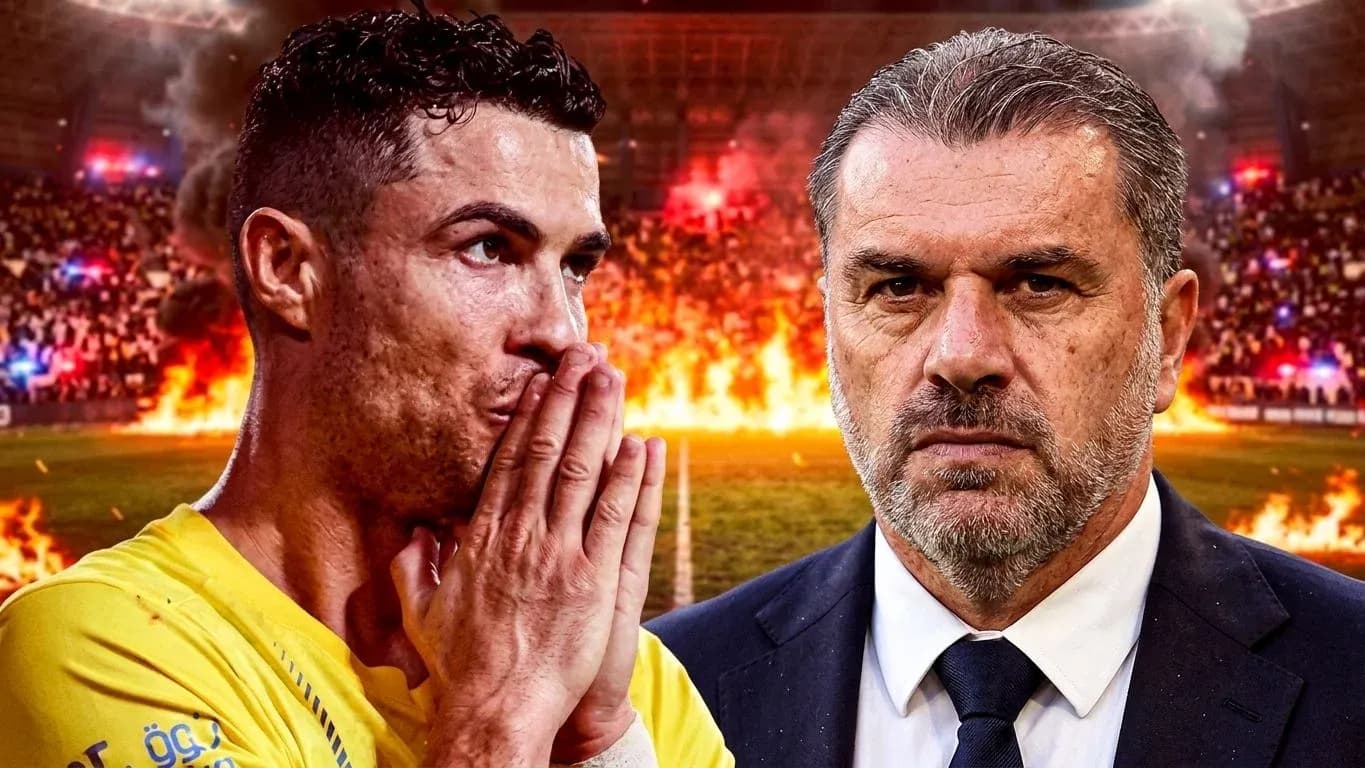
One of Al-Nassr’s biggest problems carried a famous name: Cristiano Ronaldo.
It was not just about his finishing or his lack of it. His presence distorted the entire pressing structure. Ronaldo could not maintain constant pressure on Al-Ittihad’s back line. That gave Danilo Pereira, in particular, time and freedom to receive, look up and start attacks from deep without serious harassment.
Too often, Al-Ittihad’s defenders began moves in comfort, picking their passes, stepping forward and steering the ball into the exact areas they wanted. The mistakes Al-Nassr needed to spark transitions never came.
Tactically, Ronaldo was “present yet absent.” On one hand, Al-Nassr had one of the most dangerous forwards in world football on the pitch. On the other, whenever Al-Ittihad had possession at the back, it felt like Al-Nassr were pressing with one man missing.
The issue was not his quality or his instinct in front of goal. The match demanded relentless, collective pressure. Ronaldo could not deliver that volume of work, and the structure around him did not compensate.
Postecoglou had options. He could have tweaked the press, shifted the trigger points, or tightened the distances between his lines to cover the gaps. The adjustment did not come in time. By then, Al-Ittihad were already two goals to the good and dictating the rhythm.
With “the Dean” dominant through the opening third of the contest, Al-Nassr were dragged into chasing the game. Against a side that knew exactly where the spaces lay and how to attack them, the task grew heavier with every minute.
Fesing read another weakness clearly: the forward surges of Al-Nassr’s full-backs. The moment his players recovered the ball, they launched long passes into the channels behind those advancing defenders. Each turnover became a springboard, turning defence into attack in a few strides.
This was the clearest evidence that Al-Ittihad’s coach did more than spot soft points. He flipped Al-Nassr’s attacking strengths into liabilities. Every time the full-backs flew forward, a fresh pocket opened behind them. Every time Al-Nassr lost the ball, Al-Ittihad were racing towards their goal.
Around the half-hour mark, the pattern finally began to shift. Al-Nassr steadied themselves, learned to breathe under pressure, and started to handle Al-Ittihad’s press with more composure. “Al-Alami” held the ball for longer spells and pushed into the attacking third.
The change showed on the scoreboard. In the 36th minute, Angelo struck, slicing the deficit in half and injecting life into Al-Nassr’s performance. Suddenly the match felt less straightforward, the narrative less one-sided.
Angelo’s goal suggested that Al-Nassr had found at least part of the solution. If Al-Ittihad kept pressing at the same ferocious level, they risked opening the very gaps their opponents needed.
At that moment, the other side of Vieceli’s character emerged. He refused to treat a lead as a licence to keep rolling the dice. After the break he reshaped his team, dropped them a little deeper, and leaned on transitions and the spaces Al-Nassr would inevitably leave as they hunted an equaliser.
The game flipped after half-time. Al-Nassr now owned the ball, the initiative, and the territorial edge. Al-Ittihad retreated into a compact block, absorbing pressure and waiting for the right moment to spring forward.
The logic was cold and clear. Trailing, Al-Nassr had to commit more bodies. That commitment opened lanes for counters. Vieceli protected his advantage without needing to chase a third goal recklessly.
Late on, he doubled down on Al-Nassr’s tendencies by introducing Youssef En-Nesyri and aiming for crosses and deliveries into the box.
The Moroccan’s introduction fit the evolving script. With Al-Nassr pouring forward and slinging balls into dangerous areas, En-Nesyri offered a focal point in the air and sharp movement in the penalty area, plus another outlet on the break as the spaces behind Al-Nassr’s defence grew wider.
In the closing stages, the young coach trusted his plan. He ceded the ball entirely, backed his side’s organisation and transitions, and watched Al-Ittihad see out a contest they had earned on structure, intensity and a ruthless reading of Al-Nassr’s flaws.