.svg&w=384&q=75 "GoalGist logo")
VAR Controversy: Neco Williams' Disallowed Goal Analysis
New footage has dropped, and it settles one argument while igniting another.
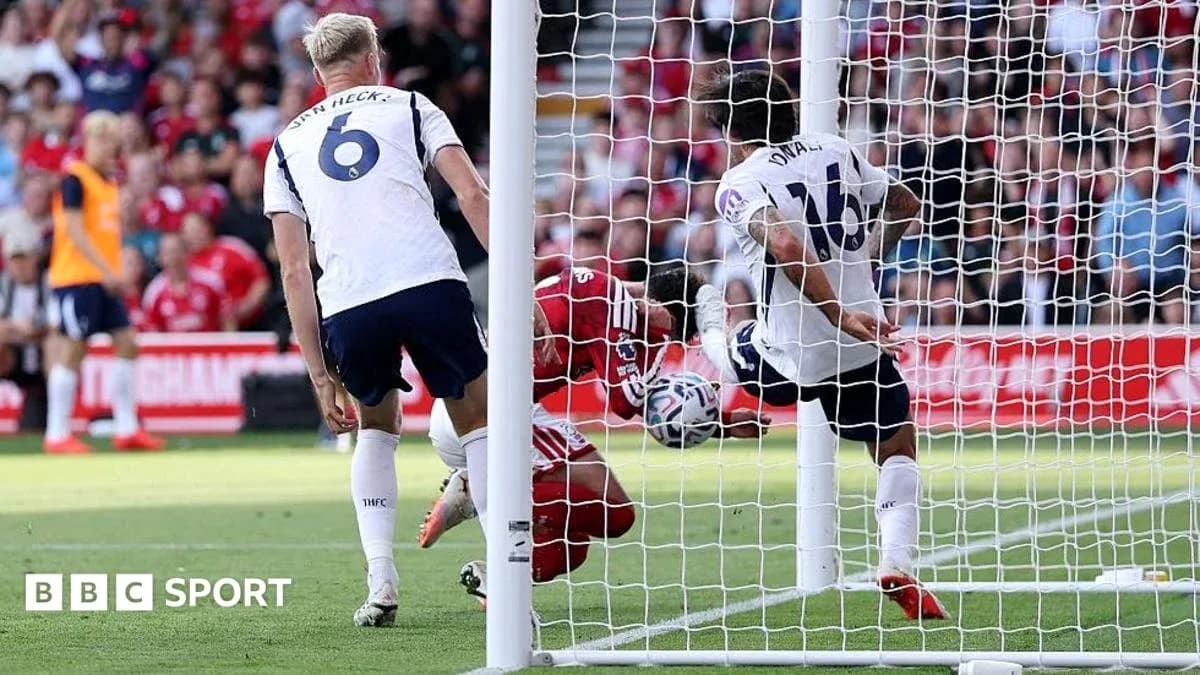
A fresh camera angle from Nottingham Forest’s 0-0 draw with Tottenham Hotspur shows the ball striking Neco Williams’ left arm and then his right forearm in the build-up to his disallowed goal. The 67th-minute strike, bundled in from close range, was ruled out by VAR Peter Bankes for accidental handball – a call that infuriated Forest and left Williams and head coach Oliver Glasner insisting there was no evidence of any contact.
There is now.
The new clip clearly shows the ball brushing Williams’ arms before crossing the line. It backs up Bankes’ decision. It does not, however, end the row.
VAR vindicated – with a catch
Inside the VAR hub, Bankes only had access to the broadcast cameras used for live coverage. The new angle that reveals the arm contact was not one of them. It came from one of several cameras that do not transmit into the VAR feed on a matchday.
Bankes based his original call on what he did have: a tell-tale ripple in Williams’ shirt as the ball appeared to graze his right forearm. He was, by all accounts, 100% convinced he’d seen enough to chalk the goal off.
Now he has visual backing. But Forest fans will argue something different: not whether the ball hit an arm, but whether VAR should have intervened at all without what they regard as conclusive proof at the time.
Inside Pro Ref – the new name for the refereeing body previously known as PGMOL – there is no such doubt. BBC Sport understands the organisation is fully satisfied with the decision to disallow the goal and believes the new footage simply confirms Bankes got it right.
There is also irritation. Not just at the scale of the backlash, but at how confidently Williams dismissed the possibility of handball.
Williams’ certainty meets the replay
"I've seen the images and the replays and at not one moment did I think I handballed it," Williams told Sky Sports after the game.
"I have seen all the images and at not one moment can you tell that has clearly hit my arms, because it never. I knew straight away I've headed it down in between my arms. It didn't hit my arm."
The new footage shows two arm contacts and no touch on his head. Given the speed of the incident, it is possible Williams genuinely believed he had headed the ball. But his absolute certainty poured fuel on the debate. The feeling within Pro Ref is simple: if he had been less emphatic, the storm would not have been quite so fierce.
Nottingham Forest have been approached for comment.
Clear and obvious? Not this time
Much of the noise around the incident has focused on one phrase: “clear and obvious”. Glasner referenced it. Williams echoed it on X. Many Forest supporters framed their anger around the idea that VAR did not have clear and obvious evidence to overturn the on-field decision.
That is not how this law works.
“Clear and obvious” applies to subjective calls – penalties, red cards, incidents where the referee is sent to the pitchside monitor to review their own judgement. Handball in the attacking phase before a goal sits in a different category. It is treated as a factual offence.
In those cases, the VAR does not ask whether the on-field referee has made a clear and obvious error. The question is more blunt: does the VAR believe they have proof an offence occurred? If the answer is yes, the goal goes.
Bankes believed he had that proof. Many viewers thought they could see the handball even from the original angles. Others, like former midfielder Danny Murphy on Match of the Day, were not convinced.
"It's a really tricky one," Murphy said. "Maybe it could be a tiny bit on his sleeve or right forearm. But is it clear and obvious? No. That's the answer."
That split lays bare a truth the technology cannot escape: even so-called factual interventions still carry an element of subjectivity. One person’s “proof” is another’s “not sure”.
The Sesko example and Webb’s frustration
The contrast with another high-profile incident is stark. Last season, Benjamin Sesko scored for Manchester United against Liverpool with a goal that appeared to brush his fingertips on the way in. VAR Stuart Attwell checked it and let it stand, deciding he could not be certain there had been a handball.
Later, referees’ chief Howard Webb admitted the ball “probably does hit the hand” but stressed that “the VARs need to see that conclusively”. Attwell did not feel he had that level of proof. Bankes did in the Williams case.
That inconsistency – two similar situations, two different thresholds of certainty – is exactly the kind of grey area that keeps VAR under constant fire.
Webb himself has already identified attacking handball as one law he would change. Under the current wording, any contact with an attacker’s hand or arm immediately before a goal is enough to rule it out, regardless of intent.
"The problem is the law forces VARs on every goal to look at what body part the ball went in off," Webb said during pre-season media briefings.
"If you were only to penalise when the attacker deliberately handles the ball or makes himself unjustifiably big – and not have that forensic examination – you could 'check complete' it more quickly.
"It is a law I would definitely look to change. So Pro Ref and the Premier League are going to try and lobby for that to be changed."
Under such a revision, Williams’ goal might well have stood, based on the original evidence available on the day.
VAR’s lighter touch, heavy scrutiny
This season, VAR is supposed to be operating with a lighter touch. So far there have been just two subjective interventions – around 0.06 per game, down from 0.15 last season. Fewer stoppages. Fewer trips to the monitor.
Yet the Williams incident shows how little that matters when a big call lands on a fault line of law, technology and tribal loyalty. Even with reduced involvement, VAR still dominates the conversation whenever it steps in at a crucial moment.
Bankes now has the footage to support his conviction. Pro Ref has the backing to defend its officials. The laws, as written, were applied.
The question that lingers is not whether this decision was technically correct, but how many more like it the game is willing to tolerate before the law – not the technology – finally changes.