.svg&w=384&q=75 "GoalGist logo")
Tottenham's Struggles Continue with 0–2 Defeat to Newcastle
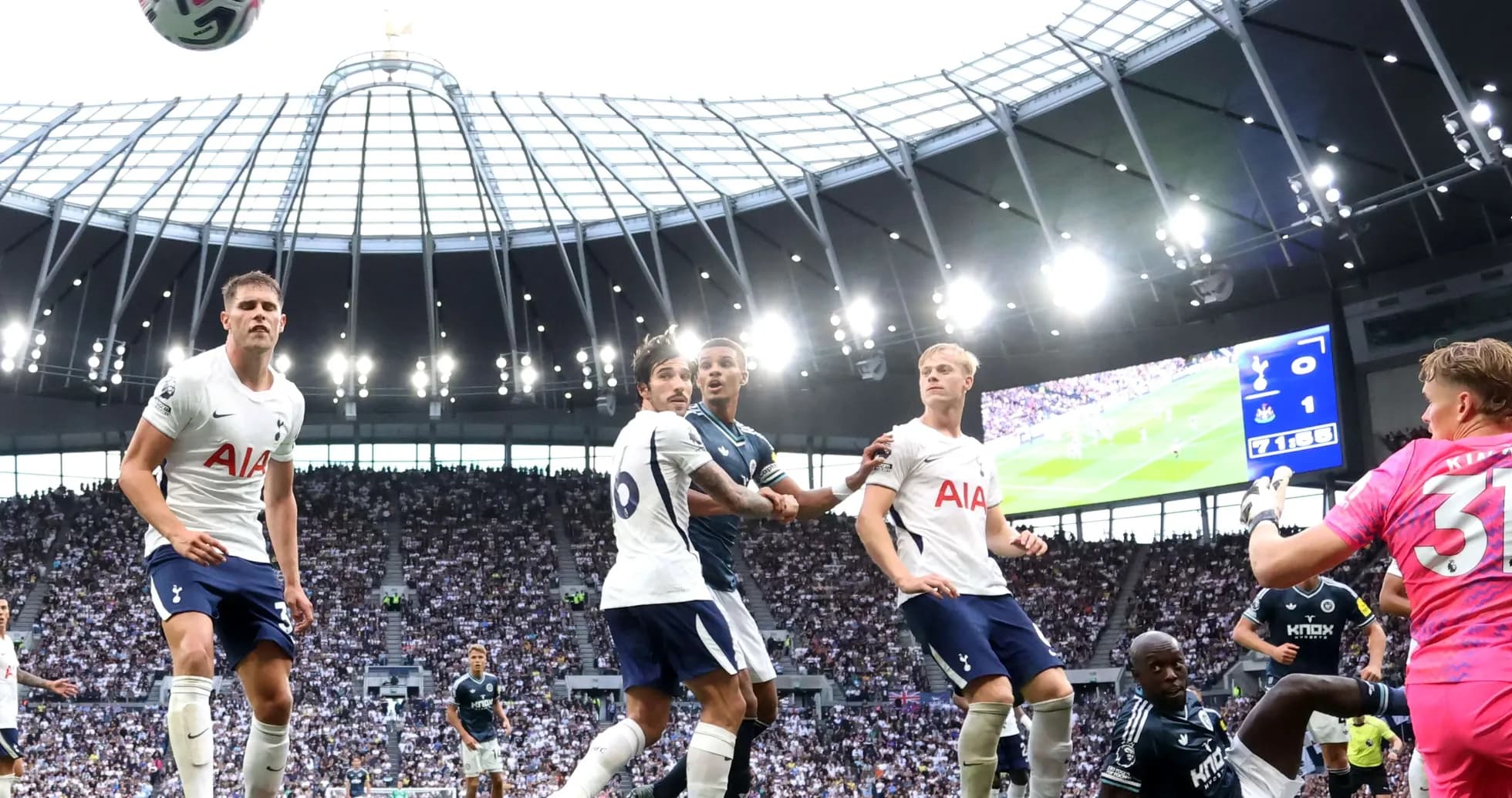
Under the grey North London sky, Tottenham Hotspur Stadium watched a familiar Premier League story unfold: a side trying to reinvent itself under a new coach undone by a more coherent, more ruthless visitor. Tottenham’s 0–2 home defeat to Newcastle in Regular Season - 2 did more than settle a single fixture – it crystallised where these two squads are in their tactical journeys.
I. The Big Picture – Diverging early-season trajectories
Following this result, Tottenham sit 20th with 0 points, a goal difference of -5 from 0 goals scored and 5 conceded overall across 2 matches. At home, they have played 1, lost 1, scored 0 and conceded 2. The numbers are stark: they have failed to score in both league games so far, with an overall average of 0.0 goals for and 2.5 goals against per match.
Newcastle, by contrast, leave London with the quiet authority of a side building something stable. They are 5th with 4 points, their overall goal difference +2 from 4 scored and 2 conceded. On their travels, they have played 1, won 1, scoring 2 and conceding 0; their away average stands at 2.0 goals for and 0.0 against. Two games into the campaign, they have yet to lose, yet to fail to score, and already own an away clean sheet.
Both teams lined up in a 4-2-3-1, but the shared formation masked very different realities.
For Tottenham, Roberto De Zerbi’s selection underlined the scale of the rebuild. A. Kinsky started in goal behind a back four of A. Robertson, M. van de Ven, J. P. van Hecke and A. Gray. Ahead of them, R. Bentancur and S. Tonali formed the double pivot, with P. Porro, M. Fernandes and M. Tel supporting lone forward O. Marmoush.
Newcastle’s mirror shape under Matthias Jaissle felt far more settled. L. Hornicek was protected by a back four of L. Hall, S. Botman, M. Thiaw and A. Dedic. In midfield, Nico and L. Miley anchored the centre, with an advanced line of A. Elanga, J. Willock and H. Barnes behind Y. Wissa as the striker.
II. Tactical Voids – Absences and discipline
Tottenham’s attacking bluntness is not just a form issue; it is structural and personnel-driven. The list of absentees reads like an entire creative department: D. Kulusevski (knee injury), J. Maddison (knock), W. Odobert (knee injury), P. M. Sarr (injury) and X. Simons (knee injury) all missed the fixture. That stripped De Zerbi of ball-carriers between the lines, late runners from midfield and set-piece quality.
The consequence was visible in the roles of P. Porro, M. Fernandes and M. Tel. All three were forced to oscillate between providing width and trying to occupy central pockets usually owned by Maddison or Simons. Marmoush, isolated as the lone forward, often received with his back to goal and little support from the second line.
Disciplinarily, Tottenham’s season profile hints at a side that can be frantic early on. Their yellow cards so far are split 50.00% in minutes 0–15 and 50.00% in minutes 31–45, underlining a tendency to lunge into challenges as they try to impose the press. There are no red cards yet, but the pattern suggests a team that expends emotional and tactical energy before half-time without the attacking returns to justify it.
Newcastle had their own absences – D. Burn (ankle injury), Joelinton (injury), V. Livramento (hamstring injury) and W. Osula (injury) – yet their squad depth softened the blow. Burn’s absence pushed S. Botman and M. Thiaw into even more central responsibility, while Nico and L. Miley had to absorb some of the physical edge Joelinton usually brings. Still, the structure held.
Their card profile is broader and more controlled. Yellow cards are spread across the match, with a late-game surge of 28.57% in minutes 76–90 and another 14.29% in 91–105, suggesting a team that can manage games aggressively when protecting a lead rather than losing control early.
III. Key Matchups – Hunter vs Shield, Engine Room vs Engine Room
The “Hunter vs Shield” storyline belonged to Newcastle. Heading into this game, they had 4 goals overall in 2 matches, averaging 2.0 per game, with A. Elanga already among the league’s top scorers with 2 goals in 2 appearances. Y. Wissa added 1 goal and 1 assist, making him both finisher and facilitator.
Against that, Tottenham’s “shield” had been porous: 5 goals conceded overall in 2 games, with an overall average of 2.5 against. At home, they concede 2.0 on average; away, 3.0. The centre-back pairing of M. van de Ven and J. P. van Hecke, flanked by Robertson and Gray, were tasked with absorbing a multi-layered Newcastle attack that could hurt them wide through Elanga and Barnes, and centrally through Wissa’s movement and Willock’s timing.
Elanga’s league profile – 4 shots, 3 on target, 2 goals, plus 2 successful dribbles from 3 attempts – tells of a direct runner who needs only small windows. Against a Tottenham side still learning their rest-defence structure in a 4-2-3-1, his threat between full-back and centre-back was a constant tactical pressure point.
In the “Engine Room”, the duel between Bentancur–Tonali and Nico–Miley shaped the flow. Tottenham’s double pivot were asked to both initiate build-up and protect transitions, but without natural outlets ahead of them, their passes often became horizontal or forced into crowded central zones. Newcastle’s pair, by contrast, had clear vertical lanes: Dedic overlapping on the right, Elanga driving inside, and Willock ghosting beyond the first line.
Dedic deserves special mention as a bridge between defence and attack. His 47 passes with 89% accuracy and 2 key passes this season, plus 4 tackles and 2 blocks, frame him as both outlet and shield. In this match context, his side of the pitch pitted him against M. Tel and A. Robertson, forcing Tottenham’s left to constantly choose between tracking his overlap or narrowing to handle Elanga.
IV. Statistical Prognosis – Why the 0–2 felt inevitable
Strip away the emotion and the numbers tell a coherent story.
Tottenham’s overall offensive profile: 0 goals, 0.0 average at home and away, 2 matches failed to score out of 2. Defensively, they concede 2.0 at home and 3.0 away, with no clean sheets. Their most used shape is already set – 4-2-3-1 in both games – but the personnel within it are unsettled and, crucially, shorn of their primary creators.
Newcastle, meanwhile, carry a balanced statistical identity. They score 2.0 goals on their travels and concede none away, with 1 clean sheet already. They have not failed to score in any match so far, and their 4-2-3-1 has been deployed in both games, giving continuity. Elanga, Wissa and Willock share 4 goals between them, with Wissa also among the league’s top assist providers. Supporting threats like N. Woltemade and W. Osula have already chipped in with assists, underlining the depth of creative contribution even beyond the starting XI.
Defensively, the away clean sheet here extends a pattern: Newcastle can afford to commit their full-backs forward because the central pairing of Botman and Thiaw, screened by Nico and Miley, has yet to be breached on the road this season.
Put simply, Newcastle arrived with a functioning 4-2-3-1 that knows how to create and protect leads. Tottenham fielded the same structure on paper but with key creative absentees, a fragile defensive record and an attack still searching for its first league goal.
In that light, a 0–2 scoreline at Tottenham Hotspur Stadium does not feel like an upset. It feels like the current logical intersection of two squads at very different stages of their tactical evolution: one already sharpening its European credentials, the other still trying to find its voice.