.svg&w=384&q=75 "GoalGist logo")
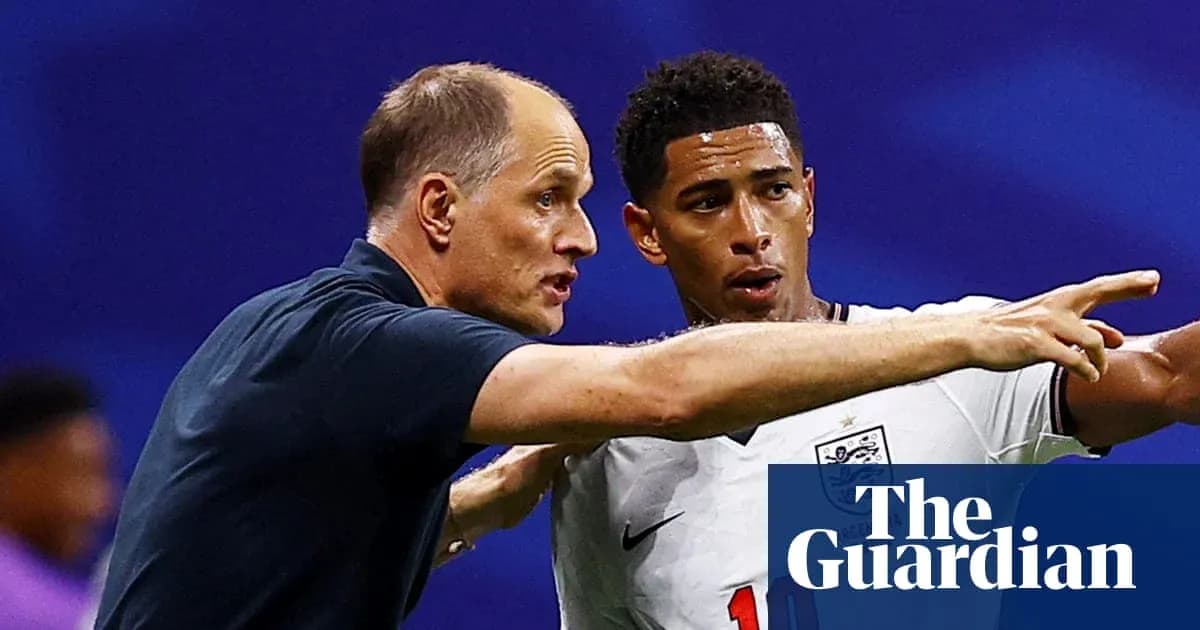
Thomas Tuchel Reflects on England's World Cup Journey and Future Challenges
Thomas Tuchel has been a familiar face again around Premier League grounds this season, moving quietly through directors’ boxes and hospitality suites. In one such VIP enclave, he stopped with a coaching colleague and let the mask slip.
“People are killing me,” the England manager said. Still.
Two months on from England’s 2-1 World Cup semi-final defeat by Argentina in the United States, the wound has not closed. The emotions remain raw: heartbreak, anger, disbelief. A 1-0 lead with five minutes to play, a World Cup final in sight, and then it all vanished. For many, that is the moment that will not let them sleep.
From there, the debate splits in two.
One side cannot forgive. They see a golden chance wasted and pin it squarely on Tuchel – on his substitutions, his caution, his inability to stem Argentina’s surge. For them, the semi-final is not a sign of progress. It is a crime scene.
The other side looks at the bigger picture. They see only the fourth World Cup semi-final in England’s history. They remember the personality of the team, the wild, lung-bursting win over Mexico at the Azteca in the last 16, played at altitude and with 10 men. They recall the extra-time grind past Norway in Miami’s furnace, the breathless opening victory against Croatia, the third-place play-off win over France – England’s best World Cup finish since 1966.
Both camps are loud. Both are convinced they are right. Tuchel hears them all, but it is the fury that has lodged deepest. He remains bruised by the fallout, puzzled too. England do not stroll into World Cup semi-finals every four years. They scrap and strain for decades to get there.
Yet this is the job he took. The impossible job, as so many of his predecessors have called it. The role where expectation crushes logic, where defeat triggers inquests, where every tactical call can be replayed a thousand times in slow motion. Lose, and the noise around the team thickens, making the next step harder. The circle turns, always tightening.
Tuchel now has to live in that space while plotting the next cycle, all the way to Euro 2028, when England will be co-hosts. On Friday he names his squad for the opening four Nations League fixtures: Spain at Wembley, Czechia home and away, then Croatia in Zagreb. That is the new reality. No more Argentina re-runs. No more therapy sessions.
He wants to move on. So do the Football Association. At some point, he has to let the criticism of that Argentina defeat sit where it is. However excessive he believes it to be, however much it has skewed the perception of his World Cup campaign, he cannot keep fighting the same battle.
Inside Wembley, the FA’s view is stark. It stands fully behind him. It considered any talk that he should resign or be sacked after reaching a World Cup semi-final absurd. That stance did not depend on the Argentina game. It ran through the entire tournament.
If anything, the FA’s faith in Tuchel hardened long before the semi-final. The clearest example came in the last 32, against the Democratic Republic of the Congo – a match that felt, for a while, like Iceland 2016 all over again. England were 1-0 down with 15 minutes left. Tuchel, by his own admission, wondered if this was it. The end of his World Cup before it had really started. Then Harry Kane scored twice, dragged England out of the abyss and turned a national trauma-in-waiting into a great escape.
The FA loved that comeback. It loved Tuchel’s in-game switches, not only that night but throughout the tournament. It loved the chemistry in the squad, the “brotherhood” Tuchel kept referencing. This was not a buzzword for the cameras. The players lived it, and the FA noticed. For the governing body, that unity is a non-negotiable. Tuchel delivered it.
He had gone to the World Cup talking about putting a second star on the England shirt. Death or glory. He did soften that rhetoric as the tournament wore on, but the ambition never changed. He fell short. Did the lofty language make the fall harder to take? Maybe. Yet what would have been more acceptable – a manager happy to bow out in the quarters?
Privately, the FA knew the scale of the challenge. England went to the United States as fourth seeds. Winning the whole thing, especially after the draw they received, always looked a stretch. The schedule did them no favours either: a late start, a long gap between the first and second group games, then a compressed run of knockouts. Long flights. Heat. Altitude. It was a tournament designed to break legs and lungs.
That is part of Tuchel’s defence of the Argentina collapse. England were shattered. The Mexico epic at altitude with 10 men had drained them. The 120-minute slog against Norway in 40C heat in Miami had taken more again. By the time Argentina turned up the aggression in the second half of the semi-final, England’s tank was almost empty.
Tuchel still has to wear his decisions. England began to sink deeper and deeper long before the second-half hydration break. The substitution that will not go away came then: Ezri Konsa on for Anthony Gordon, a switch to a back five. Attack for defence. Ambition for caution. England retreated into survival mode and never came back out.
Tuchel could not stem the tide, could not get his players on the ball, could not change the rhythm of the game. That failure is his. The call to reinforce the defence was cold and calculated, based on what he felt his players had left physically. To him, it looked like the percentage play, the least bad option. It blew up in his face. When it did, the optics were dreadful. A manager accused of blinking first.
Would a more positive substitution – a fresh winger, a ball-carrier, another runner – have altered the ending? Nobody can say. What is clear is that by the final whistle England were well beaten, swamped by a team that still had energy and rage to spare.
That chapter will not be rewritten. The only thing Tuchel can control now is what comes next.
The Nations League offers a harsher proving ground this time. England are back in Group A, where Spain, Czechia and Croatia will expose any weakness. The FA believes that is exactly what they need. The last campaign, down in Group B against Ireland, Finland and Greece, did not test them enough. England still managed to lose to Greece at Wembley. World Cup qualifying, too, lacked real jeopardy. The hope is that a tougher Nations League run will harden them for Euro 2028.
Tuchel’s first squad of the new cycle comes with complications. Four World Cup players are likely to miss out through injury: John Stones, Dan Burn, Djed Spence and Jordan Henderson. Their absence opens doors. Tino Livramento, Levi Colwill, Jarrad Branthwaite and Lewis Hall are all pushing hard for defensive recalls.
Midfield offers another dilemma. Does Kobbie Mainoo keep his place after a World Cup that never really caught fire for him? His Manchester United form has been a rare bright spot in a grim start at Old Trafford. Alex Scott and Myles Lewis-Skelly are knocking again. So are Cole Palmer and Phil Foden for the No 10 role.
Out wide, Eberechi Eze and Noni Madueke have not hit their stride at Arsenal since returning from the World Cup. That opens space for others. There is a growing buzz around Josh King and Ryo Ngumoha. The same goes for Dominic Calvert-Lewin and Liam Delap in attack, both riding strong early-season momentum.
Every name Tuchel reads out on Friday will be analysed. Every omission will be a headline. His tone will matter almost as much as his choices. Does he sound scarred? Defiant? Detached? The last time he went into a public forum on the defensive, it did not end well.
He cannot change what happened against Argentina. What he can change is how he carries it. And with Spain waiting at Wembley next Saturday, the country will soon see whether the semi-final has broken England’s manager, or simply hardened him for what comes next.