.svg&w=384&q=75 "GoalGist logo")
St. Pauli's New Era: Overcoming Relegation Challenges in the 2. Bundesliga
The high of survival didn’t last long at the Millerntor.
After clinging to Bundesliga status in 2024/25 for the first time since 1995/96, St. Pauli crashed straight back through the trapdoor. Six wins, eight draws, 20 defeats. Bottom of the table in 2025/26, and out. A brutal full stop to what had felt like a new era.
Relegation always brings casualties. In Hamburg, it brought an exodus. And a sacking.
Head coach Alexander Blessin was dismissed within weeks of the season ending, the club choosing not to gamble on continuity. The dressing room, already shaken by the drop, then watched a string of pillars walk out of the door.
Yet as the dust settles, there is something stubbornly familiar in the air at the Millerntor: defiance. A new coach, a reshaped squad, a fanbase that refuses to sulk. St. Pauli are bruised, but they are not drifting.
Irvine leaves a hole you can’t just replace
The most painful goodbye came late. And suddenly.
Jackson Irvine, the heartbeat of the side, requested a move to Cerezo Osaka. The announcement landed less than a week before the first league fixture. For a club that leans so heavily on identity and connection, this was more than a standard transfer.
Irvine leaves behind 153 appearances, 15 goals, 21 assists and something harder to quantify: he captained the promotion-winning side in 2023/24 and embedded himself in the local community. For many, he was St. Pauli.
He was not alone in heading for the exit.
- Goalkeeper Nikola Vasilj, a mainstay with 167 games and 43 clean sheets, joined Al-Diriyah on a free.
- Karol Mets moved to Bochum, also on a free, after 91 appearances.
- Manolis Saliakas, who racked up 120 games, went to Olympiacos for €1.3 million.
- Hauke Wahl, another defensive cornerstone with 105 appearances, left for Wolfsburg in a €2 million deal.
- Daniel Sinani, 70 appearances into his St. Pauli stint, departed to Sampdoria on a free.
These aren’t just squad numbers leaving. They are the spine of a side that had climbed back to the top flight and then fought for its life.
Hrgota the new reference point
So who carries the load now?
St. Pauli’s answer up front is clear: Branimir Hrgota.
Signed from Fürth on a free, the veteran arrives with a proven record and a reputation as a promotion specialist. He is Fürth’s all-time leading scorer across the top two German divisions, with 69 goals and 41 assists in 238 appearances. In 2020/21, he dragged them back into the Bundesliga for only the second time in their history, scoring 16 and laying on seven more.
This is not a speculative punt. This is a striker who knows the grind of the 2. Bundesliga, knows how to lead a line, knows what it takes to get out of the division. For a club that has just lost its captain and emotional anchor, his experience and presence are almost as important as his finishing.
At the back, St. Pauli have moved to plug gaps with the free signing of Marcus Mathisen from Magdeburg. A seasoned centre-back, he arrives at a time when the defensive structure has been heavily disrupted by departures. He is not a marquee name, but he is a necessary one.
The biggest new face, though, stands in the technical area.
Rapp’s promotion pedigree
Marcel Rapp, 47, takes over after impressing at Holstein Kiel. Two years ago, in 2023/24, he coached Kiel to their first-ever Bundesliga promotion. That was the same season St. Pauli stormed to the 2. Bundesliga title. Now, their stories intersect.
Rapp inherits a club that expects bold football and emotional investment, not just results. His track record suggests he can build organised, proactive sides capable of punching up. At Kiel, he showed he can navigate the pressure of a promotion race. At St. Pauli, he must do it again in an environment that demands more than just tactical competence.
Pre-season offered the first clues as to what his St. Pauli might look like.
A pre-season with both swagger and warning signs
The summer schedule started with a familiar local fixture: Altona 93. St. Pauli brushed their city neighbours aside 6-2, a statement of attacking intent as much as a tune-up.
Next came Regionalliga Nord side Kickers Emden. It was less spectacular, more workmanlike, but a 3-1 win still hinted at a team settling into new patterns under Rapp.
The third friendly carried a different kind of meaning. Babelsberg, with whom St. Pauli share a well-known fan friendship, hosted a game that felt as much like a celebration of that bond as a test of form. On the pitch, St. Pauli were ruthless in a 4-1 win, highlighted by a first-half hat-trick from Abdoulie Ceesay. The forward looked electric, a livewire option for the season ahead.
Then came the first real setback.
Against Croatian side Gorica, St. Pauli won 2-1 thanks to goals from Louis Oppie and Ricky-Jade Jones. The result was encouraging; the injury was not. Ceesay, fresh from his hat-trick heroics, suffered a capsule-ligament injury in his right ankle. For a squad already coping with major departures, losing an in-form attacker was a sharp reminder of how thin the margins are.
The penultimate friendly raised the level again: Bournemouth, a Premier League and Europa League participant, in Austria. St. Pauli struck first through Kaars in the 22nd minute, but then the game flipped. Four goals conceded in 27 minutes, a 4-1 defeat, and a clear illustration of how punishing lapses can be against top-tier opposition. It was their only pre-season loss, but it was a heavy one.
Back at the Millerntor, the final test came against freshly promoted LaLiga side Deportivo de La Coruña. Twice St. Pauli took the lead, through Taichi Hara and then Kaars. Twice they were pegged back, the second equaliser coming in the 84th minute. A 2-2 draw that felt like a missed opportunity, yet also a realistic snapshot of a team still learning its new shape.
Across those games, one theme stood out: this St. Pauli can create, can score, and can impose itself on opponents. It can also wobble. Rapp’s job is to tilt that balance.
How Rapp’s St. Pauli should line up
Rapp looks set to stick with a three-at-the-back system. The structure is familiar, the personnel less so.
With Eric Smith’s fitness still in doubt ahead of the opener against Fürth, the back three is likely to feature new signing Mathisen alongside Nemeth and one of Tomoya Ando or Adam Dzwigala. That decision may define the early rhythm of the season; get it right, and the defensive line stabilises quickly, get it wrong, and old frailties could resurface.
In midfield, Fujita is expected to anchor the centre, partnered by either Rasmussen or Metcalfe. Out wide, Pyrka and Oppie should offer energy and width, with Lars Ritzka and Erik Ahlstrand providing depth and rotation options.
Up front, the combinations are intriguing. Hrgota is almost certain to start, his experience too valuable to leave out. Around him, Rapp can mix and match: Jones, Hara, and, once fit again, Ceesay are all candidates to play off him, with Kaars leading the line as the central reference in a 3-4-2-1.
The projected XI reflects that blend of continuity and change: Voll – Nemeth, Mathisen, Ando – Pyrka, Rasmussen, Fujita, Oppie – Hrgota, Jones – Kaars.
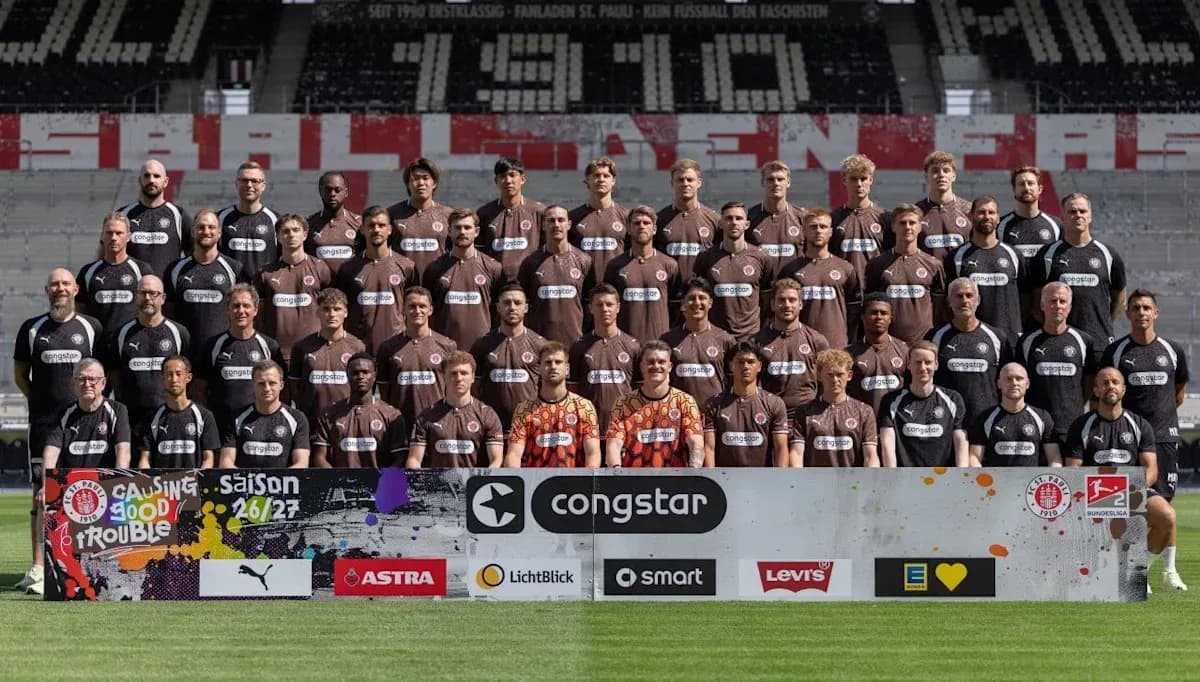
Given the scale of the turnover, St. Pauli have done well to preserve a recognisable core and surround it with credible alternatives. The squad may not be as star-studded as last year’s Bundesliga version, but it looks competitive, layered, and built for the demands of a long 2. Bundesliga campaign.
Can St. Pauli break their promotion pattern?
History is not kind here.
The last time St. Pauli were relegated before this drop, in 2010/11, it took them 13 years to return to the Bundesliga. The quickest they have ever bounced back is four years, a feat they managed twice in the 1990s and early 2000s. This is not a club that traditionally springs straight back up.
This time, though, the landscape is different.
Despite losing key figures, St. Pauli still boast one of the strongest squads in the division. By market value, only Wolfsburg sit above them in the 2. Bundesliga, and the gap is substantial – nearly €200 million – but that speaks more to Wolfsburg’s resources than to any weakness in Hamburg. The pre-season showed a team that can still take the initiative, still score in bunches, still stretch opponents.
Promotion is not a fantasy. It is a realistic, if demanding, target.
Wolfsburg will start as title favourites. Behind them, the race for second and third is shaping up to be ferocious. Hannover have built with intent. Heidenheim, also coming down from the Bundesliga, will expect to be in the mix. St. Pauli must elbow their way into that group and stay there.
The margin for error is slim, but the ceiling is clear. A finish outside the top six would be a disappointment. A top-three push is absolutely within reach if Rapp’s ideas bed in quickly, if Hrgota delivers what his CV promises, and if the new-look defence finds cohesion.
St. Pauli have been here before, staring up at the Bundesliga from below. The question now is not whether they can compete in this league. It is whether they are finally ready to rewrite their own promotion script.