.svg&w=384&q=75 "GoalGist logo")
Spain vs Belgium: Quarter-Final Clash at SoFi Stadium
Spain arrive in Inglewood as the only side at this World Cup yet to concede a goal. Belgium arrive as the team that blew the tournament wide open by knocking out the co-hosts. The prize for surviving Friday night at SoFi Stadium? France, waiting in Arlington on Tuesday.
It feels like a fork in the road for both.
Spain: flawless at the back, flickering up front
Luis de la Fuente’s team have eased their way into this quarter-final without ever really needing to show their full hand.
They topped Group H with seven points, opening with a goalless draw against Cape Verde, then brushing aside Saudi Arabia 4-0 and edging Uruguay 1-0. Austria were swept away 3-0 in the round of 32. Portugal were suffocated in the last 16 until Mikel Merino finally broke them with a stoppage-time header for a 1-0 win.
The constant thread: defensive control bordering on obsession.
Unai Simon has five clean sheets in five matches. Spain have set a tournament record of 609 minutes without conceding, stretching back to the 2022 World Cup. Aymeric Laporte and Pau Cubarsi have been imposing, but the real shield sits higher up the pitch. Spain squeeze the ball, the space and the air out of games. They press high, win it back early, and spend long stretches camped in the opposition half.
The trade-off is at the other end. The attack has come in bursts, not waves.
Mikel Oyarzabal has carried the scoring load with doubles against Saudi Arabia and Austria, yet Spain drifted for long spells against Uruguay and Portugal, recycling possession without the final incision. The sense lingers that they are still waiting for their big attacking performance.
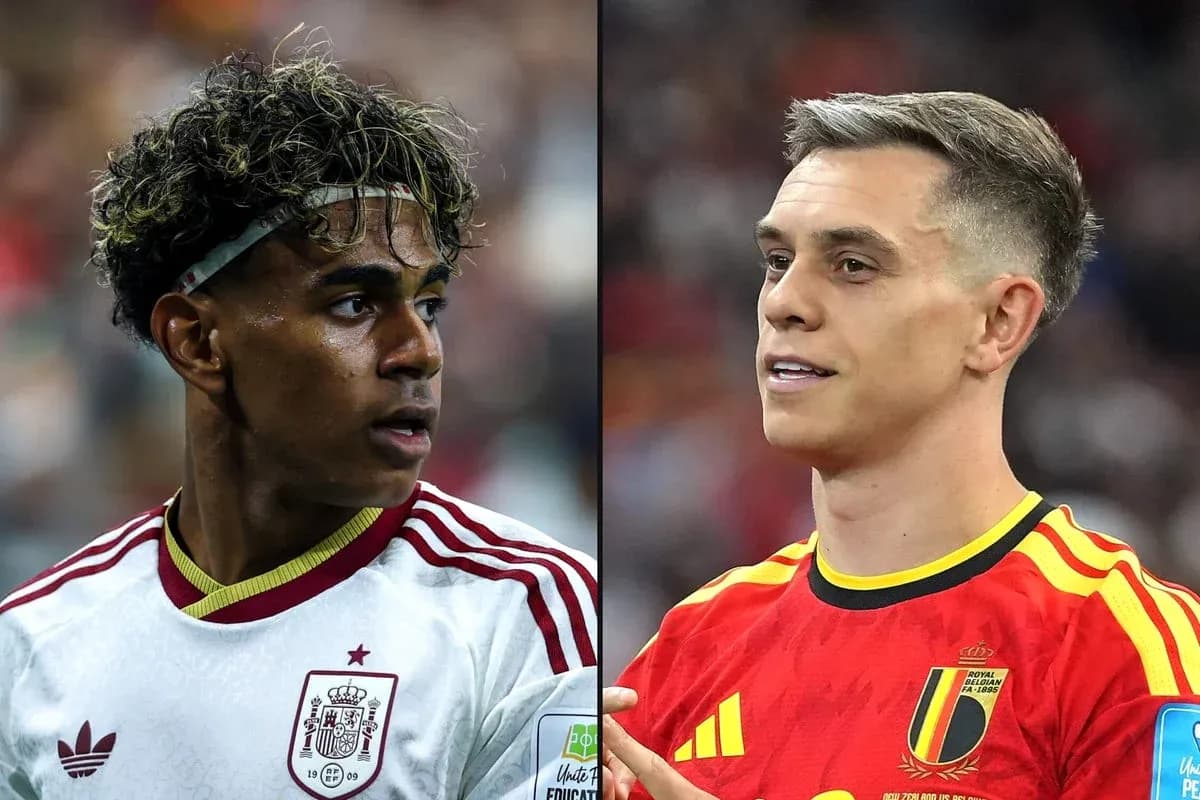
Which brings the spotlight back to Lamine Yamal.
The Barcelona winger, 18 and turning 19 on Monday, has shown flashes rather than fireworks. Nuno Mendes kept him quiet in the last 16 before going off injured; Nelson Semedo then stepped in and did the same job. The feeling around Spain’s camp is that Yamal is playing his way into form and fitness. This, against a Belgium back line that has creaked at times, could be the stage for his first truly defining night at a World Cup.
De la Fuente’s main dilemma sits at No 10. Dani Olmo has been neat, effective, one of the few attackers to really impress against Portugal. Yet Merino’s 91st-minute winner off the bench has complicated the picture. There is also the option of freshening the midfield with Fabian Ruiz, with Pedri short of his best. On the left, Alex Baena has quietly done enough to keep his place.
Whatever the final selection, Spain will look like Spain: front-foot, high line, ball-hungry. No team has drawn more offsides in this tournament (18). No team has won more possessions in the final third (36). Their brilliance with the ball is built on a ruthless attitude without it.
Belgium: stars on the bench, structure on the pitch
Belgium’s route here has been far more chaotic. Group G looked messy, disjointed, almost rudderless at times. They drew 1-1 with Egypt, 0-0 with Iran, then finally clicked with a 5-1 demolition of New Zealand to top the group with five points.
The real turning point came in the round of 32 against Senegal. With five minutes of normal time left, they trailed 2-0 and looked finished.
Rudi Garcia tore up his own script.
He hooked Jeremy Doku for Dodi Lukebakio and, more dramatically, sacrificed Kevin De Bruyne for Nicolas Raskin. On paper, it was conservative: Raskin is a ball-winner, not a playmaker. On the pitch, it changed everything. Belgium became compact, aggressive, collective.
Romelu Lukaku and Youri Tielemans dragged them back, scoring late to force extra time before Tielemans converted a late penalty to complete a 3-2 comeback that felt like a rebirth.
That same steel carried into the last 16. Against the United States, amid the storm around FIFA’s suspension of Folarin Balogun’s red-card ban, Belgium produced their most complete performance of the tournament, winning 4-1. They did it again without leaning on their biggest names from the start.
De Bruyne and Doku both began on the bench. They may do so again.
Garcia has found a team that runs, presses and thinks together. Raskin has held his spot alongside Tielemans and Amadou Onana. When Onana’s World Cup ended with an anterior cruciate ligament injury just 21 minutes into his first start, Hans Vanaken stepped in and the structure held. Later in games, when legs tire and spaces appear, Garcia has turned to Lukaku and Doku as impact weapons.
Against Spain, he is unlikely to abandon that formula. Belgium know they will spend long periods without the ball. They want a solid base first, stardust later if the game demands it. De Bruyne didn’t even get on the pitch against the U.S. That tells you how much Garcia has committed to this new version of Belgium.
Leandro Trossard has quietly become the creative hub, leading all players at this World Cup with 17 chances created. Tielemans has added late surges into the box and calm on the ball. The improvement has been collective, not star-led.
The tactical battleground: the flanks and the press
This game is likely to be decided out wide.
On Spain’s right, Yamal remains one of the most dangerous one-on-one players in the tournament, even if the explosion has not yet come. His understanding with Pedro Porro has grown, with Porro’s overlaps and underlaps opening pockets of space for Yamal to cut inside or roll defenders down the line.
On the opposite side, Marc Cucurella and Baena have formed a relentless pairing. They overload the flank, drag full-backs out of position and time runs in behind, as Austria discovered to their cost.
Belgium under Garcia have leaned heavily on their own full-backs’ off-the-ball runs, creating angles for low crosses and cut-backs. It has worked: both Belgium and Spain have created three chances from low crosses, the joint-most in the tournament alongside the Netherlands and Switzerland. Belgium lead all teams for first-time shots with 58; Spain sit third with 46. If the ball is fizzing across the six-yard box, don’t blink.
The other decisive theme will be what happens when possession turns over.
Spain counter-press like a reflex. Lose it, swarm it, win it back. That has strangled opponents and protected their centre-backs from extended defending. Belgium, by contrast, have been vulnerable when teams play through their midfield. They have already committed six errors leading to shots, behind only the United States and Brazil (seven each), and have allowed 53 shots in total — almost double Spain’s 29.
There is another quirk to Belgium’s attacking profile. They shoot a lot, but from crowded positions. Thirty-two of their efforts have been blocked, the most in the tournament. Only 14 of their 107 shots have been “clear” efforts with zero or one defender in the way — but they have scored 13 of those. That conversion rate outstrips France, England and even Spain. If they get a clean look, they punish.
History, weight and whispers of destiny
Spain and Belgium know each other well. They have met 23 times, starting with Belgium’s 3-1 win at the 1920 Olympics in Antwerp. The most famous clash came in the 1986 World Cup quarter-final in Mexico, when Jan Ceulemans’ diving header was cancelled out late by Juan Senor’s 30-yard strike, only for Jean-Marie Pfaff to become the hero in a penalty shoot-out that fed into Spain’s long, unhappy relationship with spot kicks.
Spain took their revenge at Italia ’90 with a 2-1 group-stage win that sent them through as group winners, Belgium as runners-up. Since the turn of the century, the balance has flipped decisively: Spain have won all five meetings, including a 5-0 qualifying rout in La Coruna on the way to their 2010 World Cup triumph. Their last encounter was a 2-0 Spanish win in Brussels in 2016, with Thibaut Courtois, Lukaku, Thomas Meunier and De Bruyne all involved for Belgium.
Those ghosts will linger in the background at SoFi Stadium, but they won’t decide this.
What might is whether Belgium can live with Spain’s suffocating structure for 90 minutes, and whether Spain can finally turn territorial dominance into something more ruthless.
Predictions and the sense of an edge
Among analysts, the pattern is clear: respect for Belgium’s resurgence, belief in Spain’s superiority.
Multiple experts see a 2-0 Spain win. The logic is simple. Spain’s defence has been immaculate, their midfield built to own the ball, and Yamal is overdue a breakout performance. Belgium’s 4-1 dismantling of the United States was impressive, but this is a step up in class against a team that rarely lets chaos in.
One forecast goes bolder: Spain 3-1 Belgium, with Belgium landing the first blow before De la Fuente’s side settle, adjust and let Yamal loose.
There is also a selection subplot up front for Belgium. Some argue Charles De Ketelaere should start as the No 9 ahead of Lukaku, offering more mobility and link play even if he lacks the same penalty-box presence. Whatever Garcia chooses, he knows this: Spain will not gift many chances. When they do, Belgium’s clinical edge on clear shots has to hold.
The stage and what comes next
Michael Oliver will referee his seventh World Cup match, more than any other English official. The venue is SoFi Stadium in California; the kick-off times are set across three continents. The winner heads to AT&T Stadium in Arlington to face France on Tuesday, July 14.
Spain are gliding through the rounds without spectacle, yet with an authority that suggests there is another gear waiting. Belgium have already reinvented themselves once in this tournament.
The question now is simple: does the team that hasn’t conceded yet finally get dragged into a firefight, or does the team that thrives in chaos run into a wall they cannot move?