.svg&w=384&q=75 "GoalGist logo")
Southampton's Spying Allegations and Play-Off Final Uncertainty
Kim Hellberg stood in the bowels of St Mary’s, his side knocked out of the play-offs, and spoke about heartbreak.
Not the kind you’d expect after a 2-1 extra-time defeat. Not the missed chances, the tired legs, the season slipping away under the floodlights.
He was talking about a man in a car.
A man who, according to the English Football League, drove five hours to secretly film Middlesbrough’s training session before the first leg of this semi-final. A man linked to Southampton. A man Boro staff say they caught.
“If we hadn't caught that man that they sent up five hours to drive, you would sit there and say well done [to Southampton] in the tactical aspect of the game and I would go home and feel like I've failed,” Hellberg said.
“When that is taken away from you – ‘we're not going to watch every game, we're going to send someone instead and film the sessions and hope they don't get caught’ – it breaks my heart in terms of all the things I believe in.”
On any other May morning, the conversation would have shifted seamlessly to Wembley, to form guides and tactical battles, to who might handle the occasion better on 23 May.
This year, nothing is seamless.
A final shrouded in doubt
Southampton are scheduled to face Hull City in the Championship play-off final for a place in the Premier League. The date is set. Wembley is booked. The season’s showpiece is 10 days away.
Yet no one can say with certainty that the game will even go ahead as planned.
Southampton have been charged by the EFL with breaching regulations by spying on Middlesbrough’s training. They have not denied the allegations. They have asked for more time to complete an internal review. Time, however, is precisely what the league does not have.
Tickets must be sold. Police and stewards must be organised. Supporters need trains, hotels, days off work. A season that has stretched over nine exhausting months is now in the hands of an independent disciplinary commission that has never had to rule on a case quite like this.
For Middlesbrough, there is only one acceptable outcome: that they walk out at Wembley a week on Saturday.
Until that commission sits, everything is frozen.
Business as usual – on the surface
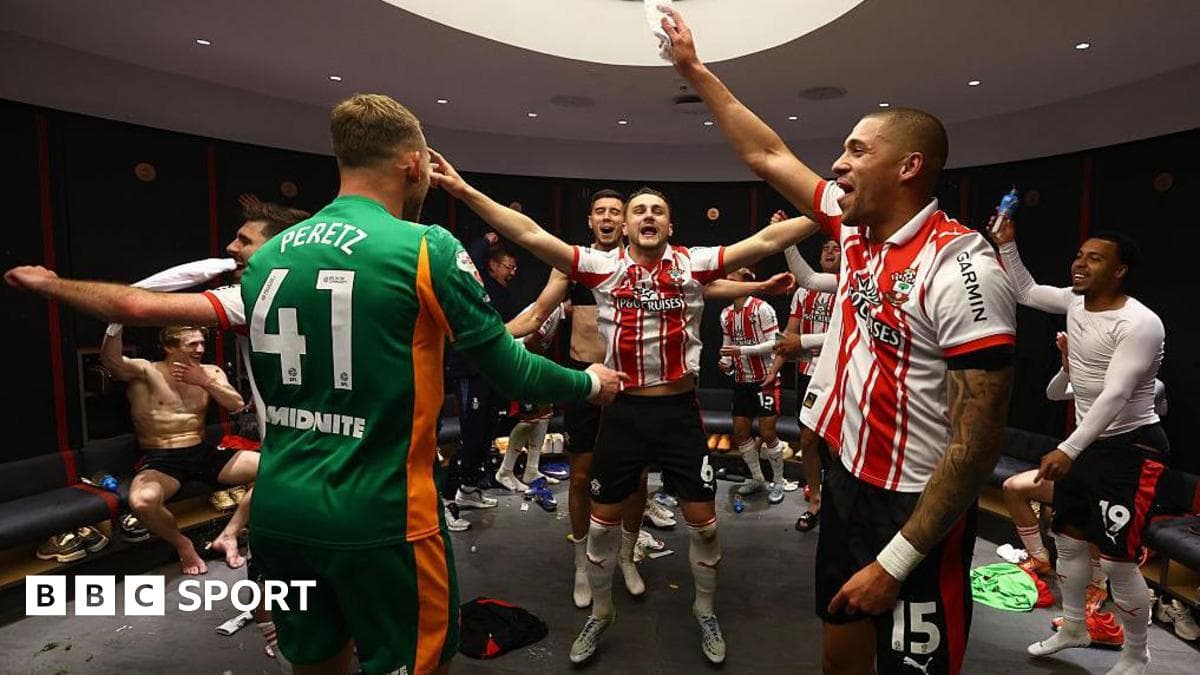
Southampton’s celebrations on Tuesday night were noticeably restrained. How could they not be? Every cheer carried a question mark.
On Wednesday morning, the club quietly launched a play-off final merchandise range on their website. No big fanfare. No triumphant social media campaign. Just a new tab for a game that might yet be taken away from them.
Tickets for the final are due to go on sale on Thursday. Fans will buy them in good faith, not knowing if they will ever see their team under the arch.
Head coach Tonda Eckert must prepare as if nothing is wrong. He has an opponent to analyse, a game plan to build, a group of players to keep focused. On the training ground, cones are laid out, drills are run, video clips are cut. The routine continues because it has to.
Up on Teesside, there is no such rhythm.
Middlesbrough’s players have been told to stand down, for now. BBC Sport understands they will be given a few days off, but with a caveat: phones on, passports away. No Dubai, no Ibiza, no early escape to the usual off-season haunts.
They may yet be asked to restart a season they thought had ended.
Gibson loads the legal artillery
From the moment the allegations emerged, Boro’s stance has been clear. A fine for Southampton would not wash. They want a sporting sanction.
Club owner Steve Gibson has already shown he is willing to take on the game’s authorities. In 2021, Middlesbrough launched legal proceedings against Derby County, arguing that Derby’s financial breaches had cost them a play-off place in 2018-19. The case never reached a full courtroom showdown; the clubs reached a “resolution” believed to be worth £2m to Boro.
This time, Gibson has reportedly turned again to Nick De Marco, one of the most formidable sports lawyers in the country. De Marco has built a reputation for influencing major disciplinary outcomes, including helping ensure Sheffield Wednesday started this season on zero points when a hefty deduction had been expected.
Back then, he fought to reduce a punishment. Now, he would be arguing for one.
If the independent disciplinary commission does not deliver what Gibson considers justice, the story may not end with its verdict. A separate claim for compensation, should Southampton keep their place in the play-offs and potentially win promotion, would surprise no one.
The EFL, for its part, wants this sorted quickly. But the league has handed control to an independent body. And that body now has to set a precedent.
Inside the commission’s room
The case is being managed by Sport Resolutions, a mediation and arbitration specialist that supplies panels for sporting disputes.
The independent disciplinary commission will consist of three members. The chair is typically a senior legal figure – a judge, KC or QC – flanked by two side members, often sports lawyers, barristers or experienced mediators.
They are selected for suitability and availability, a crucial factor with Wembley looming and international duty closing in soon after. The exact timetable is theirs to determine, and it will not be made public.
The EFL has requested an expedited hearing. Southampton have argued for more time. Somewhere between urgency and due process, a date must be found.
One hearing will not be enough. Any party deemed to have an interest – a category that will surely include Middlesbrough – must be given the right to appeal. And any appeal decision is final. EFL rules do not allow this to go to the Court of Arbitration for Sport.
All of this has to happen before 23 May. Rearranging the final is almost impossible. Wembley is unavailable the following weekend, and players will then disperse for international duty.
The logistical headache grows if Boro are parachuted into the final at short notice. Ticket allocations, police planning, travel arrangements – all of it would have to be turned around in days.
Yet the biggest question remains the simplest: what punishment fits the crime?
No template, no hiding place
This is uncharted territory. Profit and sustainability hearings come with frameworks and sliding scales. This does not. There is no ready-made tariff for spying on an opponent’s training session within 72 hours of a play-off semi-final.
The only vaguely comparable domestic case is Leeds United’s infamous “Spygate” saga in 2019, when Marcelo Bielsa admitted sending a staff member to watch Derby County train.
Back then, Leeds were fined £200,000. Crucially, there was no specific rule against observing another club’s training sessions. The only charge available was under regulation E.4, which requires clubs to act in the “utmost good faith” towards each other.
That case prompted the EFL to introduce regulation 127, which explicitly bans any club from directly or indirectly observing another team’s training in the 72 hours before a match.
Southampton now stand accused of breaching both E.4 and regulation 127. They have not disputed the allegations.
The context is different too. Leeds were caught in mid-January, with months of the season still to run. Southampton are accused of spying in the build-up to one of the biggest fixtures of the year, a play-off semi-final that shapes careers and bank balances.
At Middlesbrough, the feeling is stark. If Southampton go on to beat Hull and win promotion, the financial windfall of Premier League football would dwarf any fine. That is why Boro want them removed from the play-offs entirely.
The most direct route would be to award Middlesbrough a default 3-0 win for the first leg, flipping the tie to a 4-2 aggregate victory and sending them to Wembley. It would be dramatic, but not without precedent: in 2002, West Bromwich Albion were handed a 3-0 win when their match against Sheffield United was abandoned after the Blades were reduced below the minimum seven players.
A points deduction is another option – a kind of halfway house. Southampton could be allowed to play the final, but with a sporting penalty hanging over them. If they win promotion, the EFL cannot enforce a deduction in the Premier League itself, but it can recommend that the Premier League board carries it over.
Whatever the commission decides must feel fair, but it also has to bite. Without real jeopardy, the message to clubs is obvious: if the stakes are high enough, why not take the risk?
Questions that won’t go away
Southampton have stayed largely silent. The club’s media officer has shut down attempts to question Eckert about the case. There have been no detailed explanations, no public defence, no narrative from their side beyond the request for more time.
Inside the dressing room and the staff offices, there are uncomfortable questions.
Who knew what, and when? Was there a live feed from Rockliffe Park? Was footage shared, stored, analysed? Or was this, as the club may yet argue, the work of a lone operator who acted on his own initiative?
Hellberg does not buy that.
After Tuesday’s game he was clear: “There’s someone who makes decisions to go and try to cheat.”
The commission will have to decide where responsibility lies. Is this a systemic issue, or the misjudgement of one individual? And if staff members are implicated, what happens then?
World football has already seen a far more severe response in a different spying case. During the 2024 Olympics women’s tournament in Paris, Fifa deducted six points from Canada after they were found to have spied on New Zealand using a drone. Three members of Canada’s staff, including the head coach, received one-year bans from all football activity.
Could Southampton’s staff face similar individual sanctions? Could the commission hand out bans as well as club punishments?
Between justice and chaos
One argument rings loud from the south coast: why should Southampton’s fans pay the price?
They have followed their team across 48 league and play-off games. They have seen enough wins, goals and late drama to believe their side has earned the right to play for promotion. To rip that away on the eve of Wembley would feel brutal.
Yet there is a harsher question on the other side. If a club can spy on an opponent before a game of this magnitude and escape with only a fine, what stops anyone else? What does “utmost good faith” mean then?
If Southampton are in the Premier League next season, pockets swollen by broadcast revenue and prize money, what punishment will really have stung?
Somewhere between those competing truths, three people in a quiet room must decide the fate of a final, the direction of two clubs and the boundaries of acceptable behaviour in English football.
How they draw that line will echo far beyond 23 May.

