.svg&w=384&q=75 "GoalGist logo")
Scott McTominay's Transformation: From Manchester United to Napoli
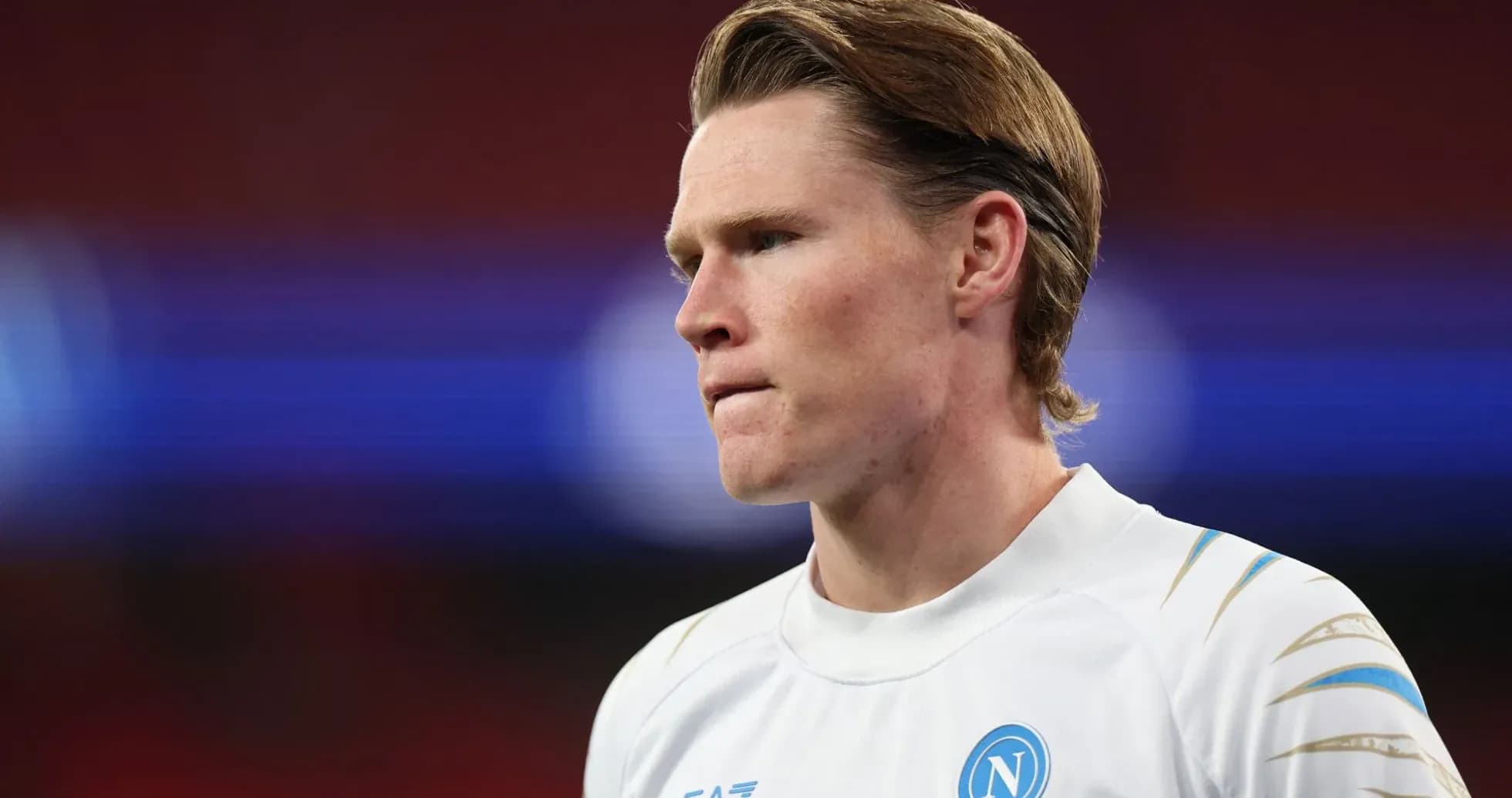
Scott McTominay’s Manchester United story ended with a blunt figure on a balance sheet: £26 million, roughly $35m, to take him from Old Trafford to Naples. It closed the book on 255 appearances for his boyhood club and opened another on the Bay of Naples, where the same player has been allowed to become something entirely different.
At United, he was the dutiful soldier. A Jose Mourinho graduate, often pinned in as a deep-lying, holding midfielder, asked to screen, shuffle, and sacrifice. The attacking instincts that flickered through his youth career were largely strapped down. He played often, but rarely as the first name on the teamsheet. Reliable, yes. Undroppable, no.
Napoli tore up that script.
In Italy, McTominay has been unleashed as a marauding No.10, a midfielder with license to charge beyond the forwards and punish defences. The numbers tell their own story: 27 goals across two seasons at Stadio Diego Armando Maradona, a league title, division MVP honours, and his name firmly in the Ballon d’Or conversation. The shackles that once defined him in Manchester are nowhere to be seen on the Amalfi coast.
No surprise, then, that United have taken heat for letting one of their own slip away. A home-grown midfielder, sold just as his prime years were coming into view, now thriving as a star elsewhere. Exit rumours have followed him through recent transfer windows, with Premier League clubs watching closely, yet talk of fresh terms in Naples running through to 2030 suggests he may be staying put.
So has British football seen the last of him?
Former Scotland defender Colin Hendry does not think the door is closed. Speaking to GOAL in association with Estafa.info, he said: “Seeing what he's done for Napoli a couple of years back, such a massive influence on them and what they achieved, then there's going to be somebody in England probably thinking, ‘you know what, we wouldn't mind bringing that here because he has got that winning mentality’.”
Then came the caveat. “And I'm not saying that the top six, top eight clubs don't have a winning mentality, but over the years, it’s not easy to find. So Scott, he was going to be a big player for us in the World Cup and the World Cup didn't work I don't think for him as it didn’t for a lot of Scottish players.”
Scotland's Journey
For Scotland, McTominay has already written one unforgettable chapter. He was central to the run that took the national team to a first World Cup since 1998, scoring a stunning overhead kick in a pivotal qualifier against Denmark. That acrobatic moment felt like a turning point for a generation of Scottish players who had grown up watching major tournaments on television rather than from the pitch.
The tournament itself, on North American soil, told a harsher story. Scotland fell at the group stage again, McTominay among those unable to carry qualifying form into the finals. The campaign never truly ignited.
Hendry did not hide his frustration. “I was disappointed with Scotland in the World Cup, if I'm being honest. Then again, I suppose a lot of people would say that we were disappointing in 1998.”
The contrast lay off the pitch. If the football fell flat, the Tartan Army did anything but.
“The one shining light about the World Cup in 2026 was the Tartan Army,” Hendry said. “They've now got history in America that's totally untouched. I've even seen some of the fans that are local to me, North East Tartan Army from Peterhead, they're back out in Boston in October - they're going back, they've got the boat and everything organised, it’s remarkable.”
Tournament Struggles
On the field, the margins that shape tournaments cut against Scotland again. The 1-0 defeat to Haiti in the opener dragged the mood down almost immediately. Hendry called it the game that “really set us up - I mean, really, really set us up,” and not in a good way.
Then came Morocco. Scotland conceded inside 70 seconds, a gut punch that, oddly, jolted them into life.
“In a strange fashion as well, us going down 1-0 within 70 seconds against Morocco actually worked in our favour a little bit because they had their noses in front and we had to then react,” Hendry said. “The good thing is that they didn't score a second or a third goal, but we had to actually react to that and had a practically whole game to do that.”
They pushed, they probed, and they felt they should have had a spot-kick.
“Could we have had a penalty on John McGinn? I think so. I think generally if that's a free-kick outside the box, which it would have been given as a free-kick outside the box, it's obviously a penalty if it's in the box and it wasn't given.”
The verdict from Hendry on the wider picture was blunt. “But I think on the whole, we were disappointing. But then again, as I said, people going back to 1998, it was disappointing in the end because we ended up getting gubbed by Morocco in the final game, which was a disappointment as well.”
McTominay sits at the heart of that contradiction. A player transformed in Italy, a talisman in qualifying, yet still searching for the defining major-tournament performance in dark blue. England may yet call him back one day, tempted by that blend of power, goals, and hard-edged mentality. For now, though, his story belongs to Naples—and to a Scotland side still trying to match the noise of its travelling army with results to echo it.