.svg&w=384&q=75 "GoalGist logo")
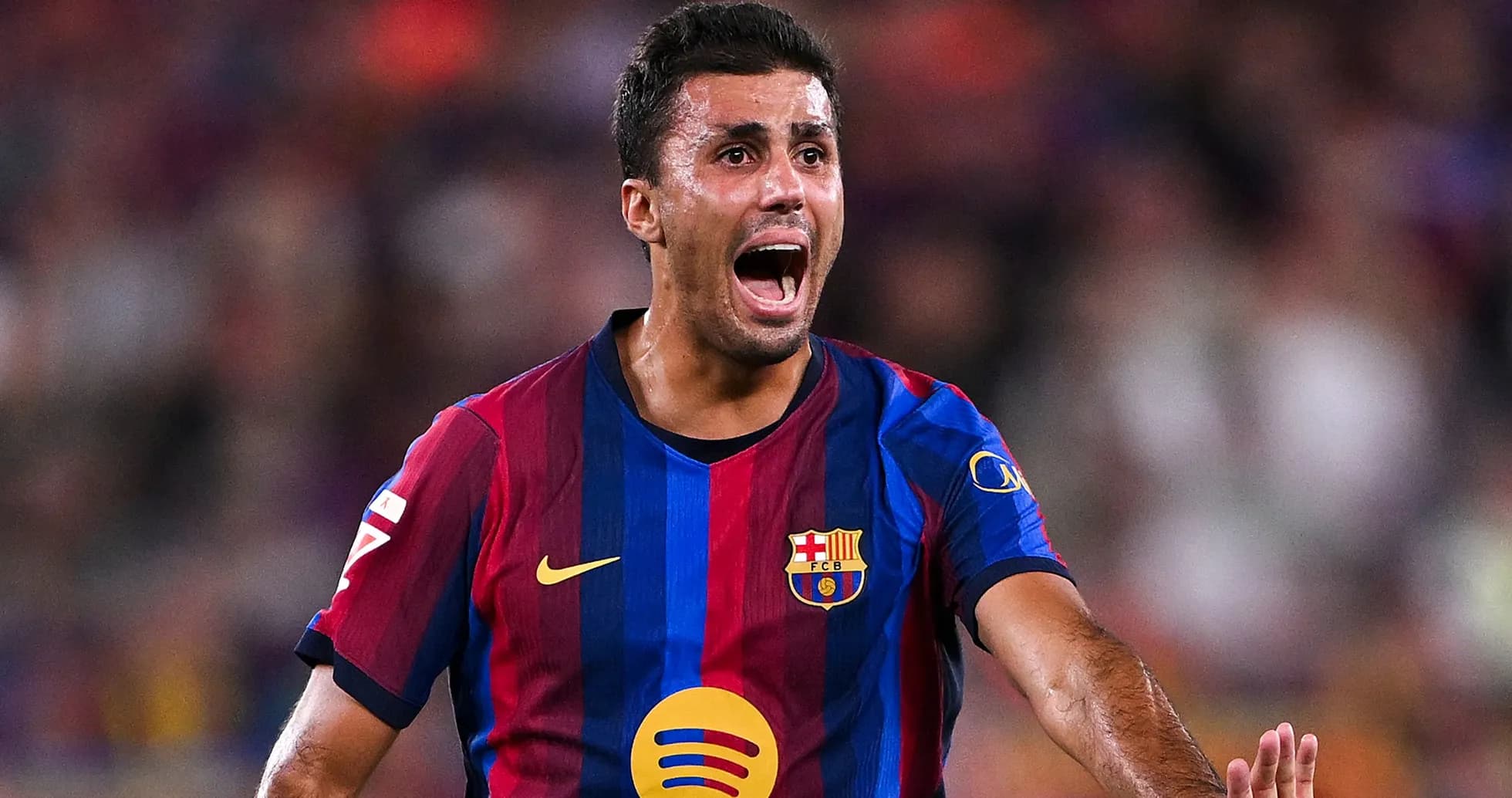
Rodri's Bold Move to Barcelona: A New Era Begins
Rodri did not just change clubs this summer. He walked away from the empire he helped build.
Manchester City’s metronome, the 2024 Ballon d’Or winner and heartbeat of Pep Guardiola’s side, chose a new life in La Liga. Not in white. In blaugrana. Barcelona, not Real Madrid, won the race for the 30-year-old, turning one of the window’s biggest transfer sagas into a statement about footballing identity as much as power.
A choice shaped over time
Rodri is clear: this was not a snap decision, not a late twist in a bidding war.
“It’s been a process, rather than a decision,” he told Mundo Deportivo. Those words matter. They hint at a slow realisation that his cycle at City was ending, that the trophies, the dominance, the perfection of Guardiola’s machine had run their course for him personally.
“First, you have to realise that your time there has come to an end and that you might want a new challenge,” he explained. “From there, the moment the opportunity at Barcelona arose, I realised it was the best thing for me for many reasons.”
That “moment” was no ordinary offer. Both Barcelona and Real Madrid wanted him. Madrid pushed hard. For Los Blancos, losing out on the best midfielder in the world – and a Spaniard at that – cuts deep.
Barcelona’s project wins the argument
Rodri insists the decision was made on the pitch, not in the boardroom.
“I’ve always based my decisions on sporting considerations – where I believe I’ll be able to win, be happy and, above all, develop as a player,” he said. That is where Barcelona, with Hansi Flick on the touchline and Deco in the sporting director’s office, found their edge.
“And that’s why I’ve chosen Barca – also because of the generation of players they have and what Hansi is building there. Ultimately, Deco and Hansi, at the top of the organisation, convinced me.”
This is not the Barcelona of nostalgia and faded glory Rodri is walking into. It is a squad packed with emerging talent, a coach with a clear tactical blueprint and a hierarchy that, in his eyes, knew exactly how to use him. The pitch, not the paycheque, carried the day.
Saying no to Madrid
Turning down Real Madrid is never a neutral act for a Spanish international. It is a decision that follows you.
“I had to weigh up a lot of things and make such an important decision between two of the best clubs in the world,” Rodri admitted. The pull of the Bernabeu, the history, the guarantees of competing for every major trophy – it all sat on one side of the scale.
“In the end, I made my decision based on sporting considerations – on what sparked a bit more enthusiasm in me and on understanding where I could win and develop the most as a player. It wasn’t an easy decision at all; saying no to Madrid wasn’t easy, especially as they treated me exceptionally well.”
Madrid did almost everything right. Barcelona, though, made him feel something more.
A “family club” pitch
What truly resonated with Rodri was how Barcelona went about it. No ultimatums. No pressure.
He described the environment as “very homely, like a family club”. That line will echo around Catalonia.
“At no point did they put any pressure on me whatsoever; everyone expressed their desire to have me on board, to work together, and to see what I could bring to the team,” he said. “It was more about the football itself – what they understood I could bring both on and off the pitch, and I really liked that.”
Barcelona sold him on his role, his influence, his fit within a group that is still forming its identity. For a player who has spent years as the understated fulcrum of a super-team, the chance to anchor a new project clearly hit home.
Ballon d’Or storm left to one side
His move came on the back of Real Madrid’s high-profile boycott of the Ballon d’Or ceremony, where Rodri beat Vinicius to the prize. The narrative practically wrote itself: snubbed Madrid, snubbed gala, snubbed award.
Rodri rejected that storyline outright.
“Anyone who knows me knows that I try to distance myself from that sort of thing, like the media hype,” he said. “I focus on football. In that sense, I’m very English, aren’t I? The Premier League is football and little else.”
It is a revealing comment. Years in England have shaped his outlook. Less noise, more football. That same mindset guided the biggest decision of his career.
Now he swaps Manchester’s rain for Barcelona’s glare, the Premier League’s relentlessness for La Liga’s tactical chessboard. He leaves as a champion and arrives as the centrepiece of a new era.
The question is no longer why he chose Barcelona. It is how far he can drag them back to the summit from the base of that holding midfield role.