.svg&w=384&q=75 "GoalGist logo")
The Rise of the Player in Football Culture
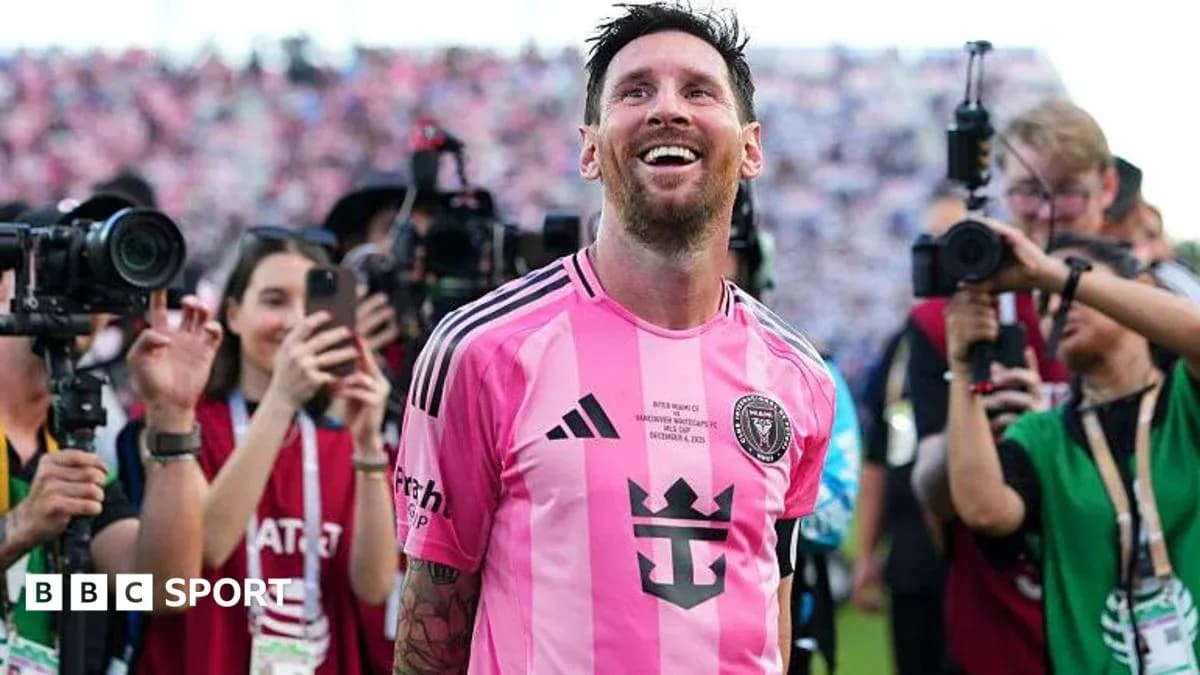
The golden ticket dropped in flamingo pink.
Not a traditional club colour. Not a nod to history or heritage. A statement. Lionel Messi’s Inter Miami shirt was designed to live on bedroom walls from Buenos Aires to Barcelona, to flash across billboards and flood timelines.
It worked. Instantly.
Inter Miami’s social numbers exploded. Shirts vanished from club shops. Tickets were flipped for eye-watering prices. But those new followers weren’t suddenly falling in love with a young franchise from Florida.
They were following a man.
The age of the name on the back
“A lot of people are walking around cities and towns in the UK and Europe wearing that flamingo pink of Inter Miami with zero affiliation to Miami, having never been there,” says sports brand strategist James Kirkham.
“It’s quite a normal thing now. But it is the player who has done the job.”
Messi has always moved people like this. So has Cristiano Ronaldo. From Barcelona v Real Madrid to MLS v Saudi Pro League, their rivalry has carved football into camps and comment sections for more than a decade.
But the shift runs deeper than Messi v Ronaldo.
Kirkham remembers the wave that followed Zlatan Ibrahimovic across Europe. He sees it now as part of a bigger pattern: young fans building their football world around individuals, not institutions.
He argues they are “less rigid or tribal than they used to be” and armed with a “more encyclopaedic knowledge” of the game, pieced together from EA Sports FC, Football Manager, YouTube compilations and trading cards.
They don’t just pick a club and stay there. They pick a player, then follow the trail.
“Fans play as these players in games,” Kirkham says. “So there is a really thin line between virtual and real life.
“Following a player and buying them as part of your Ultimate Team and then wearing that player’s name on the back of your shirt, be that Atletico Madrid or Chelsea or Dortmund, kind of makes no difference.”
The badge on the front still matters. But not like it used to.
One club for life… and then another
Traditionally, you don’t choose your team. It chooses you. A parent’s scarf, a local ground, a first roar from the terrace. As Eric Cantona once suggested, you can change almost anything in life, but never your football club.
Except that’s not quite the full story anymore.
A study titled ‘The Rise of the Second Club Fan’, published before this summer’s World Cup, found that 80% of global supporters now also follow a second team.
Matthew Kyle, head of insights at Engage and MTM and the report’s author, is clear: this doesn’t mean people are ditching the club they grew up with. They’re adding to it.
“They are often looking for ‘who else can I support?’ It’s more natural,” Kyle explains.
The second club might be chosen for its style of play, its story, its values. Sometimes it’s as simple as liking the kit. Geography hardly matters, especially in regions without a strong domestic league.
But one factor stands out above all.
The report identifies players as the most powerful gateway. Fans latch on to a star and drift with them from club to club. “For this audience, they are the club,” the study concludes. “These fans track individuals, not institutions.”
When a player moves, a slice of the fanbase moves with them.
Griezmann’s gamble and the rise of the player channel
Football hasn’t always been ready for this.
Back in 2018, days before France began their World Cup-winning campaign, Antoine Griezmann tried to seize control of his own story. He teased ‘The Decision’ – a half-hour TV documentary that would reveal whether he would join Barcelona.
Gerard Pique, whose company produced the show, stoked the hype with a popcorn emoji on social media. Barca believed he was coming. So did most of the audience.
Instead, the forward stood outside Atletico Madrid’s Metropolitano and announced he was staying. Two endings had reportedly been filmed to keep the secret. The final cut made him look bold to some, self-indulgent to others.
Griezmann, a self-confessed NBA obsessive, had borrowed the idea from LeBron James’ 2010 special of the same name. But Kyle believes the Frenchman was slightly out of sync with the times.
That kind of “self-commercialisation,” he says, would land very differently now if it came from Erling Haaland or Kylian Mbappe.
Griezmann tried to own his narrative. Today’s stars actually do.
Haaland, Ronaldo, Jude Bellingham, Ella Toone – many top players now run their own YouTube channels, drip-feeding training clips, behind-the-scenes footage and slices of their lives away from the pitch.
“Players are becoming their own distribution levers,” Kyle explains, “with some in particular taking a driving seat in terms of ‘how I project myself onto the world’ and building their own channels and audience.”
The club no longer controls the full story. The player does. Fans aren’t just watching matches; they’re subscribing to journeys.
More than a shirt deal
This shift isn’t only about content. It’s about what players represent.
“Players are far more culturally symbolic than they used to be,” Kirkham says. “It is not that players don’t do endorsements now, but they know they have to resonate with fans, so fans can really latch on to them and get behind them.”
He points to Marcus Rashford’s work during Covid, when the Manchester United forward campaigned successfully to change UK government policy on free school meals.
“Young fans want to know players stand for something more – that gives them more chance to follow and pursue them, find a deeper connection with them.
“They look for stuff that is aligned to them, who they are, their causes and where they’re from. I think we will increasingly see that.”
The result is a new kind of allegiance. Not just to a style of play, but to a set of values, a personality, a cause.
World Cup as a global shop window
The World Cup in North America amplified all of this.
On the pitch, it was about goals, saves, and drama. Off it, it was a launch pad for personal brands.
Cape Verde goalkeeper Vozinha, largely unknown to many neutrals before the tournament, became a cult figure after his displays against Spain. His Instagram following rocketed from around 50,000 to nearly 30 million.
Established stars cashed in too. Spain and Barcelona’s Lamine Yamal saw his numbers surge. So did Bellingham. Even Ronaldo, already the most-followed athlete on Instagram, enjoyed another healthy bump.
The biggest winner, though, was Erling Haaland.
Norway’s forward saw his popularity explode as fans poured onto his Instagram, TikTok and Snapchat accounts. Kyle calls it a “massive” gain: more than 51 million followers across his social platforms since 1 July, compared with 11 million in the first six months of the year.
Haaland’s appeal came from a cocktail of factors. A humble, almost awkward charm. Viral moments in cowboy hats or helping Norway’s kit man. A steady flow of social media posts where he actually replies and engages. Memes about his “bromance” with Bellingham. A Russian model going viral for looking uncannily like him. Norway reaching the last eight for the first time. The now-famous rowing celebration with fans.
“Haaland was a massive winner from the World Cup,” Kyle says. “Obviously he had a good World Cup. But a massive part of it was the personality coming across, interacting with fans, memes, his stature and what he looks like, Norway being there [in the last eight] for the first time and the fans’ rowing celebration – all that kind of stuff.”
The football mattered. The character sealed it.
When the hero leaves town
All of which leaves clubs with a problem they can’t ignore.
If millions arrive because of one player, what happens when that player walks away?
The question is already live. Trabzonspor are enjoying a surge after signing Egypt’s Mohammed Salah, fresh from nine glittering years at Liverpool. Tottenham had something similar with Son Heung-min, whose decade in north London turned Spurs into South Korea’s most-supported foreign club, ahead of Manchester United.
“Son is a great example,” says Kyle. “He wasn’t a global superstar when he arrived but he was a huge player from South Korea, and over the course of his time with them Spurs became the most-supported foreign club there, topping Manchester United.
“Now, when Son left, Spurs didn’t immediately lose millions of followers on their socials from Korea. But we did see a small spike on his new club.”
The lesson? Those fans are not necessarily lost. They’re watching. They just need a reason to stay.
Kyle believes the answer lies in what clubs offer beyond the 90 minutes.
“It is about trying to deliver content those fans still want to engage with,” he says. “The easy answer is to say global superstars will do it on their own and these clubs without them will struggle. But every club has characters.
“Every player leaves eventually, even if they leave by retiring at your club. So it’s about using them as an asset while there and thinking about how all fans are also interested in stuff off the pitch.
“Behind the scenes content always does really well. Even if you’re not a fan of that club, you might stop scrolling and watch ‘a day in the life’ of a player because it might be good content.”
Clubs, in other words, need to behave a little more like their stars: show personality, tell stories, open the doors.
From superstar striker to superstar owner
And just as fans have begun to follow players across borders, another figure has entered the frame.
The owner.
The documentary series ‘Welcome to Wrexham’ turned a struggling Welsh club into a global curiosity, powered by the star wattage of Ryan Reynolds and Rob McElhenney.
“Ryan Reynolds and Rob Mac would have been a huge draw for people who don’t know football,” Kyle says. “On the counter, there will be people in the football community saying ‘this will be interesting because what the hell do they know?’.”
That tension is part of the appeal. Football, he argues, already behaves like a never-ending drama.
“You’ve got the benefit of football being like soap opera – seasons of television, seasons of football, different stories. And football never ends.”
Messi’s pink shirt, Haaland’s memes, Son’s legacy in Seoul, Reynolds on the Wrexham touchline – they’re all chapters in the same story.
The club crest still matters. It always will. But in a world where a teenager in Seoul can wake up as a Spurs fan and go to bed checking LAFC highlights, the real power may belong to whoever writes the next episode: the player, the owner, or the one star the world decides to follow next.