.svg&w=384&q=75 "GoalGist logo")
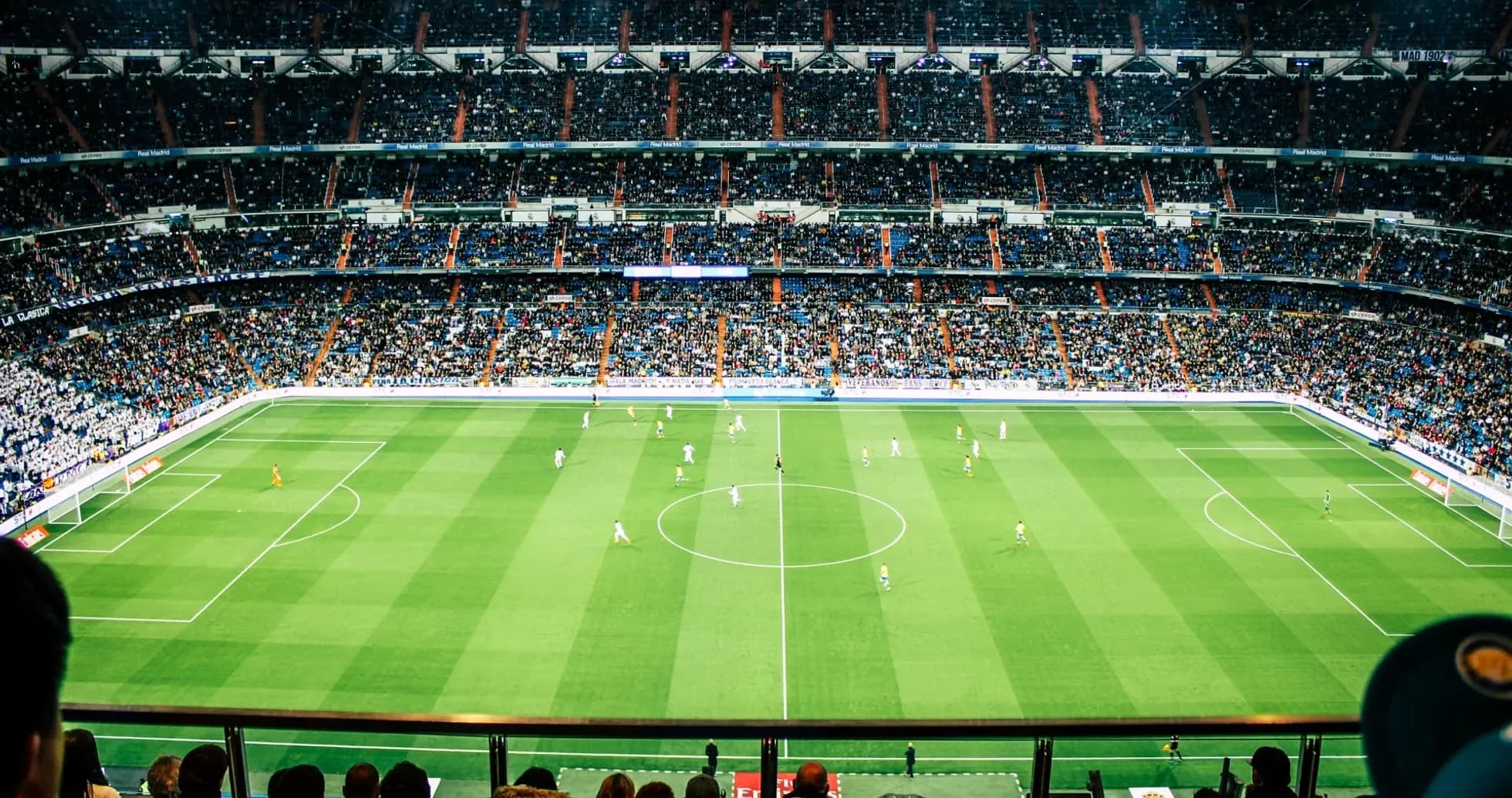
Real Madrid Dominates Real Sociedad 4–1 in La Liga Opener
Under the Bernabéu lights, this felt less like a league opener and more like a statement of intent. Real Madrid, already humming in the early days of the 2026–27 La Liga season, dismantled Real Sociedad 4–1, a scoreline that mirrored the structural gulf between a side built to dominate and one still searching for its shape.
I. The Big Picture – Madrid’s New Order
Following this result, the table tells a blunt story. Real Madrid sit 2nd with 6 points from 2 matches, a perfect record built on 6 goals scored and 2 conceded overall, giving them a goal difference of +4. At home, they have already put down a marker: 4 goals for and 1 against in their single Bernabéu outing. On their travels, they have been efficient too, with 2 goals scored and 1 conceded.
Real Sociedad, by contrast, leave Madrid anchored to 20th place. They have lost both of their matches, all of them away, scoring just 1 goal and conceding 5 overall, for a goal difference of -4. The early-season narrative is stark: Madrid’s form reads “WW”; Sociedad’s, “LL”.
Both coaches set their teams up in a 4-2-3-1, but the systems could not have felt more different in execution. Jose Mourinho’s Real Madrid used the shape as a launchpad for relentless verticality, while Pellegrino Matarazzo’s Real Sociedad looked like a side still in pre-season, their double pivot unable to stem the white tide.
II. Tactical Voids – Absences and Discipline
Madrid’s dominance came despite a long injury list that would have crippled lesser squads. Eder Militao (hamstring), A. Tchouameni (muscle), F. Mendy (hip), Rodrygo (knee), Endrick (muscle), R. Asencio (muscle) and T. Pitarch (knee) were all ruled out. That stripped Mourinho of a starting-calibre centre-back, his most natural holding midfielder, a first-choice left-back, and two high-impact forwards. The response was telling: Ibrahima Konate and Dean Huijsen formed a new-look central pairing, Alejandro Carreras stepped in at left-back, and the attacking burden shifted fully onto Kylian Mbappé, Vinicius Junior and Jude Bellingham.
Real Sociedad had their own problems. J. Gorrotxategi (groin), P. Marin (injury) and A. Odriozola (knee) were all unavailable, thinning Matarazzo’s defensive and wide options. That mattered: with Jon Mikel Aramburu already one of La Liga’s most card-prone defenders – 2 yellow cards in 2 appearances – Sociedad’s right side was always walking a tightrope against Vinicius.
The disciplinary trends added another layer. Heading into this game, Madrid’s yellow cards were spread evenly across the match, with 25.00% of their cautions arriving in each of four windows: 0–15, 31–45, 61–75 and 91–105 minutes. It paints a picture of a side that competes aggressively in every phase rather than losing control in specific spells. Real Sociedad’s bookings, by contrast, are clustered: 16.67% between 31–45 minutes, 50.00% from 46–60, and 33.33% from 61–75. This is a team that tends to unravel around and just after half-time – precisely when Madrid like to raise the tempo.
III. Key Matchups – Hunter vs Shield, Engine Room vs Engine Room
The “Hunter vs Shield” duel was brutally one-sided. Kylian Mbappé arrived as La Liga’s leading scorer, with 3 goals from 2 appearances, 14 shots (10 on target), and an average rating of 8.25. He is already the sharpest spear in Spain. Real Sociedad’s “shield” is a unit that, on their travels, had conceded 1 goal in their first away outing before this match, but their broader seasonal pattern is more worrying: across 2 away games, they have allowed 5 goals, an away average of 2.5 conceded per match.
With L. Beitia and J. Martin at centre-back and Aramburu and S. Gomez as full-backs, Sociedad’s back four was always going to be under siege. Aramburu’s profile is emblematic: 7 interceptions show good reading of the game, but 7 fouls committed and 2 yellow cards in just 147 minutes highlight a defender often forced into recovery tackles rather than controlling duels. Against Mbappé’s pace and Vinicius’s constant dribbling threat (11 dribble attempts, 4 successful, 10 fouls drawn overall), that imbalance was ruthlessly exposed.
Behind Mbappé, the “Engine Room” battle tilted decisively white. Fede Valverde, B. Silva and Bellingham formed a rotating triangle ahead of the double pivot. Valverde’s numbers heading into this game were quietly elite: 125 passes overall at 95% accuracy and 5 tackles, the classic two-way midfielder who both feeds and protects the front line. Bellingham, with 1 goal, 2 assists and 6 key passes from 81 total passes at 95% accuracy, is already one of La Liga’s most influential midfielders. Arda Guler, with 12 key passes and 1 assist from 88 passes at 90% accuracy, adds a third creative axis.
Sociedad’s double pivot of Y. Herrera and B. Turrientes simply could not match that blend of physicality and incision. Herrera’s work rate was there, but the visitors lacked a true enforcer to disrupt Bellingham’s late surges and Guler’s between-the-lines drifting. Higher up, Takefusa Kubo and M. Oyarzabal had to work from increasingly isolated positions, feeding off transitions rather than structured possession.
IV. Statistical Prognosis – Why 4–1 Felt Inevitable
Strip away the names and the story is written in the numbers. Heading into this game, Real Madrid were averaging 3.0 goals per match overall, with 4.0 at home and 2.0 on their travels. They had failed to score in 0 matches, and had yet to keep a clean sheet – a side built more for overwhelming than for strangling opponents. Real Sociedad, meanwhile, were scoring just 0.5 goals per match overall, all of them away, and conceding 2.5 on their travels.
Madrid’s biggest home win so far – 4–1 – is now also Sociedad’s heaviest away defeat, a symmetry that underlines the structural mismatch. Madrid’s lack of penalties so far (0 taken, 0 missed) shows this is not a side relying on marginal calls; their goals come from open play and sustained pressure.
Defensively, Madrid are not yet watertight – 1 goal conceded at home and 1 away – but their attacking ceiling is so high that opponents must either sit deep and hope, or engage and risk being torn apart. Sociedad tried to hold their 4-2-3-1 shape, but without the pressing cohesion or individual defensive quality to compress space between lines, they were stretched until they broke.
Following this result, the prognosis for both is clear. Madrid look every inch a title contender, their 4-2-3-1 already bedded in, their stars statistically and tactically aligned. Real Sociedad, rooted to the bottom with 0 points, must tighten their away structure and protect a defence that is seeing too much of the ball in bad areas. On this evidence, when La Liga’s most ruthless “hunter” meets one of its most porous “shields”, 4–1 is less an upset than the logical conclusion of the data.