.svg&w=384&q=75 "GoalGist logo")
Real Madrid’s Penalty Controversy Explained: The Bartra and Mbappe Incident
Real Madrid’s first defeat under Jose Mourinho was always going to be dissected from every angle. In the end, the loudest argument came down to a single step from Marc Bartra and a saved penalty from Kylian Mbappe.
The moment that lit the fuse
Real Betis had already landed the punch. A late goal from Los Verdiblancos left Madrid chasing the game, needing two strikes in the final minutes to turn a damaging night into a statement comeback.
They got one lifeline.
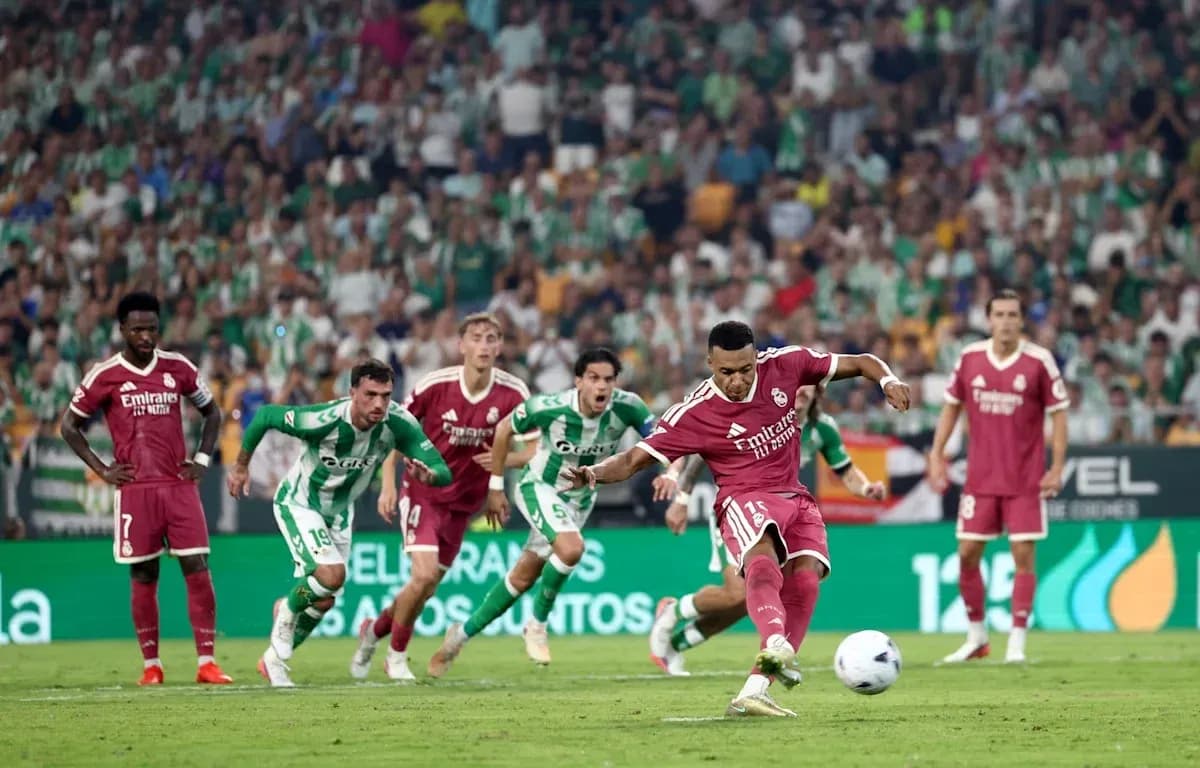
Deep into added time, Vinicius Jr. drove into the box and won a penalty. Up stepped Mbappe, season still unbeaten, Mourinho’s Madrid still unbroken. The script felt obvious.
Alvaro Valles tore it up. The Betis goalkeeper guessed right, saved cleanly, and chaos followed.
Replays showed Bartra inside the box before Mbappe made contact with the ball. Social media erupted. Madrid fans demanded a retake. Pundits split into familiar camps. How could that not be encroachment?
The answer, according to Spain’s refereeing committee, is that it was encroachment – but not enough.
What the rulebook actually says
Mundo Deportivo report that the CTA, Spain’s Technical Committee of Referees, has reviewed the incident and backed the on-field decision: no retake, no error.
Their reasoning leans on two pillars: IFAB’s Laws of the Game and the CTA’s own CARD manual.
Under IFAB regulations, a penalty must be retaken for defensive encroachment only if the encroaching player:
- Directly affects the penalty taker,
- Plays the ball,
- Or challenges an opponent.
There is also a clarification for players who are mid-air at the moment of the kick. If a player is off the ground, their position is judged by where their feet would be projected to land, but that only comes into play when the entire body is airborne. It’s a technical detail, but one that shows how specific these situations can get.
The CTA’s CARD manual mirrors IFAB’s stance. It states that a retake is required only when the defender’s encroachment has a direct impact: influencing the taker, going for the ball, or challenging an attacking player.
Encroachment alone is not enough. It has to matter.
Why Mbappe didn’t get a second chance
Apply those rules to the scene in Seville and the picture changes.
For Mbappe to receive a second shot, Bartra’s early step into the area needed to affect the penalty or the immediate aftermath. He would have had to interfere with Mbappe, contest the rebound, or challenge another Real Madrid player in that phase of play.
He did none of that.
Bartra did not touch the ball after Valles’ save. He did not block Mbappe. He did not prevent a Madrid player from attacking the rebound. His position looked ugly in freeze-frames, but by the letter of the law, it did not alter the outcome of the move.
That is the line the CTA have drawn. Controversial position, yes. Decisive impact, no.
So the penalty stood as taken, the save stood as decisive, and Mourinho’s first defeat as Real Madrid coach stayed on the books without the safety net of a retake.
The debate will rage on in Madrid, but the referees’ stance is clear: on this night, the law backed the whistle.