.svg&w=384&q=75 "GoalGist logo")
Real Madrid's Dilemma: Kylian Mbappe's Impact and Team Dynamics
As Real Madrid’s players file through the tunnel at the Bernabeu, they pass a line that has come to sound less like history and more like accusation.
“No player is as good as all of you together.”
Alfredo Di Stefano meant it as a hymn to collective greatness. Right now, it reads like a rebuke to a club that has spent two seasons chasing individual brilliance and ending up with empty hands.
The quote belongs to a man who defined Madrid’s first empire: five straight European Cups as their all‑purpose genius, two spells in the dugout, honorary president, an 88-year life welded to the white shirt. It now hangs above a squad being whistled by its own people, a president under fire, and a superstar forward who was supposed to be the final piece and has instead become the centre of a noisy argument.
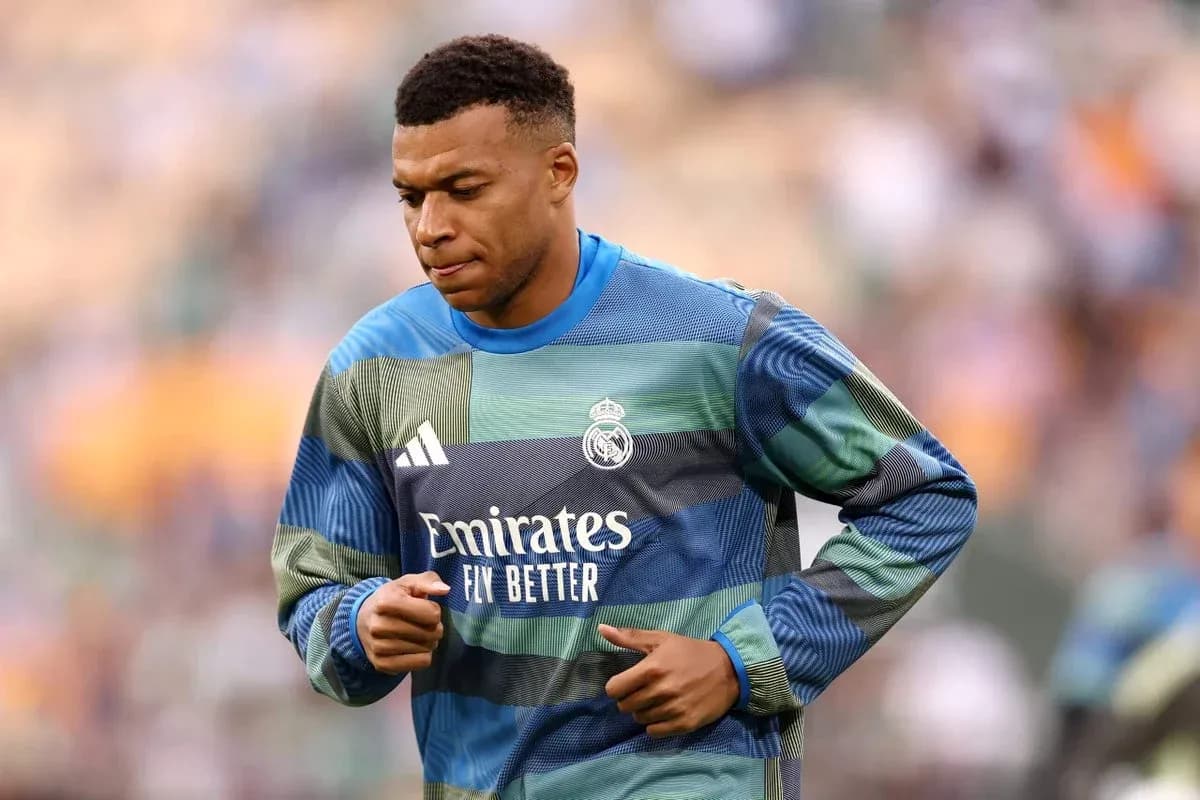
The galactico era never really ended at Madrid. It just changed faces. This time the poster boy is Kylian Mbappe.
Goals, numbers, and the uneasy truth
On paper, the case for Mbappe looks bulletproof.
Since walking through the door on a free transfer in June 2024 — with a signing fee that was anything but free — he has been Madrid’s ruthless finisher. Seventy-seven goals in La Liga and the Champions League. Golden Boot in 2024-25. Fifteen goals in this season’s Champions League alone, closing in on Cristiano Ronaldo’s record of 17 from 2013-14.
When Madrid fell to Bayern Munich in the Champions League quarter-finals last month, he was one of the few who matched the stage, scoring twice across the tie. The data backs up the eye test: he has scored almost double the goals of any team-mate, absorbed most of the team’s shooting opportunities and outperformed his expected goals by seven. He has not merely taken chances; he has bent probability.
That is usually the stuff of statues and marketing campaigns. At Madrid this spring, it has earned him boos.
In the first home game after the Bayern exit, Mbappe’s name came over the tannoy and the whistles cut through the night. Vinicius Junior and Jude Bellingham heard them too. So did Florentino Perez, the architect of the modern galactico project, sitting high in the stands as his own philosophy was jeered.
The noise has only grown. A training‑ground row with a member of Carlo Ancelotti’s staff before a trip to Real Betis on April 24 leaked out. A short break in Italy with his partner during injury recovery became another flashpoint. Madrid sources spoke of a worsening atmosphere; his camp pushed back, insisting criticism came from “over-interpretation” and that his recovery had been “strictly supervised by the club”.
The goals are real. So is the tension.
The case against: balance, chemistry, and a cold number
Inside Valdebebas, the doubts started before Mbappe had even signed his contract.
When his move from Paris Saint‑Germain was finally lining up two years ago, a member of Ancelotti’s staff pointed to one column in the data: off‑the‑ball work. The lack of defensive contribution was “remarkable”, they said. It was not a throwaway line. It was a warning.
The concern was simple: could Madrid carry Mbappe’s defensive profile and still keep the team’s balance, especially in a squad already built around Vinicius Jr, Bellingham and Rodrygo?
The numbers since then have been brutal.
Across La Liga and the Champions League, Mbappe posts the fewest tackles, interceptions and ball recoveries per 90 minutes of any Madrid player. Strip it back to “true” tackle attempts — tackles won, tackles lost and fouls committed, a measure of how often a player actually engages — and the picture gets even starker. In La Liga, among 461 outfield players, he ranks 461st. Around 0.6 attempts per game. Nobody does less.
There are exceptions, of course. Certain Clasicos. A Champions League tie here and there where he has chased, pressed, harried. But over the span of two seasons, he has been the player who runs least towards his own goal.
For a star forward, that is not automatically fatal. Many elite scorers are indulged. The problem in Madrid is what happens when you place that profile alongside other attackers who also need freedom and the ball.
The most delicate fault line lies on the left.
Mbappe and Vinicius Jr were sold as a terrifying partnership, a blur of pace and improvisation that would shred defences. In practice, they often step on each other’s toes. Touchmaps show both drifting to the same flank in build‑up, occupying similar lanes, demanding the same spaces. There have been flashes — quick one-twos, overlapping runs, a glimpse of what it could be — but nothing like the natural, almost telepathic connection Vinicius once shared with Rodrygo.
That overlap has triggered uncomfortable questions in the boardroom. Who decided that two dominant, left‑sided attackers were a long‑term solution? How much of the team’s structure can you bend around one man’s best zone? And at what cost?
The raw scoring numbers do not settle the argument. Madrid hit 87 league goals in 2023-24, when Bellingham often played as a false nine and Joselu operated as a late‑game target man. There was no single attacking reference point, no Mbappe, and yet the attack flowed. Last season, with Mbappe in place, they scored 78 in La Liga. This year they sit on 70 with three games left.
It is not a collapse. It is a subtle shift: more goals for one man, fewer for the collective. Di Stefano’s quote on the tunnel wall looms over that trade‑off.
Then comes the dressing room.
Mbappe arrived as a leader by reputation and salary. The highest‑paid player in the squad. The star Perez had chased over multiple windows, only to be rebuffed in 2022 in a saga that left scars among fans and some inside the club. At his presentation in July 2024, Perez praised the “great effort” Mbappe had made to join. Many supporters still wondered what effort that really was, given the financial package and the lack of a Champions League medal.
Leadership at Madrid is not just about interviews and highlight reels. It is about how you carry yourself when the season turns dark, when criticism bites and tempers flare. Those are the moments in which the club expected Mbappe to impose calm, to drag the group forward. Instead, they have watched training‑ground fights — Aurelien Tchouameni and Federico Valverde clashing last week — and a general sense of fracture.
The question grows louder in the press box and in the bars around the Bernabeu: has this pursuit, this long courtship and enormous investment, really been worth it?
The case for: a superstar built for the spotlight
Strip away the noise and Mbappe’s talent remains undeniable.
He is still one of the most devastating forwards in the world, still only 27, still with three years left on his contract. This summer’s World Cup could easily turn into another stage he owns with France, where he operates as the undisputed protagonist and often looks completely at ease with that burden.
His international record already carries the weight of history. World champion at 19 in 2018. A hat‑trick in the 2022 final, joining Geoff Hurst as the only man to score three in the biggest game of all, even if Lionel Messi’s Argentina ultimately walked away with the trophy.
When Xabi Alonso, during his time in charge, tilted the system more clearly towards Mbappe in the first half of this season — giving him primacy over Vinicius Jr — the Frenchman’s performances lifted. He looked relaxed, decisive, like the player Madrid thought they were signing.
There is room for growth. He can, and should, improve his defensive work. He can adjust his movement to mesh better with those around him. The question is whether Madrid are willing to give him the trust and tactical platform he craves, especially in a squad that has lost heavyweight voices such as Karim Benzema, Toni Kroos and Luka Modric in recent years.
In a quieter way, Mbappe has already shown elements of the leadership the club wants. He speaks well in interviews and in mixed zones, rarely ducking difficult topics. When Vinicius Jr accused Benfica’s Gianluca Prestianni of racist abuse in their Champions League play‑off first leg in February, Mbappe stepped forward with a forceful, articulate defence of his team‑mate. UEFA later handed Prestianni a six‑game ban for homophobic, not racist, conduct, but the episode underlined Mbappe’s willingness to stand publicly beside those in his dressing room.
Madrid have been here before with a superstar whose early years did not immediately translate into European domination.
Cristiano Ronaldo’s first two seasons in Spain yielded just a Copa del Rey. His first Champions League with Madrid did not arrive until 2014, five years after his signing, and the path there was littered with cryptic messages and emotional turbulence. In September 2012, after scoring twice against Granada, Ronaldo refused to celebrate and later said: “I’m sad and the people at the club know it.”
The club held their nerve. Ronaldo stayed, and what followed rewrote their modern history: four Champions League titles, a mountain of goals, and an exit in 2018 as Madrid’s all‑time top scorer.
The parallel is not perfect. Mbappe’s personality, role and context differ. But the lesson is clear enough for those in the president’s box: sometimes the wait, and the discomfort, are the price of backing a generational forward.
What comes next?
Madrid now stand at a crossroads of identity as much as personnel.
They can lean harder into Mbappe, hand him the keys, reshape the attack so that Vinicius Jr and others orbit his gravity. Or they can ask their superstar to bend more towards the collective, to embody Di Stefano’s line rather than challenge it.
What they cannot do, not for long, is live in this half‑light — a team that has its galactico, but not yet the harmony or the trophies that were supposed to follow.