.svg&w=384&q=75 "GoalGist logo")
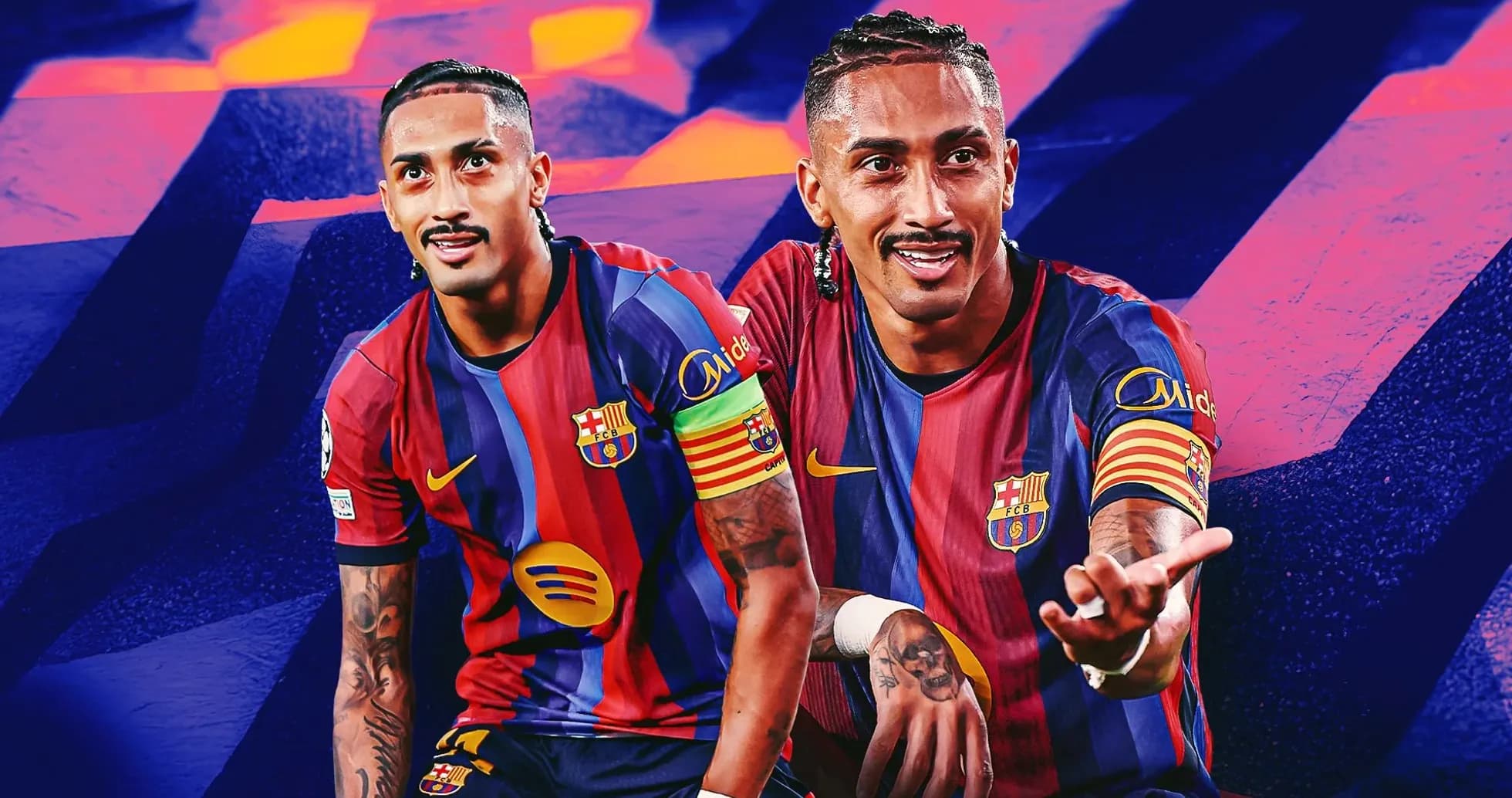
Raphinha’s Revenge Season: From Ballon d’Or Snub to Barcelona's New R9 Echo
Last season broke him. Hamstring after hamstring, 125 days out, a World Cup wrecked and his numbers slashed from a ridiculous 60 goal contributions to a modest 29. For a player who had roared into the Ballon d’Or conversation, the fall was brutal.
This year, he didn’t even make the 30-man shortlist. Hansi Flick could barely hide his anger.
“He is far too good not to be on that list, but we can’t change it,” the Barcelona coach snapped, speaking from a place of certainty rather than frustration. He had already seen what Raphinha had become in a new role: not a winger, not a support act, but the sharp, snarling centrepiece of his attack.
A new position, a new monster
Under Flick, Raphinha has drifted away from the touchline and into the chaos. No longer chained to the left wing, he now prowls centrally, floating between the lines, darting in and out of pockets, dragging defences to pieces.
The transformation exploded onto the European stage in Rotterdam.
In Barca’s Champions League opener against Feyenoord, Raphinha scored twice and played as if the entire competition belonged to him. His first goal was pure theatre. He collected a slightly wayward pass from Lamine Yamal, burned past one defender, glided into the box and shaped to shoot. Then came the twist: a cold-blooded dummy that sent two more defenders sprawling, opening a clear lane to pass the ball into the net with absurd calm.
His second was straight from the centre-forward manual. When Dani Olmo picked the ball up in the centre circle, Raphinha initially checked towards him, dragging his marker with him. Then he spun and burst away in the opposite direction, took Olmo’s threaded pass in stride and whipped a low finish across the helpless Feyenoord goalkeeper.
Barcelona ran out 5-1 winners. Raphinha walked off with the Player of the Match award and the aura of a man playing the game at a different speed to everyone else. Right now, he carries himself like the best player on the planet.
“Rapha has played fantastic,” Flick said. “He’s on another level – he’s unbelievable.”
The numbers don’t argue. Eleven goals already this season, a start no Barcelona player has matched in the last 60 years. Lionel Messi reached 10 in his first seven outings of 2012-13 and hit nine twice at the same stage in other seasons. Ronaldo hit nine in 1996-97. Raphinha has gone past them all.
Why this Barca attack suddenly purrs
Raphinha’s instant adaptation to the role has changed everything about Barca’s attack. Robert Lewandowski, with his back-to-goal mastery, gave them structure. Ferran Torres offered razor-sharp runs in behind. Raphinha gives them both, wrapped in chaos and velocity.
At 29, he roams freely, using explosive acceleration and tight control to yank defenders out of shape and stitch together moves. His movement opens corridors for Yamal on one flank and Anthony Gordon on the other, yet he’s also the first to punish any gap himself, always half a second ahead of the back line.
Racing Santander discovered that the hard way.
In a 7-2 La Liga demolition, Raphinha hit a hat-trick. Two came from the penalty spot. The one in between showcased his brain. Olmo again took on the role of architect. Raphinha drifted between Racing’s centre-backs, vanished from their eyeline, then sprang to life the moment the pass came. One touch to set, a half-volley guided into the corner. Simple on the eye, impossible to defend.
On the ball, he makes difficult things look routine. Off it, he is a menace. Barcelona’s press starts with him, a captain harrying centre-backs and goalkeepers, forcing rushed clearances and errors simply because he refuses to stop running.
This is the intensity Flick demands. It’s also why, deep down, the coach will not be losing sleep over the Alvarez deal that never happened. His frontline is humming without another marquee striker, and the club can now channel funds into other areas in the next transfer windows.
Walking in the shadow of R9
Barcelona know what a Brazilian phenomenon looks like. Romario, Rivaldo, Ronaldinho, Neymar – the lineage is rich. Yet one season still stands apart: Ronaldo’s volcanic year in 1996-97.
Ronaldo arrived from PSV for a then-world record $19.5 million at just 20 years old and promptly tore La Liga and Europe to shreds. Forty-seven goals in 49 games. Copa del Rey, UEFA Cup Winners’ Cup, Supercopa de España. Thirty-four league goals, the Pichichi Trophy, the European Golden Shoe, the 1997 Ballon d’Or. Defenders bounced off him or were left in the dust.
He dismantled SD Compostela with one of the greatest solo goals the club has ever seen. He dragged Barca back from the dead with a hat-trick in a 4-3 Copa del Rey comeback against Atletico Madrid. Every week, a new highlight reel.
“He is the most spectacular player I’ve ever seen,” Sir Bobby Robson said at the time. Laurent Blanc added: “I’ve never seen anyone with that velocity and power. He was like a freight train coming at you with a ball at his feet.”
Ronaldo – R9 to the world – was a fixed spearhead, a reference point. Raphinha is more fluid, more nomadic. Yet the resemblance in their ruthlessness is hard to ignore. Both are direct. Both slice through teams in seconds, feeding off space and panic.
If Raphinha keeps this level, his output could begin to echo that legendary season. The difference? He has the chance to turn it into a treble-defining campaign.
The captain who nearly walked away
This version of Raphinha almost never happened at Camp Nou.
His first two years in Barcelona were underwhelming. Under Xavi, he flickered rather than burned, fighting for a starting spot, never quite convincing as the long-term solution. By 2024, a parting of ways felt likely.
Then came Flick.
The German saw something others had only glimpsed. He handed Raphinha responsibility, not excuses. And when Marc-André ter Stegen left on loan to Ajax in the summer, Flick didn’t hesitate: he made Raphinha Barcelona’s new permanent captain.
The first Brazilian to wear the armband in Catalonia has embraced it. He leads by sprinting, tackling, demanding the ball when games tighten. He sets the standard for work rate and sacrifice, a visible reference point for the younger players who orbit around him.
Raphinha doesn’t see this as a finished story. After the Racing rout, he refused to indulge in self-congratulation.
“I will never say I am performing well; I always strive to improve everything I can,” he said. “I am happy with the goals, and with the win, and that is the most important thing, but we have to keep improving.”
He insisted he feels “comfortable” through the middle and credited Flick for reshaping his game and mindset. “He is the coach who changed the way I think and how I see myself. I am extremely grateful.”
Depth, variety and the plan to protect a star
Raphinha is the beating heart of this attack, but he’s not alone in making it sing.
Flick’s Barca, even after losing Lewandowski and Torres and sending Marcus Rashford back to Manchester United, are more fluid and unpredictable than before. Gordon, Karim Adeyemi and Gabriel Jesus have slotted in quickly. Behind them, 18-year-old Hamza Abdelkarim has stepped up from Barca B, adding another intriguing option up front.
“Raphinha, Gabby and Hamza are three different profiles, but there are other ways we could play,” Flick said. “Anthony and Karim can also play in this position (as striker). Or Dani Olmo. Dani has showed us in last two years he can play there – the same with Fermin [Lopez]. We have a lot of options.”
Those options matter. So do the substitutions. Flick has already shown he won’t run his captain into the ground. Raphinha was withdrawn early against Feyenoord and in league wins over Athletic Club and Racing, the coach acutely aware of the hamstring history that derailed last season and the World Cup.
The same caution applies to Yamal. Playing closer to Raphinha, the teenager looks even more dangerous. Their understanding is instinctive. The moment a centre-back shifts his body to track Yamal, the youngster slides a pass into the channel, trusting that Raphinha is already sprinting into the blind side.
Yamal doesn’t seem bothered about the spotlight tilting towards the captain. Inside the dressing room, star power hasn’t morphed into ego. The collective edge is sharp, the hierarchy clear.
Towards the Hall of Fame?
Raphinha embodies that collective spirit more than anyone. Captain, pressing trigger, primary scorer, connective tissue between the lines. He has turned a Ballon d’Or snub into fuel and a positional switch into a personal revolution.
Barcelona’s Hall of Fame already has a Brazilian corner: Romario, Rivaldo, Ronaldinho, Neymar, Ronaldo. One season of savage brilliance once set the standard there.
If Raphinha keeps striding through this campaign with the same ferocity, the question won’t be whether he belongs alongside R9.
It will be whether he can lead Barca to a season that even Ronaldo’s might struggle to overshadow.