.svg&w=384&q=75 "GoalGist logo")
Raphinha Faces Tough Competition at Barcelona
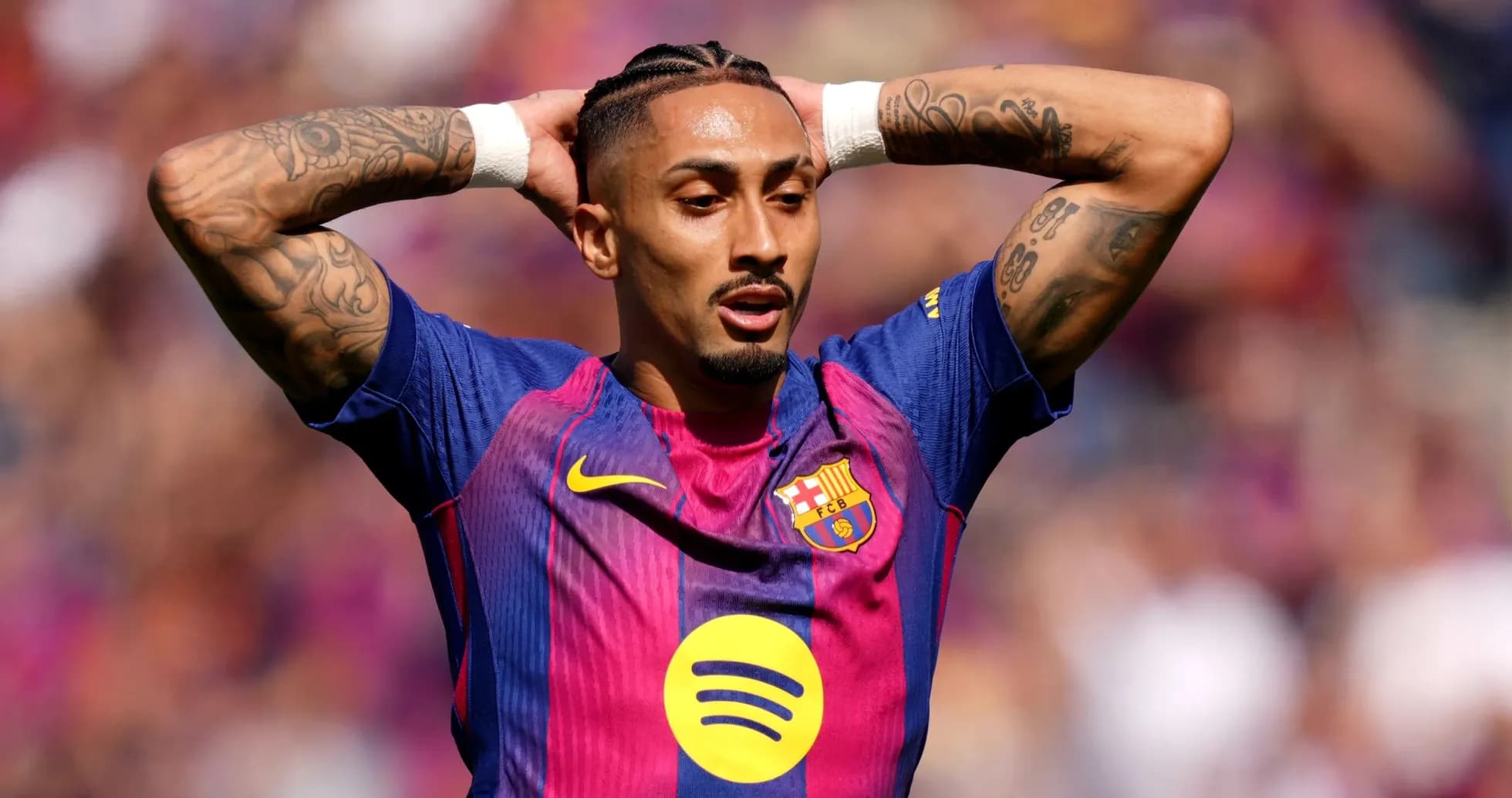
Raphinha still has one powerful ally at Barcelona. Hansi Flick has never lost faith in him.
The new coach trusts the Brazilian, trusts his talent, and trusts the idea that, if the body holds, the player who once terrorised full-backs in LaLiga can return. But trust alone does not clear a crowded left flank, and at Barça right now that position has become one of the most fiercely contested areas of the pitch.
Flick’s faith vs. the treatment room
Injury has stalked Raphinha for too long. The hamstring in his right thigh has turned into an old enemy, flaring up, easing off, then coming back again. Each recurrence has chipped away at rhythm, confidence, explosiveness. The most alarming sign came not in club colours, but with Brazil at the World Cup, when he again felt physical discomfort.
Barcelona’s medical and technical staff know the story cannot repeat itself. The plan is clear: rebuild the best physical version of Raphinha, restore his acceleration, his change of pace, his intensity in duels. Only then, they believe, will the footballer everyone remembers truly reappear.
At the same time, the club have acted as if that recovery might not arrive on schedule.
Gordon, the statement signing
Anthony Gordon is the clearest proof. The Englishman does not just overlap with Raphinha’s role; he mirrors his profile and challenges him directly for the left wing.
The numbers around the transfer speak as loudly as any press conference. A fee of 70 million euros, with another 10 million in potential add-ons, is a serious financial swing for a club still wrestling with its accounts. Barcelona do not spend that kind of money on a luxury reserve. They spend it on a player they expect to see in the starting XI.
Gordon can cover several attacking roles, centre-forward included, and his versatility will matter over a long season. Yet Flick’s insistence on signing a pure No. 9 tells its own tale. If a specialist striker is still on the shopping list, then Gordon’s primary home is clearly drawn: the left touchline, the same territory Raphinha usually patrols.
The message is blunt. That wing now comes with a queue.
Youth knocking on the same door
Behind them, another name is already pushing into the conversation. Jesse Bissiwo, just 18 and Belgian, has been earmarked as a project for the future, but the club do not intend to hide him away.
He will be treated as a first-team player from the outset, even if his squad number belongs to the reserves. Train with the seniors, live at their tempo, learn their standards. And if he proves he belongs, he immediately becomes one more option on that left flank, another rival for both Raphinha and Gordon.
This is how big clubs refresh themselves: not with sentiment, but with pressure.
Adeyemi, the flexible threat
Then there is Karim Adeyemi, the wildcard in Flick’s attacking puzzle. The German prefers the right, where he can cut inside onto his stronger foot, but he is no stranger to the opposite side.
At Borussia Dortmund he played 43 of his 146 matches on the left wing, a substantial chunk of his minutes and a clear sign of his comfort in that role. Flick knows he can flip Adeyemi across the front line without losing structure, which only tightens the squeeze on anyone who thought the left wing might be reserved for them alone.
A battle with no guarantees
Put all of that together and the picture is stark. Raphinha enjoys the full confidence of his coach, but he now operates in one of the most unforgiving ecosystems at the club. Gordon’s price tag, Bissiwo’s emergence, Adeyemi’s flexibility, and the hunt for a central striker all converge on the same strip of grass.
For Barcelona, this is exactly the kind of internal competition they have been trying to build. For Raphinha, it is something else entirely: a fight to prove that once his body finally stops betraying him, there is still nobody better than him to own that left wing.