.svg&w=384&q=75 "GoalGist logo")
Qarabag vs CSKA Sofia: Tactical Insights from a Goalless Draw
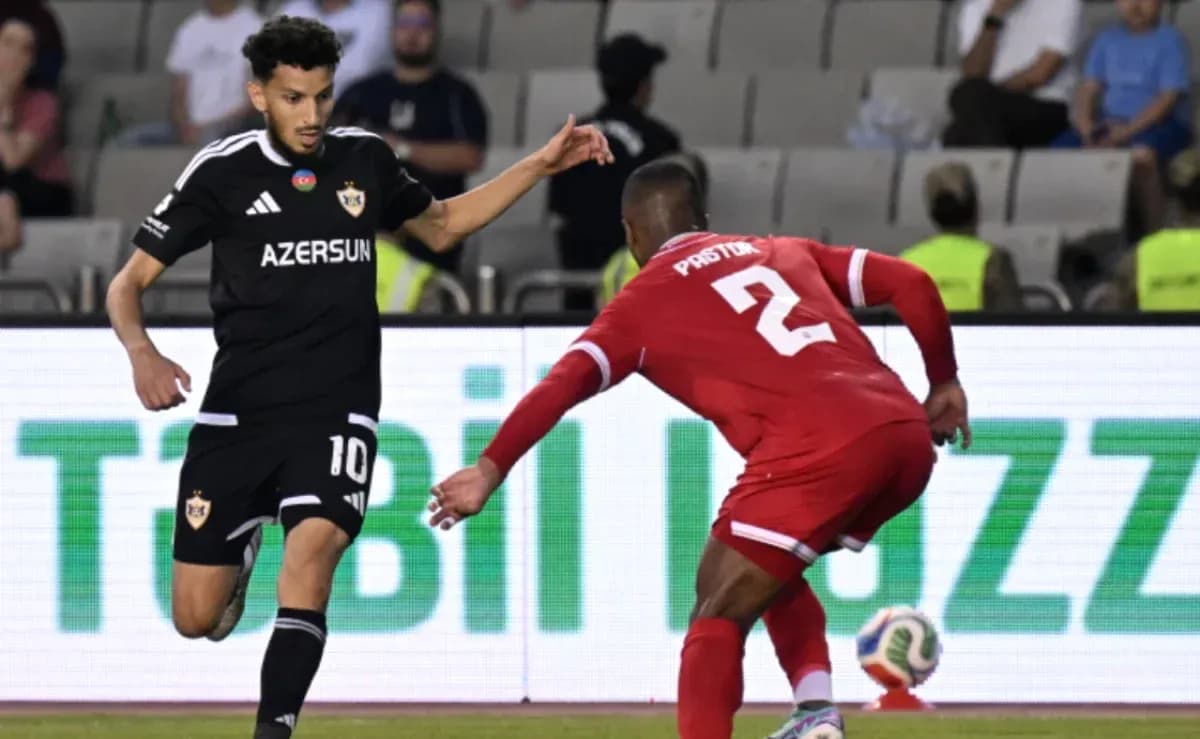
Qarabag and CSKA Sofia produced a goalless but tactically dense first leg at Azərsun Arena, a match defined by structure, risk management and small territorial swings rather than chaos in either box. With the UEFA Europa League 2nd Qualifying Round context clearly in mind, both coaches set up to protect the tie as much as to win it, and the 0-0 reflected that balance.
Qarabag's Tactics
Qurban Qurbanov’s Qarabag lined up in a 4-2-3-1 that behaved like a classic positional-possession side. The double pivot of Pedro Bicalho and M. Janković gave the hosts central circulation and rest defence: one pivot (often Bicalho) dropped closer to the centre-backs to initiate build-up, while Janković stepped slightly higher to connect with the three attacking midfielders. With 48% possession and 12 total shots (5 on goal), Qarabag did not dominate the ball, but they used it more aggressively than CSKA, trying to progress through the half-spaces via Kady Borges and O. Kashchuk and then isolate Z. Sawo as a reference up front.
The full-backs were key to Qarabag’s territorial play. Matheus Silva and B. Langa started as a conventional back four but pushed on in settled possession to pin CSKA’s wide midfielders, allowing A. Zoubir and Kashchuk to drift inside. That created a 2-3-2-3 structure in many phases, with B. Huseynov and B. Varkonyi holding a high line. The eight corner kicks Qarabag earned underline how often they managed to force play into the final third, even if CSKA’s compact box defending limited the quality of chances.
CSKA Sofia's Response
CSKA Sofia, under Hristo Yanev, answered with a 4-4-2 that was clearly designed for control without the ball and vertical threat when they recovered it. Their 52% possession is deceptive: much of it came from calmer circulation in deeper zones rather than sustained pressure in Qarabag’s half. The double axis of J. Gbamin and B. Jordao in central areas gave CSKA a strong defensive spine. Gbamin, listed as a defender but operating as a holding presence in the line of four, frequently dropped between or alongside the centre-backs F. Rodríguez and T. Ivanov to form a situational back five in the defensive phase, while Jordao shuffled laterally to close Qarabag’s No. 10 space around Kady Borges.
Out wide, M. Ebong and S. Sensi were disciplined in their starting positions, often forming a narrow midfield four to deny Qarabag’s interior passing lanes and funnel play toward the flanks. That helped CSKA limit Qarabag to 5 shots on goal despite conceding more total attempts. Up front, the pairing of L. Godoy and I. Pittas alternated pressing triggers: one would jump to the ball-carrying centre-back while the other screened the pivot, but CSKA rarely committed more than those two plus one wide midfielder to the press. The priority was clearly to keep the block intact rather than chase high turnovers.
Match Control
The card pattern reflects a controlled, rather than overly physical, contest: CSKA picked up two yellow cards, Qarabag one. Both sides were cautious in their duels, aware that disciplinary damage in a two-legged tie can be as costly as a conceded goal.
Substitutions were used to adjust energy and maintain the tactical framework rather than to radically alter shape. On 56', Qarabag refreshed their structure without changing the base 4-2-3-1: M. Janković (OUT) made way for R. Cephas (IN), and B. Langa (OUT) for E. Cafarquliyev (IN). Cephas’ introduction pushed Qarabag into a more direct and dynamic attacking posture, with extra vertical runs from deeper zones, while Cafarquliyev’s fresh legs on the flank maintained the width and overlapping threat. At 74', O. Kashchuk (OUT) was replaced by J. Mouaddib (IN), and B. Huseynov (OUT) by C. Makreckis (IN), again more about energy and minor role tweaks than systemic change; Qarabag kept their front four structure but with different profiles between the lines.
On CSKA’s side, the 73' double change — L. Godoy (OUT) for J. Zwarts (IN) and M. Ebong (OUT) for I. Solet (IN) — subtly rebalanced the front line and right side. Zwarts offered more running in behind against a Qarabag defence that was pushing higher in search of a breakthrough, while Solet brought fresh legs and ball-carrying from midfield to help CSKA escape pressure. Later, A. Martino (OUT) for T. Ouorou (IN) at 84' and, deep into added time, Pastor (OUT) for M. Brahimi (IN) and S. Sensi (OUT) for P. Panayotov (IN) at 90+1' were about preserving defensive stability and seeing out the 0-0 with no structural gamble.
Statistical Overview
Statistically, the match was almost perfectly balanced. Qarabag’s 12 shots to CSKA’s 11, with a 5–4 edge in shots on goal, mirror the slight attacking initiative of the hosts. Yet CSKA’s superior possession share (52%) and their ability to keep blocked shots at zero on both sides point to a game where penalty-area defending was clean and well-timed. Qarabag’s eight corners to CSKA’s two indicate that Qurbanov’s side did a better job of pinning the Bulgarians back in spells, but Yanev’s low-to-mid block was rarely disorganised.
With neither side conceding a red card and both keeping the foul profile low enough that free kicks did not become a major attacking platform, the tie remains finely poised. Qarabag can take encouragement from their territorial pressure and shot volume, while CSKA will be satisfied with having neutralised that pressure away from home, managed transitions prudently, and carried enough possession to avoid a siege. From a tactical standpoint, this first leg was about information gathering and preserving structural integrity; the second leg is likely to see bolder adjustments from both benches as the margin for caution shrinks.