.svg&w=384&q=75 "GoalGist logo")
PFA Chief Warns of Player Burnout Ahead of World Cup
Maheta Molango leans forward when he talks about it. Not TV deals, not prize money. Bodies.
The Professional Footballers’ Association chief executive has spent the past two years touring dressing rooms warning players that the calendar was breaking them. This summer, with a swollen World Cup looming at the end of another marathon campaign, he believes the sport is about to find out what happens when the game ignores its main characters.
“The World Cup should be the culmination of a dream,” he says. “But the reality is that it will be the survival of the fittest. It’s not right.”
Survival, not spectacle
This is supposed to be football’s grand stage. Instead, Molango sees a tournament that will reward whoever is still standing.
“Now you see games which are not won by the best team, they are won by the fittest,” he argues. “The players are superheroes. They are also very well paid. But that does not mean they should be pushed to the limit from a human perspective.”
The numbers back him up. According to Opta, 19 Premier League players who have already gone past 4,000 minutes in all competitions this season are heading into the World Cup. Across Europe’s top five leagues, 11 of the 20 most-used players belong to English clubs.
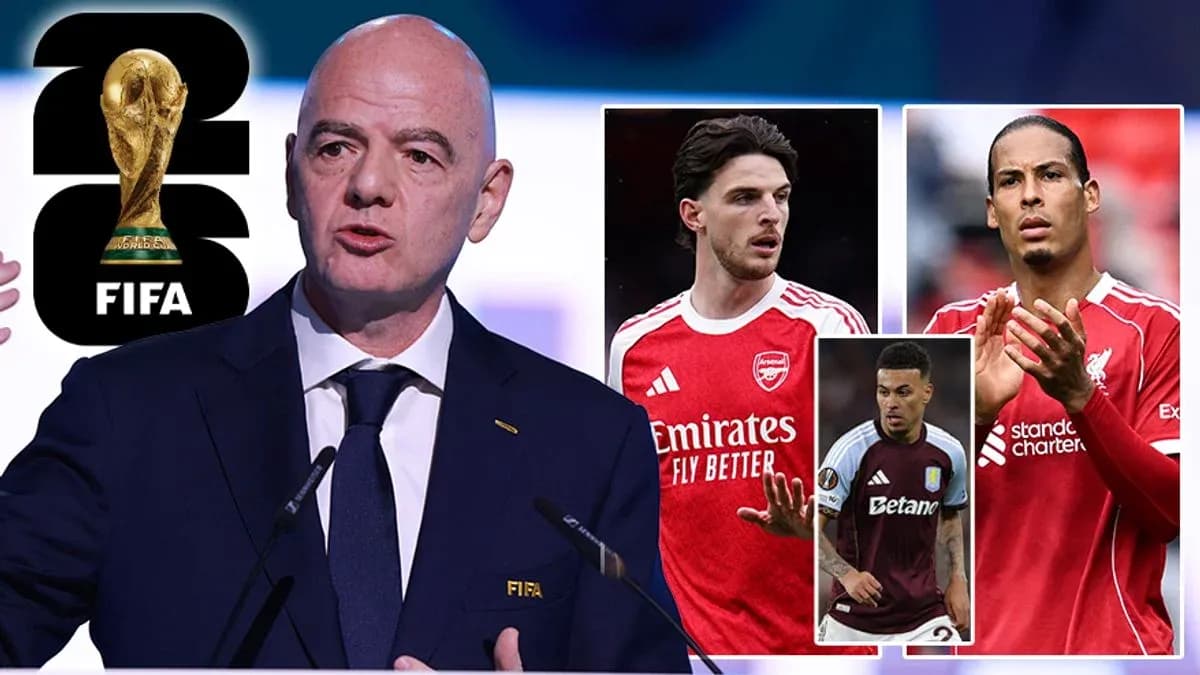
Liverpool’s Virgil van Dijk tops the entire continent with 4,761 minutes. His team-mate Dominik Szoboszlai sits fourth on 4,556. Aston Villa’s Morgan Rogers is the most-used Englishman in Europe’s elite, 11th on the list with 4,382 minutes in his legs.
Newcastle, Crystal Palace, Arsenal and Nottingham Forest all have players high on the workload charts, a direct consequence of European runs combined with regular international duty. The modern elite footballer no longer has a season. He has a loop.
Last year’s Fifpro report on player workload, which modelled the 2024-25 season including the expanded Club World Cup, called out “unprecedentedly long and congested seasons” and pushed for minimum four-week close-season breaks and winter shutdowns. The calendar has gone the other way.
‘They think you can just bully your way through’
Molango’s language is pointed. He believes the game’s decision-makers have treated players as an endlessly renewable resource.
“There is a real risk to the player,” he says. “And for those who don’t care about that, there’s a real risk to the product because people will pay thousands of pounds to watch people ‘walking’ at best.”
He talks openly about self‑regulation, about players simply refusing to take part in games they deem unnecessary.
“Maybe the players need to self regulate. That friendly you have organised, I’m not going to play it. The authorities have decided to encroach, we live in a world of bullies and they think you can just bully your way through.
“But unfortunately, people don’t seem to realise they are dealing with human beings and those human beings are not as stupid as maybe they think they are. They understand the power of the collective. They are not dumb. They are smart and switched on.”
He has already seen the mood change. In September 2024, Manchester City midfielder Rodri warned that players were “close” to strike action after his own 63-game season. Later that month he ruptured his ACL.
FIFA and UEFA have pressed ahead regardless, expanding the World Cup, inflating the Club World Cup, reshaping the Champions League and adding the Conference League. At home, English football has scrapped FA Cup replays but clung to the League Cup. The squeeze remains.
One conversation sticks in Molango’s mind. A player told him: “I don’t drink, I don’t go out, I could not do more to be fit but I’m injured.” The same player then admitted: “You were right. When you came to see us two years ago about the calendar, we listened, but… you were right.”
“There was one occasion this year in this country where they said to me: ‘Should we think about doing something?’” Molango recalls. “The reality is that we never really put the focus on domestic competition because it’s the bread and butter of our players. Most of their income comes from the domestic competitions. We have always danced to the tune of others.
“But let me tell you, this is a generation of players who are so smart, so switched on, so committed and they see the bigger picture.”
La Liga lesson: no players, no game
To prove his point, Molango reaches for an example from Spain. La Liga, he says, found out the hard way what happens when players decide they have had enough.
“They wanted to play a game in Miami. They did their usual and just decided to crack on. The players just said we are not going. In the end, the game was cancelled.
If there’s one league with strong leadership, it’s La Liga. There was no game because the players realised they are the product. You can sell tickets but we are not going.
“That should have been a wake-up for football. If the players are not there, there is no game. They need to understand what the players think.”
Molango is convinced that same realisation is spreading through English dressing rooms. Captains are calling him, he says, including some who are not even regular starters. They want to talk about workload, about legacy, about what the sport will look like when they are gone.
Heat, hard pitches and dizzy players
The calendar is not the only concern. Conditions are becoming extreme too.
Molango attended the Premier League’s Summer Series in the United States and spoke to players who took part in last year’s Club World Cup. Chelsea’s Enzo Fernandez described the heat there as “incredible” and “dangerous”, admitting it left him feeling “really dizzy”.
“The temperatures, climate and lunchtime kick-offs were a huge concern,” Molango says. He credits FIFA for at least listening over kick-off times and venues, but insists “concerns are still there ahead of this summer.”
His own experience in the US was sobering.
“I went to the Premier League summer series. I went to a game in Philadelphia at 3pm and with the temperatures, I couldn’t breathe. The games were back to back and the difference between the early and the later games were like night and day.
“I’ve spoken to players directly who said to me they couldn’t breathe. The grass is so dry because they are American Football pitches. You go to Atlanta and the pitch is so dry. They are not playing NFL.”
The image is stark: exhausted players, blistering heat, rock‑hard surfaces, a global audience expecting intensity.
Millionaires and the pyramid
The PFA occupies an unusual space in the labour movement. It represents multi-millionaire superstars and League Two journeymen under the same umbrella. Molango sees that as its greatest strength.
“You need to remember that most of them come from the football pyramid,” he says. “Even the national team. Harry Kane has played for Leyton Orient. I don’t need to explain to him what it means. I don’t need to explain it to Kyle Walker. Declan Rice was rejected from an academy.
“They get it. Jude Bellingham played in the Championship with Birmingham City. I don’t need to tell him what it means. They get it. It’s not just a fight for them because it’s also a fight for whatever comes next.”
He loves a phrase borrowed from the Lionesses: “We want to leave the shirt in a better place.” He namechecks Kim Little, Leah Williamson, players who have spoken repeatedly about legacy and responsibility.
“It’s not just about themselves. They want to leave a legacy and to leave the shirt in a better place. That was not necessarily the case 20 years ago.
“I’ve got captains calling me and some are not even in the starting XI but they call me because they care. Both on the men’s and women’s side.
“What is for sure, the PFA is here for the right reasons. People will not just bully through when they want. Luckily, we live in a country with laws and that will always be the last resort. The days of thinking the players are the weakest link are over. They are the strongest link.”
Declan Rice and the 70‑game season no one will mention
If you want a symbol of the current strain, Molango says, look at Declan Rice.
The Arsenal midfielder, 27, is driving his club’s push for trophies while anchoring England’s midfield. He has already racked up 4,246 minutes in all competitions this season, the 10th-highest workload among Premier League players and the second-highest Englishman behind Villa’s Rogers. By the time the World Cup kicks off, he could be staring at a 70-game season for club and country.
Molango is blunt: no one will care.
“Who will have sympathy for Declan Rice? Everyone forgets the 68 games. If he’s lucky then he could get to 68 games even before the World Cup. Who remembers that? No-one. They will be busy saying: We need to win the World Cup.”
This, he insists, is the heart of the problem. The sport has built an industry that talks about everything except the actual football being played.
“We need to put the game back into the centre of the industry. This is like Apple having a board meeting and talking about everything about the next iPhone. There’s no point in talking about the shop or the sales person but it’s pointless if the next iPhone is bad.
“When we go to meetings in football, it’s the same. We talk about everything but the players. We talk about everything apart from what happens on the pitch. We need to get football back at the centre of the game.”
The PFA’s demands are clear: a cap on the number of games, a fixed summer break, strict rules on back-to-back seasons. The data, Molango says, is already there.
“The data says a maximum of 50 to 60 games a year. It’s a maximum of 45 back-to-back. A minimum of one month’s rest each summer. But they say, ‘Sorry, but the calendar is locked until 2030.’ But when it comes to adding games, it’s no problem. But when it comes to reducing games, it’s locked.
“It doesn’t work like this. They want it all. The people in the stadium. The broadcast and TV rights. The authorities are massively underestimating the way players have evolved over the years.”
The players have heard the warnings. They have felt the fatigue, the dizzy spells, the late-season muscle tears. Some have already asked the question: “Should we think about doing something?”
If this World Cup really does become “survival of the fittest”, the next question may be far sharper: how long will the fittest agree to keep playing?

