.svg&w=384&q=75 "GoalGist logo")
PAOK vs Anderlecht Tactical Analysis: A 0-1 Outcome
PAOK’s 4-2-3-1 at Toumba Stadium was built to dominate the ball and territory, and the numbers confirm that plan: 65% possession, 5 corners to 1, and a 14-shot volume (3 on goal, 11 off) against an Anderlecht side that accepted a deep, resilient 4-3-3 block. Yet the match was defined by Anderlecht’s explosive start and subsequent defensive control rather than PAOK’s territorial supremacy.
The early goal at 1' from M. Cvetkovic, assisted by E. Llansana, immediately flipped the tactical script. Anderlecht’s 4-3-3, with M. Cvetkovic and D. Sikan leading the line and J. Onia Seke initially wide, became a compact, vertically disciplined unit after going ahead. The front three’s pressing intensity dropped in height but sharpened in timing: they focused on screening passes into PAOK’s double pivot of B. Santamaria and C. Zafeiris rather than hunting the centre-backs. Llansana, positioned as a right-sided central midfielder in the trio with L. Ambros and M. Kana, was pivotal—first in transition for the opener, then as a stabiliser, covering half-spaces and protecting the channels in front of L. Petrot and G. Biancone.
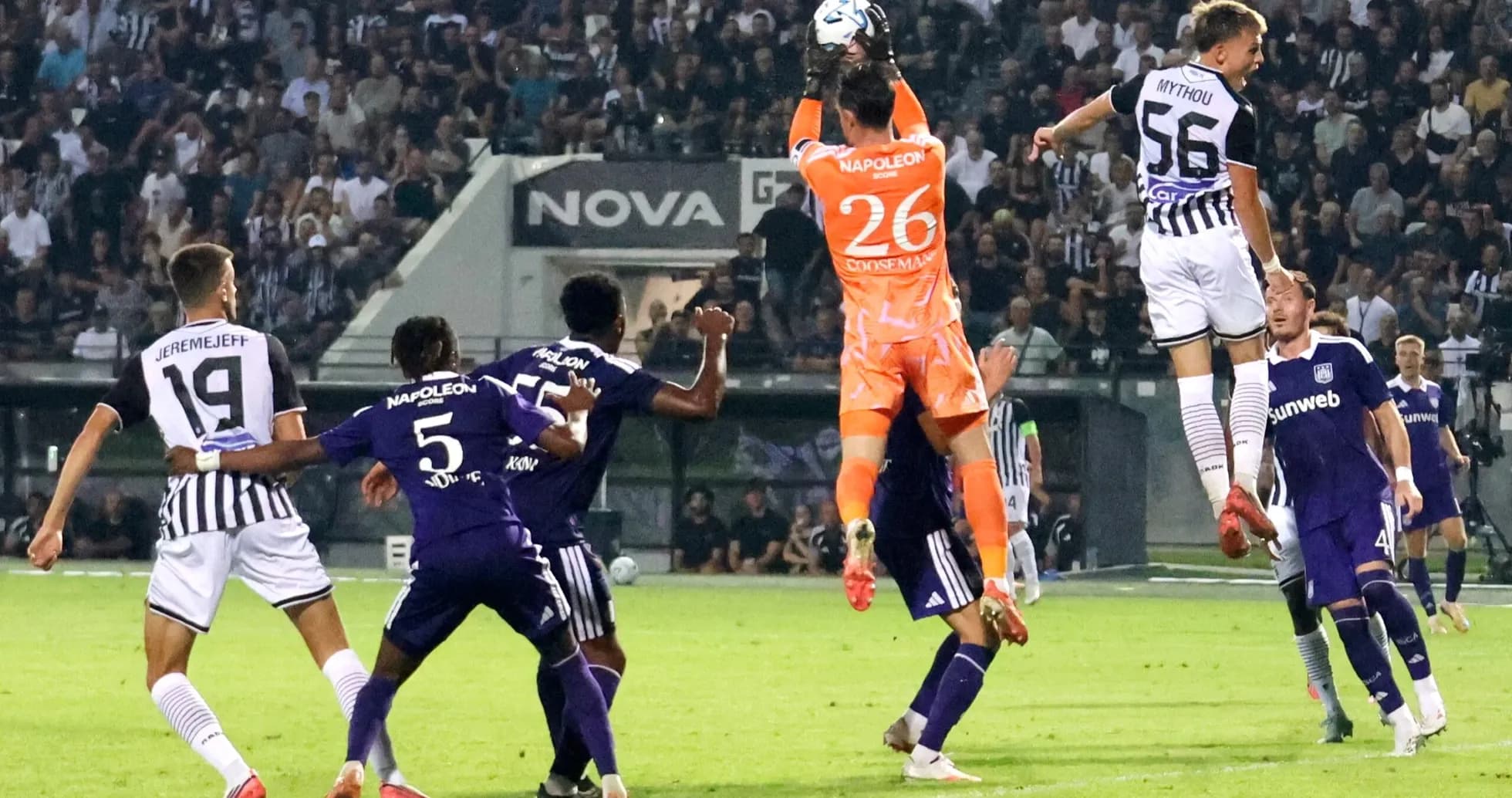
PAOK’s 4-2-3-1 relied on G. Konstantelias as the central creative hub, with A. Zivkovic and Taison starting wide and A. Mythou as the lone striker. With 65% of the ball, PAOK were able to pin Anderlecht back, but their shot profile betrayed structural issues: 3 shots on goal from 14 attempts, plus 3 blocked, suggests a lot of low-quality, forced efforts against a well-organised block. The full-backs J. Kenny and Jogo provided width, but Anderlecht’s back four—M. N’Diaye and A. Maamar outside, Petrot and Biancone inside—held a narrow, compact shape, forcing PAOK to shoot from suboptimal angles or from distance.
Key Inflection Point
The key inflection point for PAOK came around the break. Pantelis Hatzidiakos’ yellow card at 38' was followed by his substitution at 46', with A. Elustondo (IN) coming on. This was both a disciplinary and tactical adjustment: Lisci sought fresher legs and perhaps more secure distribution from the back to help progress play under Anderlecht’s intermittent pressure. However, the pattern of the match remained similar—PAOK circulating in front of Anderlecht’s lines, struggling to access Mythou between centre-backs and full-backs.
Anderlecht’s Defensive Strategy
Anderlecht’s substitutions were clearly geared towards maintaining defensive energy and protecting the lead. At 57', O. Antman (IN) came on for J. Onia Seke (OUT), refreshing the wide defensive work and adding ball-carrying threat on counters. The 71' double change—N. Saliba (IN) for L. Ambros (OUT) and T. Degreef (IN) for M. Cvetkovic (OUT)—signalled a shift towards even more control and risk management. Removing the goalscorer Cvetkovic reduced Anderlecht’s direct threat in behind but added fresh legs and defensive work rate higher up the pitch, helping to disrupt PAOK’s build-up earlier.
On PAOK’s side, the 63' double substitution—A. Baba (IN) for Jogo (OUT) and G. Taylor (IN) for B. Santamaria (OUT)—reshaped the left flank and the midfield dynamics. Baba provided more aggressive overlapping from left-back, seeking to overload Anderlecht’s right side, while Taylor’s introduction in midfield aimed to add vertical passing and late runs. Later, at 71', A. Jeremejeff (IN) replaced Taison (OUT), shifting PAOK towards a more direct, penalty-box-oriented approach with a more classic centre-forward profile. Yet despite these changes and the territorial pressure, the final ball remained inconsistent, and Anderlecht’s central block, anchored by Kana and Llansana, repeatedly repelled crosses and cutbacks.
Foul Count and Tactical Execution
The foul count—23 for Anderlecht versus 15 for PAOK—underlines the visitors’ readiness to break rhythm and accept stoppages to manage PAOK’s momentum. Three yellow cards for Anderlecht (Moussa Ndiaye at 56', Enric Llansana at 58', and Danylo Sikan at 90+1') reflect a strategy that bordered on the edge of permissible aggression but effectively disrupted PAOK’s attempts to accelerate play through the middle and half-spaces. PAOK’s two yellows, to Pantelis Hatzidiakos at 38' and Aritz Elustondo at 86', were more isolated, but Elustondo’s late booking also highlighted the risks taken as PAOK pushed higher and left more space to defend in transition.
From a structural standpoint, Anderlecht’s 4-3-3 functioned almost as a 4-5-1 without the ball after the early lead, with wide forwards dropping to form a second line and Kana often sliding into the back line to deal with crosses. Their willingness to concede possession (35%) and corners (1 versus 5) was compensated by compactness and timing in duels. PAOK’s dominance of the ball did not translate into clear chances, and the lack of recorded goalkeeper saves for either side reinforces the impression of a game of territorial control and blocked lanes rather than one of repeated clear one-on-ones or high-danger finishes.
In the end, the tactical story is of a home side that controlled tempo and territory but could not convert structural dominance into efficient final-third actions, against an away side that struck early, then executed a disciplined, foul-heavy defensive plan. In a UEFA Europa League 3rd Qualifying Round context, Anderlecht’s ability to manage a 0-1 scoreline away with limited attacking output but strong structural cohesion gives them a significant strategic edge heading into the return leg, while PAOK must find ways to turn possession and crossing volume into higher-quality shots and more central penetration.