.svg&w=384&q=75 "GoalGist logo")
Olympiakos vs NEC Nijmegen: Tactical Analysis of a Goalless UEFA Clash
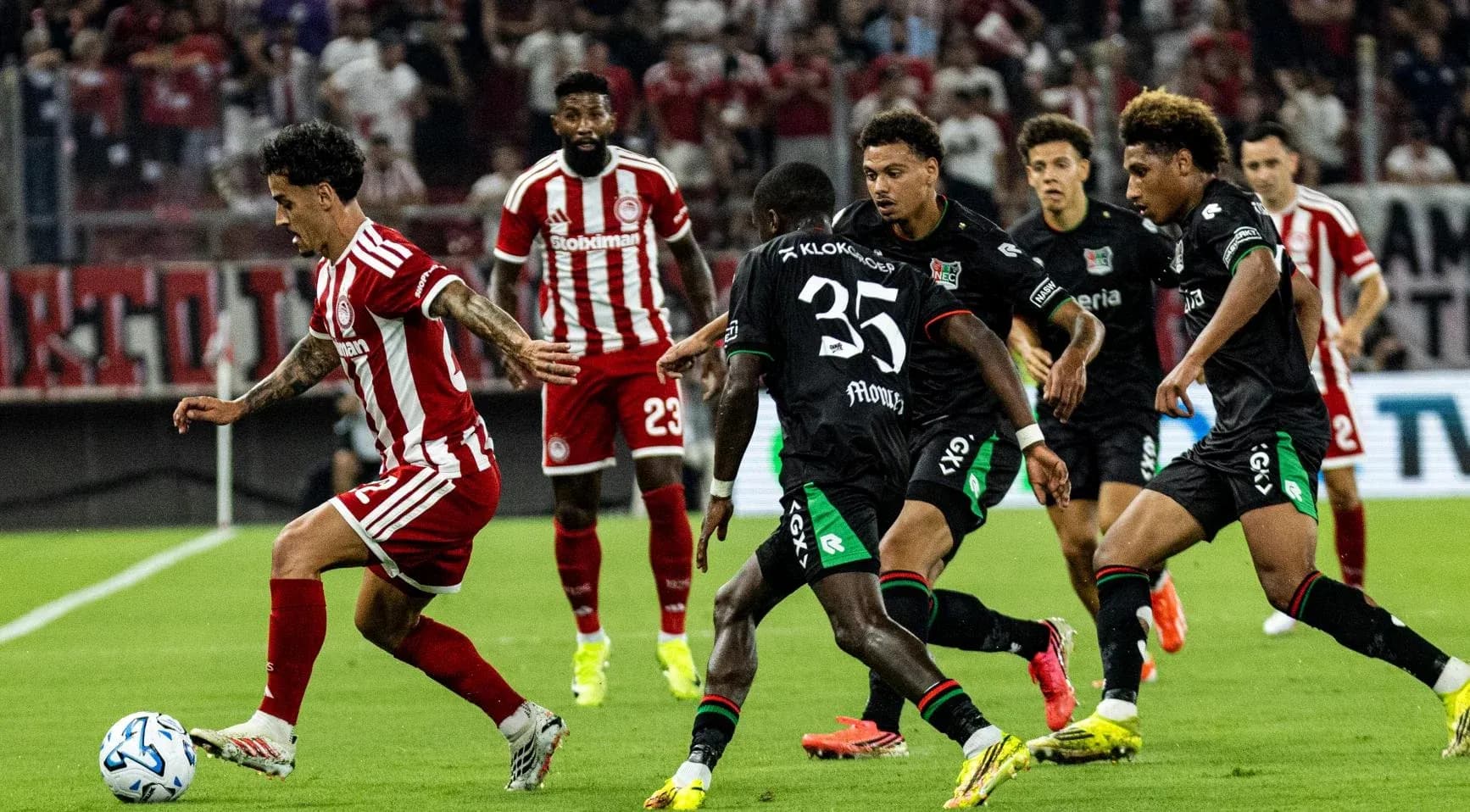
Olympiakos Piraeus and NEC Nijmegen produced a goalless but tactically rich first leg at Georgios Karaiskakis Stadium, with both sides leaning heavily into their structural identities. Olympiakos, in a 4-2-3-1 under Luis Mendilibar Jose, sought territorial control and wing progression, while NEC’s 3-4-2-1 under Dick Schreuder prioritised compactness, back-three stability and quick forward links. The 0-0 in the 3rd Qualifying Round of the UEFA Champions League reflects a match where defensive organisation and goalkeeper reliability outweighed attacking efficiency.
Olympiakos’ approach was built around controlled possession and a clear positional framework. Their 54% of the ball, 394 total passes and a medium accuracy of 67% show a side willing to circulate but not always precise enough to unpick NEC’s block. The double pivot of Dani García and C. Mouzakitis provided the structural base: García as the deeper organiser and screen, Mouzakitis offering shorter links into the advanced trio of Rodinei, Chiquinho and J. Roca behind A. El Kaabi.
The early yellow card for David Carmo on 11' for “Foul” framed Olympiakos’ defensive risk profile: an aggressive high line with centre-backs stepping into duels. That card, plus 11 fouls overall, underlined a readiness to defend forward, but it also made Carmo’s management of depth crucial until his withdrawal on 56', when L. Pirola (IN) came on and the left side of the defence became more conservative in stepping out.
In possession, the full-backs were key. B. Onyemaechi and M. Saliakas initially provided width, with Rodinei drifting inside from the right half-space and Chiquinho operating as the primary between-the-lines connector. The 5 shots on goal from 12 total shots, plus 5 efforts inside the box, suggest Olympiakos managed to reach good zones but were often shooting under pressure, reflected in NEC’s 4 blocked shots at the other end and their own 4 blocks to NEC’s 13 attempts.
NEC’s 3-4-2-1 was primarily about vertical compactness and denial of central spaces. The back three of T. Storm, P. Sandler and D. Fonville, shielded by the double pivot of D. Nejasmic and J. Monteiro, formed a narrow block that forced Olympiakos wide. The wing-backs S. Ouaissa and C. Bischoff balanced the need to press Olympiakos’ full-backs with the responsibility of tracking the wide attacking midfielders. NEC conceded 54% possession but limited Olympiakos to 5 shots inside the box, a decent trade-off given the context.
In transition, NEC were more direct. Their 13 total shots, 7 from inside the box and 4 on goal, indicate they managed to create as much, if not slightly more, volume than the hosts despite less of the ball. The front three of N. Lebreton, B. Linssen and T. Chery looked to exploit the spaces behind Olympiakos’ full-backs, particularly when the Greek side committed numbers forward. The 6 offsides against NEC underline how consistently they tried to threaten depth, sometimes a fraction too early.
Both goalkeepers were decisive within their respective defensive structures. B. Popovic (Olympiakos Piraeus) made 4 saves, underpinning a back four that occasionally left space in behind due to its aggressive positioning. His interventions were the last line behind a defence that committed 11 fouls and took two yellow cards (David Carmo and Dani García, both for “Foul”), highlighting a readiness to stop NEC’s counters at source. At the other end, G. Crettaz (NEC Nijmegen) produced 5 saves, a critical contribution given Olympiakos’ territorial edge and the home side’s 5 shots on target. NEC’s back three and Crettaz worked in tandem: the defenders protected the central lane and blocked 2 Olympiakos shots, while Crettaz dealt with the efforts that broke through.
Substitution Patterns
The substitution pattern in the second half shows how both coaches tried to tilt the balance without losing structure. For Olympiakos, the triple wave between 46' and 64' reshaped the attacking and defensive dynamics:
- 46' — G. Martins (IN) came on for J. Roca (OUT), adding more vertical passing and shooting threat from midfield.
- 56' — Jota Silva (IN) came on for Chiquinho (OUT), bringing fresher legs and more direct running on the flank.
- 56' — L. Pirola (IN) came on for D. Carmo (OUT), likely to stabilise the left side after Carmo’s earlier booking.
- 57' — P. Maffeo (IN) came on for M. Saliakas (OUT), refreshing the right-back slot to maintain high-intensity overlapping.
- 64' — Z. Smajlovic (IN) came on for P. Retsos (OUT), another defensive rotation that suggests Mendilibar wanted to keep the back line physically fresh against NEC’s depth runs.
These changes preserved the 4-2-3-1 shape but altered the profiles: more direct wing play, slightly more conservative centre-back behaviour and continued emphasis on full-back width.
NEC’s response from 70' onwards was equally structural:
- 70' — E. Mor (IN) came on for S. Ouaissa (OUT), shifting the right flank from a primarily defensive wing-back to a more attacking wide player, likely morphing the 3-4-2-1 into something closer to a 3-4-3 in possession.
- 70' — B. Pereira (IN) came on for T. Storm (OUT), refreshing the right side of the back three and maintaining defensive intensity.
- 74' — D. Tadic (IN) came on for B. Linssen (OUT), adding a more technical forward to help retain the ball higher up.
- 74' — I. Hansen-Aaroen (IN) came on for P. Sandler (OUT), potentially pushing an extra player into midfield lines and increasing ball progression through the centre.
- 90' — W. T. Willumsson (IN) came on for J. Monteiro (OUT), a late attacking-minded change that coincided with his own yellow card at 90+1' for “Foul”, underlining NEC’s willingness to contest late duels aggressively.
Discipline subtly shaped the match’s rhythm. Olympiakos finished with 2 yellow cards (David Carmo 11' “Foul”; Dani García 67' “Foul”), while NEC collected 1 (Willum Thor Willumsson 90+1' “Foul”). The card distribution mirrors the tactical intentions: Olympiakos’ early and mid-game cards came from proactive defending against counters; NEC’s late caution reflected a final push to disrupt Olympiakos’ build-up and contest territory in the closing minutes.
Statistically, the match was finely balanced. Olympiakos’ 12 shots (5 on goal, 5 off, 2 blocked) versus NEC’s 13 (4 on goal, 5 off, 4 blocked) indicate neither side established a decisive edge in chance creation. The hosts’ slight possession advantage and higher corner count (5 to NEC’s 2) suggest more sustained pressure, but NEC’s better passing accuracy (73% from 348 passes, versus Olympiakos’ 67% from 394) points to cleaner progression when they did have the ball.
Without xG data, the qualitative read is of a contest where both defensive units executed well, goalkeepers [Popovic (Olympiakos Piraeus) with 4 saves; Crettaz (NEC Nijmegen) with 5 saves] matched the demands placed on them, and attacking structures created volume but not enough clarity. As a first leg in the 3rd Qualifying Round, it leaves the tie tactically open, with Olympiakos’ territorial game and NEC’s vertical transitions both still very much alive for the return.