.svg&w=384&q=75 "GoalGist logo")
Nottingham Forest and Tottenham Clash in Tactical Stalemate
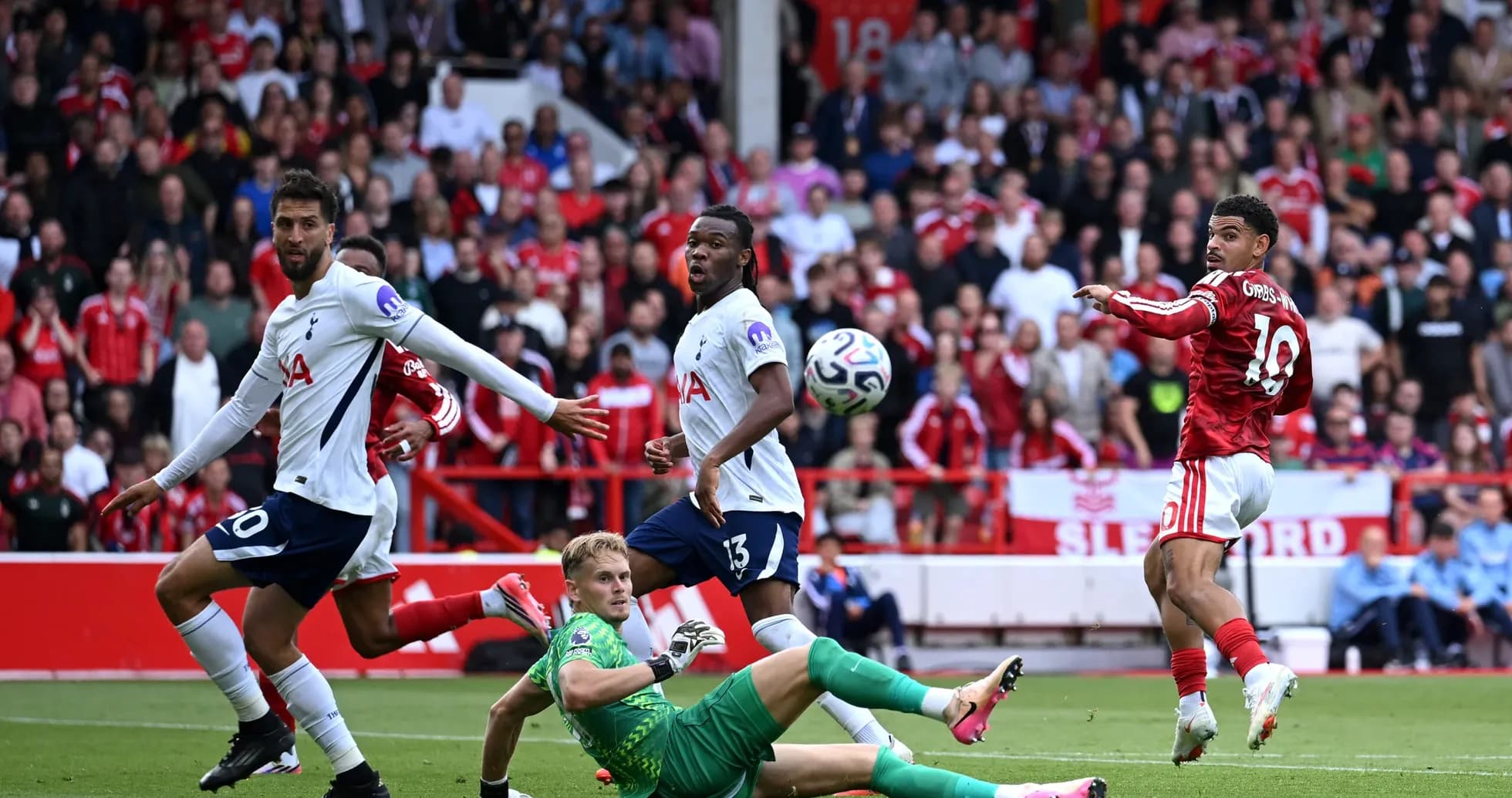
The City Ground felt tense rather than celebratory as Nottingham Forest and Tottenham emerged, both teams carrying the weight of poor early-season form into a fixture that finished 0–0 but revealed plenty about their evolving identities.
I. The Big Picture – two fragile starts colliding
Heading into this game, Forest were 16th in the Premier League, with 2 points from 3 matches. Overall they had scored 2 goals and conceded 3, giving them a goal difference of -1. At home, though, the numbers painted a more cautious picture: 2 games, 0 goals scored, 1 conceded, and 1 clean sheet. Their overall attacking output – 2 goals in 3 games, with an overall average of 0.7 goals per match – underlined why Oliver Glasner leaned into control and structure over chaos.
Tottenham arrived in even deeper trouble. They were 18th with just 1 point from 3 matches, and an overall goal difference of -5 from 0 goals scored and 5 conceded. On their travels, they had played 2, taken 1 point, and still not found the net, conceding 3. The overall defensive record – 5 conceded at an overall average of 1.7 per game (2.0 at home, 1.5 away) – suggested vulnerability, but it was the complete lack of goals that framed this as a crisis of identity for Roberto De Zerbi’s side.
Glasner stayed loyal to his structural blueprint: a 3-4-2-1 with Matz Sels behind a back three of Jair, Nikola Milenković and Murillo. The wing-backs, Ola Aina on the right and Neco Williams on the left, were asked to be both auxiliary wingers and part-time full-backs. Xaver Schlager and James McAtee formed the central hinge, with Dan Ndoye and Morgan Gibbs-White floating behind lone forward Liam Delap.
Tottenham, as ever under De Zerbi, were committed to a 4-2-3-1, but with a very different cast. A. Kinský started in goal behind a back four of Pedro Porro, Jan Paul van Hecke, Micky van de Ven and Destiny Udogie. Sandro Tonali and Rodrigo Bentancur anchored midfield, with Sávio, Conor Gallagher and Mathys Tel supporting Omar Marmoush as the nominal striker.
II. Tactical voids – absences shaping the chessboard
The team sheets were as notable for who was missing as for who played. Forest were without N. Savona due to a knee injury, a loss that trimmed Glasner’s midfield options and made his reliance on Schlager’s control even more pronounced.
Tottenham’s absentees cut much deeper into their creative core. Dejan Kulusevski (knee injury), James Maddison (knock), W. Odobert (knee injury) and Xavi Simons (knee injury) all missed the fixture. That stripped De Zerbi of line-breaking passing, half-space craft, and one-v-one threat. In response, he leaned on Gallagher’s vertical running and Sávio’s dribbling to compensate, while Marmoush was asked to stretch Forest’s back three without the usual volume of service.
Discipline also hovered over the contest. Forest’s season card profile showed a heavy cluster of yellows between 46–60 minutes, with 50.00% of their bookings arriving just after half-time and another 16.67% in the final quarter-hour. Tottenham’s distribution was more even but just as telling: 25.00% of their yellows in each of the 0–15, 31–45, 46–60 and 76–90 minute windows. This was a game primed to tighten and fray as legs tired and spaces opened.
Ola Aina, already among the league’s most-carded players with 2 yellows, had to walk a tightrope as an aggressive wing-back. On the Spurs side, Udogie and Mateus Fernandes both carried early-season yellow-card records, reinforcing the risk of late, tired challenges in wide and central zones.
III. Key matchups – Hunter vs Shield, Engine Room vs Press
With no league-wide top scorers data, the clearest attacking reference point belonged to Forest: Gibbs-White. Heading into this match he had 1 goal and 1 assist in 3 appearances, with 7 shots (2 on target) and a rating of 6.94. His 81 passes at 82% accuracy, plus 8 dribble attempts with 4 successful, made him the creative hub and the closest thing Forest had to a “hunter.”
His duel was not just against Tottenham’s back four but against a defensive unit that, despite its poor overall record, had shown the capacity for a clean sheet once already this season. On their travels Spurs had conceded 3 goals in 2 games – an away average of 1.5 – and that modest figure hinted that the problem lay more with ball losses and transitions than with the pure quality of van de Ven or van Hecke.
The “Shield” for Tottenham was a collective: van de Ven’s recovery pace, van Hecke’s positioning, and Tonali’s screening. If Gibbs-White could pull Tonali out of the six space and combine with Ndoye between the lines, Forest’s 3-4-2-1 could overload the channels between full-back and centre-back – especially on Tottenham’s left, where Udogie’s natural attacking instincts sometimes leave space behind.
In midfield, the “Engine Room” confrontation set Schlager and McAtee against Bentancur and Tonali. Schlager’s role was to dictate tempo and protect transitions, allowing Forest’s wing-backs to advance without exposing the back three. McAtee, more progressive, looked to connect quickly with Delap’s runs. On the other side, Bentancur’s press resistance and Tonali’s range of passing were Tottenham’s main tools to bypass Forest’s first line and find Gallagher and Sávio in advanced pockets.
Out wide, Aina versus Sávio promised to be a knife-edge battle. Aina’s season so far – 7 tackles, 35 duels with 17 won, and 7 dribble attempts with 4 successful – showed a player willing to step high and engage. But his card record meant that every aggressive intervention carried risk. Sávio, drifting in off the right, was tasked with exploiting any hesitation, either driving inside at Milenković or combining with Porro on the overlap.
Up front, Delap against van de Ven was a pure physical duel. Forest’s overall failure to score at home (0 goals in 2 City Ground games) meant Delap’s hold-up play and ability to pin centre-backs were crucial in turning sterile possession into genuine chances. Marmoush, by contrast, had to work in a side that had not scored at all this season, relying on quick combinations with Tel and Gallagher to break Forest’s compact back three.
IV. Statistical prognosis – a stalemate foretold
From a numbers perspective, this fixture always leaned towards low margin rather than high drama. Forest, with an overall goals-for average of 0.7 and an overall goals-against average of 1.0, have built early-season resilience on a narrow platform. Their single overall clean sheet and 2 matches failing to score hinted at a side that often needs set-pieces or penalties to tilt tight games – and their penalty record (1 taken, 1 scored, no misses) underlined that they are clinical when those rare moments arrive.
Tottenham’s profile was even starker: 0 goals scored overall, 5 conceded, and just 1 clean sheet. Their away defensive average of 1.5 goals conceded per match is not catastrophic, but combined with an away attacking average of 0.0, it creates a razor-thin margin where any mistake is fatal and any missed chance feels terminal.
In that light, the 0–0 at the City Ground felt less like a surprise and more like the logical intersection of two teams still searching for fluency. Forest’s structure and Gibbs-White’s ingenuity gave them territory and moments, but not enough incision to break their home scoring drought. Tottenham’s build-up patterns flickered without the missing creativity of Kulusevski, Maddison, Odobert and Simons, leaving Marmoush isolated for long spells.
The tactical story, then, is of two managers who stabilised the floor without yet raising the ceiling. Glasner’s 3-4-2-1 continues to offer Forest defensive solidity and a platform for Gibbs-White, but until Delap and the supporting cast convert that into goals, every match will feel like a coin flip. De Zerbi’s 4-2-3-1, shorn of its primary creators, is still searching for a way to turn sterile dominance into cutting edge.
Following this result, both sides will leave with the same questions they brought in: can Forest turn control into goals, and can Tottenham find a route to goal that does not rely on absent stars? The City Ground offered no definitive answers – only the sense that, for now, caution still rules over chaos.