.svg&w=384&q=75 "GoalGist logo")
Newcastle's Strategic Plan Post-Eddie Howe
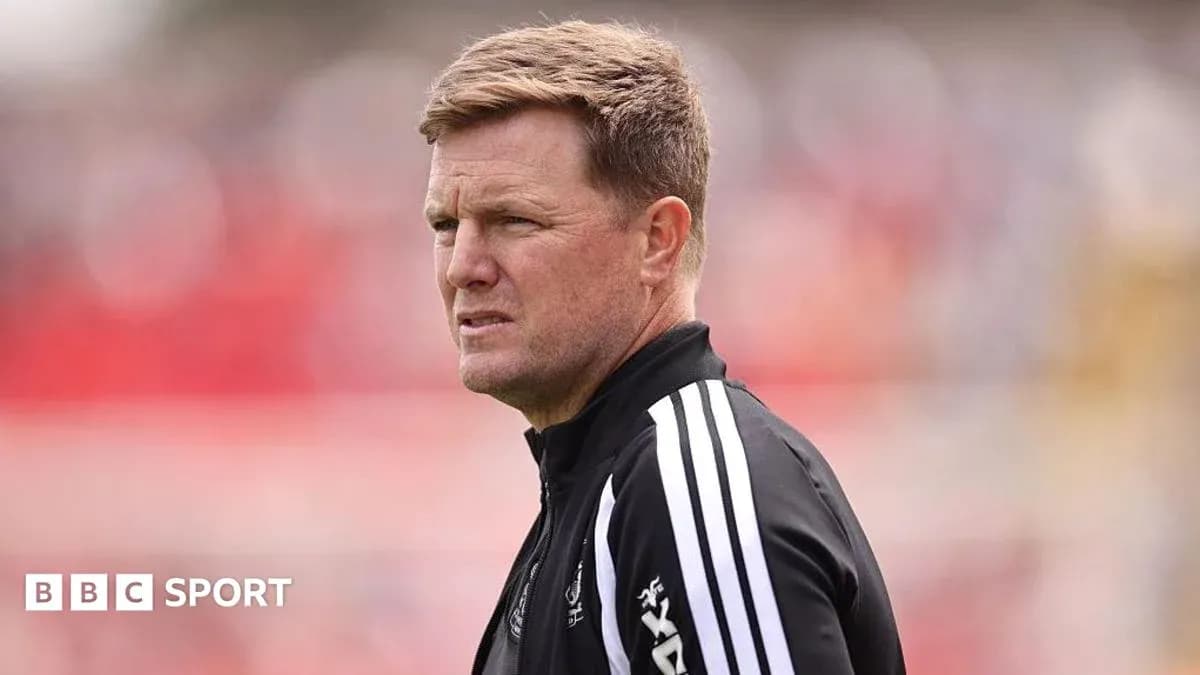
Newcastle United insist Eddie Howe’s departure did not catch them cold. It just looked that way from the outside.
Behind the scenes, sporting director Ross Wilson says the club had been quietly preparing for the end of Howe’s reign for the best part of nine months, even as the head coach wrestled with whether he had the energy to go again.
Howe had wanted to stay on for this season. Nearly five years in the job, emotionally and physically drained, he chose in July to walk away and take a break, convinced it was best for him, for the dressing room, and for the project he had helped relaunch.
The timing – in a summer when key players were already heading out of the door – made it feel like a jolt. Newcastle, Wilson admits, had not expected him to go when he did. But they had expected him to go at some point.
And that, he says, made all the difference.
“We always knew where we were going to go”
Wilson is adamant this was not a scramble.
“It was not chaotic, it was not painful,” is the clear message from the sporting director, who explains that the club had mapped out various scenarios for when Howe, an “exceptionally talented coach”, eventually moved on.
“We always knew where we were going to go,” Wilson said. “That doesn’t mean we were always going to Matthias, but he was always part of our planning.
“Part of our responsibility as leaders of the club is to be prepared and Eddie is an exceptionally talented coach. That means he was probably going to do something else at some point so we had to be prepared for that.”
The Scot, appointed in October, says he had been “planning for a managerial change for eight or nine of those months” in the background. Howe’s work, his profile, his success, all pointed to an eventual exit. Newcastle simply refused to be surprised by it.
Multiple candidates were sounded out. The club knew what they wanted: someone to build on Howe’s foundations, not tear them up.
Out of that process, Matthias Jaissle emerged.
Why Jaissle fit the brief
Jaissle did not arrive as a wildcard. He arrived as a fit.
Newcastle’s hierarchy had already decided the next man in had to embrace an aggressive, high-pressing style, a natural extension of Howe’s intensity rather than a lurch in another direction. They also wanted someone who could work inside the club’s evolving recruitment model: younger signings, development, resale.
Jaissle’s track record at Red Bull Salzburg ticked those boxes. He had worked with younger players, improved them, and sold them on. That aligned neatly with Newcastle’s strategy of targeting signings aged 24 and under.
Wilson’s first meeting with Jaissle, then at Al-Ahli in Saudi Arabia, left a mark. When he came off the call, chief executive David Hopkinson told him he sounded “really excited about this one”.
“I didn’t deliberately go on the phone to do that,” Wilson said. “But I remember saying ‘you’re probably right. I think this is it’.”
Newcastle spoke to several coaches. Jaissle, in the end, became the first choice to replace what Wilson calls a “legend of the club”.
So far, the early evidence is encouraging. Jaissle is unbeaten in his first four games in all competitions. The football has carried some of Howe’s intensity, with subtle tweaks of its own.
But the reality of a transition has been impossible to ignore.
A transition written in the team sheet
The 2-2 draw with Bournemouth told its own story.
Only three of the club’s eight summer signings – Lukas Hornicek, Amar Dedic and Nico Gonzalez – started the match. For all the talk of a new phase, much of the old core still shoulders the responsibility.
It looked like what Jaissle has repeatedly called it: a “transition phase”. A team caught between eras, with the new arrivals still feeling their way into the rhythm of the Premier League and the demands of a new coach.
Newcastle know this could take time. They have modelled a range of financial outcomes depending on where they finish this season, but Wilson insists Jaissle has not been handed a hard target in terms of league position or trophies.
Hopkinson has framed it differently. The long-term ambition, he says, is for Newcastle to “consistently and credibly compete” for top honours. Not a one-off run. A permanent change in status.
To get there, they must live within the rules.
Walking the financial tightrope
Newcastle’s project is not just about tactics and touchlines. It is also about spreadsheets and settlements.
After entering into a Uefa agreement following a breach of European football’s financial rules, the club know they cannot afford to misstep. Hopkinson has stressed that staying compliant with the game’s regulations is non-negotiable if Newcastle are to grow into a genuine force.
The plan is bold. The Magpies want to increase revenues by 50% between now and 2030, driven mainly by sponsorship and commercial deals. But they accept that player trading will remain central to how they operate and reinvest.
“We want to have players here who are on a journey with us,” Wilson said.
“Equally, if some of those players’ journeys go at rapid speed, they might go somewhere else but, of course, that’s normal. That’s part of football.”
This summer underlined that philosophy – and its limits.
Guimaraes shock, targets missed, plan holds
Newcastle had braced themselves for the exits of Anthony Gordon and Sandro Tonali, who left for Barcelona and Tottenham Hotspur respectively. Those departures were written into the planning.
Bruno Guimaraes was not.
Losing their talisman to Arsenal forced the club to adjust on the fly. So did missing out on two top targets, Victor Munoz and Johan Manzambi, who chose Liverpool and Aston Villa instead.
Wilson does not pretend those moments did not sting. But he insists they did not derail the window.
Aside from Guimaraes’ move to Arsenal, he claims “everything else that happened during the window was part of the plan”.
“That does not mean that every single player [who signed] was the number one name on our list, but that is never the case in any transfer window,” he said.
“Clearly we were disappointed a couple of times but, again, that’s normal.
No club goes into the window and reaches the end getting every target they set out to get. If they say they did, it is a lie.”
So Newcastle move forward with a new head coach, a reshaped squad, and a long-term financial framework that demands both ambition and restraint.
The question now is simple enough, even if the answer will take years to emerge: can a club planning this far ahead turn preparation into prizes, or will the Premier League’s chaos write a different script?