.svg&w=384&q=75 "GoalGist logo")
Millie Bright Bows Out: A Farewell to a Chelsea Legend
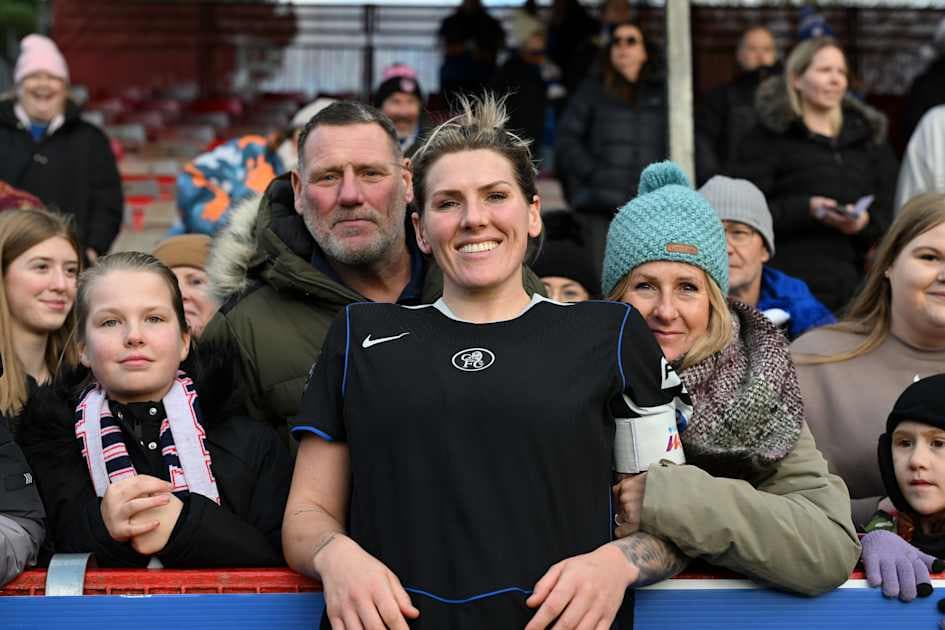
On Saturday at Stamford Bridge, as Chelsea face Manchester United in their final WSL game of the season, the football will share the stage with something bigger. Millie Bright, captain, serial winner, and the beating heart of Chelsea Women for more than a decade, will say goodbye.
There will be tackles, goals, jeopardy. But there will also be tears. Plenty of them.
No player is more tightly woven into the fabric of Chelsea Women than Bright. Across 314 appearances, she has been there for every single one of the club’s 20 trophies, chipping in with 19 goals and a thousand unseen interventions that never make the highlights reel but define a legacy. As she hangs up her boots, Chelsea are about to move into a new permanent home at Stamford Bridge. The symbolism is impossible to miss.
The captain who dragged the club into the elite steps aside just as the club settles into the main stage for good.
Passing the baton at Stamford Bridge
Bright fronted the club’s ‘Never Done’ campaign, the bold declaration that all Women’s Super League home games will be played at Stamford Bridge next season. It is a shift she has long pushed for, a statement of intent about where the women’s game belongs.
She won’t be out there to enjoy a full season in SW6. She knows people will say that is a shame. She has her answer ready.
She points back to Kingsmeadow, to nights and afternoons when a tight, noisy ground became a fortress and a springboard. Those are her memories. Stamford Bridge, in her eyes, is for the next wave.
Chelsea are “going into the new era,” as she puts it, and she wants the fans to be excited by that. This is not a reluctant exit. It is a deliberate handover. Bright talks about “passing on the baton” and being proud that she has “kept pushing the club forward.” It sounds less like retirement and more like the final act of a captain who promised to leave the shirt, and the club, in a better place.
A serial winner learning to look back
For years, Bright has been defined by what came next: the next game, the next title, the next challenge. Reflection never sat easily with her. She admits she is “not good at self-praise,” even with a medal collection that tracks the rise of the women’s game itself.
Now she is forcing herself to pause. To take in the fact that she has, in her own words, been “a serial winner.” To acknowledge not only what football has given her, but what she has given back.
That balance matters. Because for Bright, the sport has never been just a job or even just a passion. It has been a teacher.
Football, she says, has shaped her as a person, taught her to understand her emotions, hardened her without numbing her. You “have to have a thick skin” to survive at the top, she says, and that toughness bleeds into life beyond the pitch.
Her message to the next generation is blunt and honest. Do not be naive. “It’s not just football,” she warns. It is life, pressure, scrutiny, sacrifice. It is joy, too, but it moves quickly. “Enjoy every single minute of it and lap it up because it is over in a flash.”
At 32, she has decided this is the right moment. That knowledge does not soften the goodbye.
The weight of leaving a family
Bright has worn the armband, lifted trophies and fronted campaigns, but when she talks about Chelsea, she comes back again and again to one word: family.
Leaving that is the hardest part.
She says the “girls have saved me on so many occasions,” often without even knowing it. She names them one by one, the roll call of a dynasty: Sam Kerr, Guro Reiten, Erin Cuthbert, and those who came before them. Katie Chapman, whom she calls her sister, the one who took her under her wing from the start. Gemma Davidson, Claire Rafferty, Drew Spence, Jodie Brett, Rosella Ayane, Magda Eriksson, Fran Kirby, Maren Mjelde.
They are more than former team-mates. They are people she will “always call friends,” even if they do not speak every day. When they meet again, the conversation flows. The bond remains. She loves seeing them thrive elsewhere, proud to have once shared a dressing room with them.
That, more than any medal, is what will be hardest to walk away from: the daily rhythm of a group that has been there for everything, good and bad.
From regimented routines to a new kind of structure
Elite footballers live by the clock. Training, recovery, travel, meetings. For Bright, who admits she is “a sucker for routine” and doesn’t like change, that structure has been both a comfort and a cage.
She knows the next few months will feel strange. No set report time. No weekly cycle of build-up, match, reset. To meet that head-on, she has already started building a new framework. She has bought a whiteboard and begun plotting her days: nine o’clock this, ten o’clock that. It sounds like a defender’s approach to retirement—organised, disciplined, unwilling to drift.
Former England international Karen Carney once told her to make sure she had structure in place when she stopped playing. Bright has listened. She has already had a taste of that transition, stepping away from England duty and discovering how mentally draining it can be to “keep going, and going, and going, and pushing through.”
Now, she says, she can finally “sit back and appreciate all the wins.”
Home, horses and a different kind of schedule
If Chelsea has been her professional family, her real family has been waiting patiently in the background. Twelve years away from home is a long time. Too long, she suggests, when you go through life’s tougher moments without your closest people nearby.
Her family “are everything,” and they have been a major factor in her decision. The pull of home is strong. She is “ready to go back,” ready to reclaim the moments that football has taken.
That does not mean a life without structure. Far from it. She talks about going back to her horses, a different kind of schedule that still drags you out of bed at a set time. It excites her. So does the idea of learning to “live a little” after years of strict discipline and sacrifice.
No more automatic “I can’t make it, we’ve got a game” when family events come around. She is looking forward to holidays that do not depend on fixture lists, to days that are hers to shape.
She went to her nephew’s birthday meal recently. It was the first one she had managed to attend. That small detail lands harder than any statistic. It is the kind of moment she does not want to miss again.
Still Chelsea, just in a different role
Bright is not walking away from the club entirely. Far from it. She will continue as a Trustee of the Chelsea Foundation, helping to steer the club’s community and charitable work, and she will become an ambassador for Chelsea, a public face of the badge she has worn with such ferocity.
The competitive fire will not vanish overnight. It never does in players like her. But for the first time in a long time, she can rest. Recharge. Step back from the relentless churn and decide what comes next on her own terms.
On Saturday, though, there is one more job to do: lead Chelsea out at Stamford Bridge, one last time, for a final WSL game and a farewell that will feel as big as any title celebration.
The club moves into a new era at the Bridge. Millie Bright helped build the road to get there. Now she finds out what life looks like when the whistle blows and, for once, she does not have to chase the next ball.

