.svg&w=384&q=75 "GoalGist logo")
Michael Carrick's Bold Vision for Manchester United
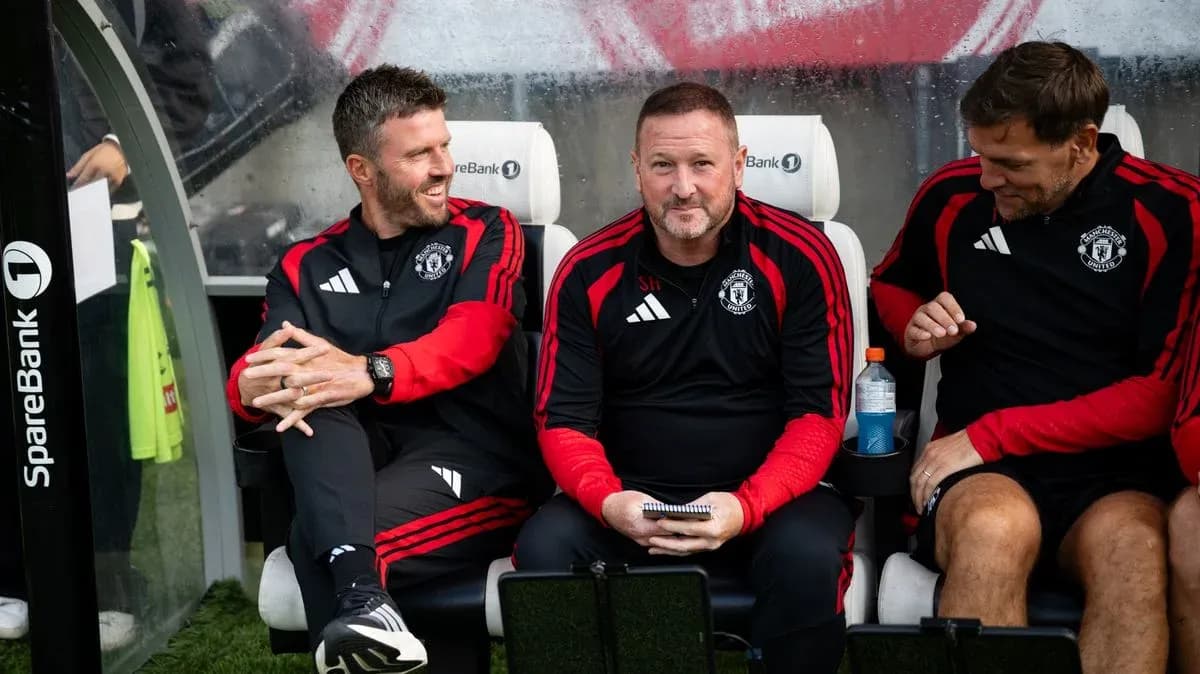
Michael Carrick is swimming against the tide. In a league obsessed with duels, second balls and set-piece chaos, the Manchester United head coach is quietly trying to build something that looks almost old-fashioned: a team that wants to breathe on the ball.
A League of Fights, Not Passes
Look at where the Premier League has gone. Last season was a story of collisions, not combinations. Games frequently broke into 11 individual contests all over the pitch. Win your battle, win territory, win a corner, win the game.
Control? That was the luxury item.
Even Manchester City, the benchmark for midfield dominance under Pep Guardiola, found it harder to suffocate matches. The tempo was frantic, the intensity relentless. Space shrank. Those who wanted to take two touches and see the picture struggled to find room to paint it.
The numbers back it up. Two seasons ago, four clubs averaged more than 60% possession, with six topping 58%. Last season, only City nudged above 60% – and only just, at 60.5%. Chelsea were the only other side to even cross 58%.
The trend is obvious: fewer teams care about hoarding the ball. More are obsessed with what happens in the scraps – the aerial duels, the tackles, the second phases from long throws and corners. The league has tilted towards power and chaos.
Carrick’s Counter‑Cultural Bet
Which is why Carrick’s Manchester United are so intriguing.
This summer, United lost a midfielder built for that modern Premier League landscape. Casemiro, a specialist in physical duels and defensive presence, has gone on a free. You might expect his replacement to be another destroyer, another enforcer for a league that rewards muscle.
Carrick has gone the other way.
United’s midfield rebuild has been about technique, not brawn. Andrey Santos has arrived. So has Youri Tielemans. Both know the Premier League. Neither is likely to be intimidated by its pace. But their primary value lies in what they can do with the ball at their feet, not what they can do with their shoulders in a 50-50.
They are passers. Rhythm players. Midfielders who can see the full width of the pitch and change the tempo with a single touch.
That is deliberate. Recruitment at Old Trafford this summer has followed a clear line: raise the technical ceiling in the middle of the pitch. Give United more ways to control the speed and shape of games. Carrick has even taken Mason Mount, long viewed as an attacking midfielder, and dropped him deeper to help knit play together.
This is not tinkering. This is identity work.
A Midfield in His Own Image
Carrick’s vision makes perfect sense when you remember the player he was.
As a deep-lying midfielder in Sir Alex Ferguson’s United sides, he rarely dominated with tackles or lung-busting runs. He dominated with the ball. He set angles, dictated tempo, and made sure United played the game on their terms. His influence was measured in passes and positioning, not in highlight-reel challenges.
Now he is trying to coach that same idea into a very different Premier League.
This is his first proper transfer window at United, his first full pre-season to drill ideas into a squad that has felt caught between styles for too long. The plan is clear: a United team that doesn’t just survive the storm, but calms it.
The pattern was there at Middlesbrough. In the Championship, Carrick built a side that wanted to play. He brought in Aidan Morris to add another layer of passing quality in midfield, another player comfortable taking the ball in tight areas and moving it with purpose.
If there was a criticism at the Riverside, it was that control didn’t always turn into incision. Boro could keep the ball, but they didn’t always cut through opponents often enough in the final third. The structure was there; the ruthlessness less so.
Fighting the Trend
Now comes the real test. Carrick is trying to impose a possession-focused model at a time when keeping the ball in the Premier League has rarely been harder.
Pressing lines are higher. Defensive blocks are more aggressive. Teams are braver without the ball than they’ve ever been. Managers are happy to let you have it in certain zones, then spring traps and turn the match into a running race.
United, under Carrick, look determined to resist that gravitational pull. They want to ask a different question: not how many duels can you win, but how long can you go without touching the ball?
It is a bold choice. It goes against the grain of where the league is heading. But if Carrick can teach this United team to control games the way he once did from the centre circle, he won’t just be keeping up with the Premier League’s trends.
He’ll be challenging them.