.svg&w=384&q=75 "GoalGist logo")
Michael Carrick's Manchester United Challenges: Transfers and Player Dynamics
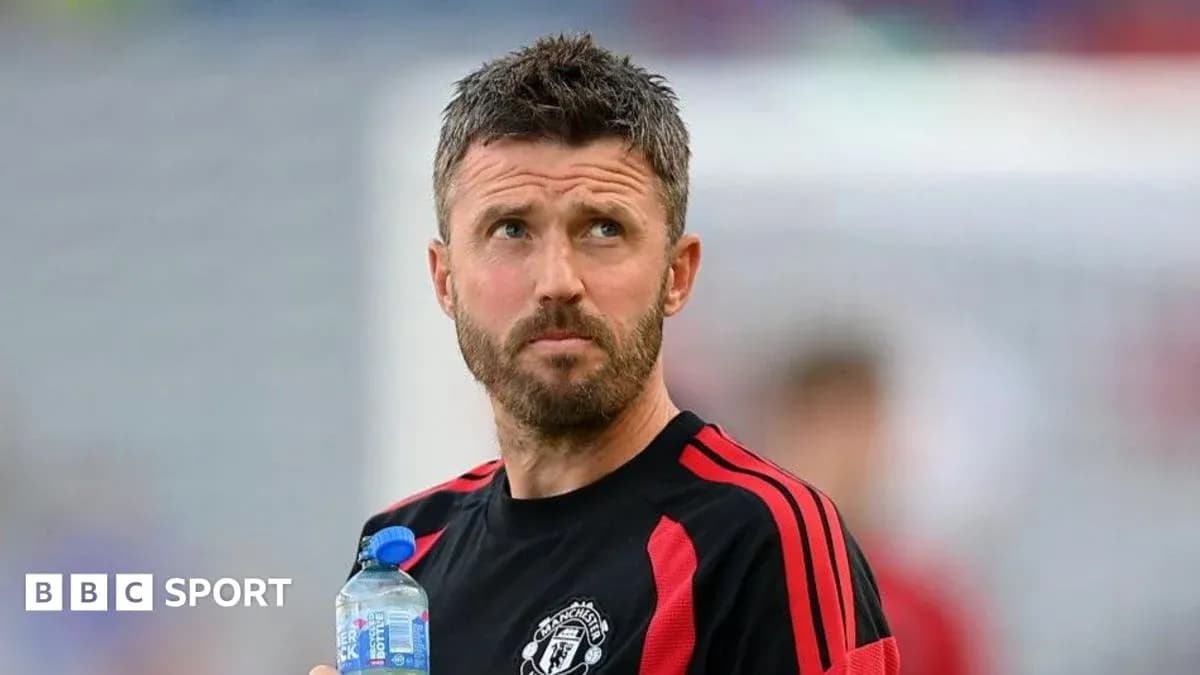
Michael Carrick knows exactly what he has walked into. First full Premier League season at Old Trafford. Champions League back on the agenda. And a squad that still looks a couple of players short.
He calls it a “privilege” to lead Manchester United, to be the public face of a club that treats managers like custodians of an institution rather than just coaches. But that privilege comes with awkward questions, and right now they all circle around the same topic: signings.
Transfers done – and transfers missed
On paper, United have moved. £83m spent on Andrey Santos from Chelsea and Youri Tielemans from Aston Villa. Karl Darlow through the door as a back-up goalkeeper on a free. Carrick insists he is “delighted” with the business so far.
The reality is harsher. Left-back still looks light. Central midfield still needs reinforcing. And all of this as United prepare to return to the Champions League after two years away.
This has also been a summer of near misses. United stepped away from deals for Elliot Anderson and Matheus Fernandes, unwilling to match rival offers. They are spending less than newly promoted Ipswich and Coventry. The numbers jar with the expectations.
Carrick understands the tension between ambition and restraint, between avoiding another era of expensive mistakes and still building a squad that can compete.
“We want more, we need more, we keep looking for how we can do that,” he said. “Money’s money, I get that. We feel like we have to be pushing for everything we’re involved in, while being realistic of what the recent history’s looked like over a period of time.
“For now, we’ve got to make the most of it, but we’ve got to push every boundary we can to be able to win again, basically. That’s the challenge.”
A manager at ease, a club under scrutiny
Away from the transfer noise, Carrick cut a relaxed figure. Thursday brought a personal high: his daughter secured the A-level grades she wanted. Professionally, he has enjoyed a rare pre-season without the long-haul circus. United have stayed relatively close to home, taking in Scandinavia for games against Wrexham, Rosenborg, Atletico Madrid and Paris St-Germain, before a final outing against Leeds in Dublin.
“I love the position I’m in,” he said. “There’s the football side; the tactical, the training, putting the team together. Then there’s the other side; being the face of it, leading it, trying to set the right messages, the right behaviours and right tone for what we want to look like as a football club.
“I never take anything that this position and this football club brings for granted.”
That public-facing role is already being tested by the biggest individual question of United’s summer.
Rashford: back in red, future in question
Carrick was offered multiple chances to say Marcus Rashford would definitely still be a United player when the transfer window shuts on 1 September. He declined every one of them.
“He’s our player,” was his repeated line. Nothing more. Nothing less.
When he spoke about Rashford, Carrick made a point of stressing that the England forward is not the only member of the squad he has coached, managed or even played alongside before. It has been framed as a key factor in Rashford’s reintroduction, but Carrick is determined not to make him a special case.
“It is not a unique situation at all and [we] treat him exactly like any other player,” he said.
Plenty of supporters are not so even-handed. Many have not forgiven Rashford for his coolness towards United during loan spells at Aston Villa and Barcelona, where most expected him to be playing again this season. Inside the club, there is an acceptance that there is a stark contrast between the disinterested figure he became under Ruben Amorim and the fully motivated version that many regard as the best player to emerge from the academy since Sir Alex Ferguson retired in 2013.
The twist? Rashford’s likely first appearance back in United colours is set to come against Amorim’s AC Milan in Wroclaw, Poland, on Saturday.
Carrick is convinced the 28-year-old still has plenty to give.
“Football’s got different directions,” he said. “You’ve got to manage through the states to have a career for 10 or 15 years. It’s never going to be smooth sailing.
“But you’ve got to keep moving forward. If you keep looking back too much, it doesn’t do anyone any favours.
“It’s been good to have Marcus around this week. He’s our player. He’s a good player, and he gives us something a little bit different.”
Mainoo’s reset and Carrick’s empathy
Rashford was not the only England international to report back on Sunday. Kobbie Mainoo also returned, and for Carrick it almost feels like starting again.
When he replaced Amorim in January, after Darren Fletcher’s brief interim spell, one of his first tasks was to lift Mainoo. The midfielder’s talent was obvious, but he had been largely ignored by Amorim. At least Mainoo did get some Premier League minutes as a substitute. For England at the World Cup under Thomas Tuchel, he did not even manage that, despite widespread feeling that the national team needed his ability to keep the ball in the latter stages.
Carrick knows the sting of that kind of omission. Fabio Capello overlooked him at the 2010 World Cup in South Africa. The parallel is not lost on him, and he made sure Mainoo did not feel abandoned.
“I spoke to him all the way through the World Cup, not loads, but little bits,” Carrick said. “It’s challenging. From the outside we all see the glitz, the glamour and all the positive sides of football.
“But players are human beings. We all have our ups and downs. It’s important we support each other.
“It was a good experience for Kobbie. It’s a World Cup and that is a big step.
“He’s still such a young man and he’s achieved so much, so quickly. To be at the stage he’s at is an achievement.”
Carrick talks about support, about development, about pushing boundaries in the market and on the pitch. The question now is whether that blend of empathy and edge will be enough to drag Manchester United back to where he insists they must be: competing to win everything they enter.