.svg&w=384&q=75 "GoalGist logo")
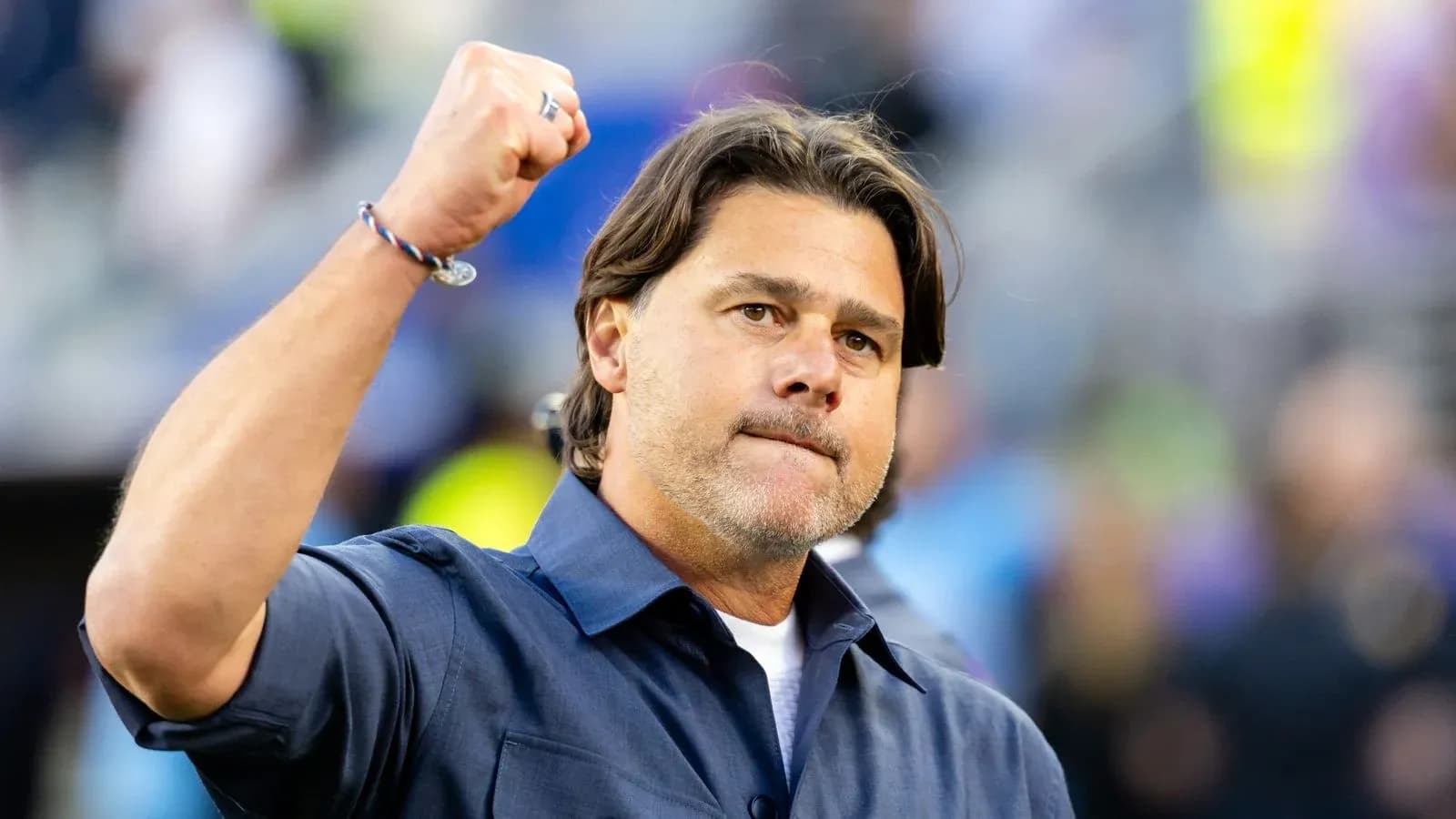
Mauricio Pochettino's Journey: From World Cup to Premier League Dreams
Mauricio Pochettino walks into the room like a man who has finally had a chance to breathe. Hugs, handshakes, holiday stories. He looks rested, but the summer he’s had would exhaust most.
While others switched off, he went deep into the eye of the storm: a home World Cup with the USA, a last-16 exit to Belgium, a political circus, a legal saga around Folarin Balogun – and somewhere in the middle of it all, he accidentally became a style trendsetter.
Then, when the dust was supposed to settle, he signed on for four more years with the USA. No sabbatical. No quick return to club football. A commitment through to 2030.
Where do you even begin?
‘We are much better coaches now’
Pochettino’s starting point is clear: the football.
The World Cup, he says, has sharpened him and his staff, including long-time assistant Jesus Perez. “We are much better coaches now,” he insists. It’s not a throwaway line. The tournament has hardened his belief that every detail matters, that international football lives on tiny margins and even smaller windows of time with players.
He talks about the difficulty of transmitting complex ideas to a squad that barely trains together compared to a club side. About the impossibility of getting every decision right. About the need, as he puts it, for “everything” to be perfect.
And that was before you add a President who thrives on the spotlight.
Managing at a World Cup is one thing. Managing at a home World Cup with Donald Trump hovering in the background is quite another. Pochettino treads carefully when Trump’s name comes up, emphasising the support and backing the team received rather than the noise that followed them.
The Balogun affair, though, could not be ignored.
Balogun, FIFA and the noise
The USA’s last-16 tie with Belgium was overshadowed by the extraordinary late twist that allowed Folarin Balogun to play. His suspension was suspended by FIFA on the eve of the game, turning a disciplinary issue into a political flashpoint.
Pochettino admitted at the time that “politics and manipulation” clouded the build-up. He understood the anger, the arguments, the accusations. But from his perspective, his job was simple: stay sane.
“If you pay attention to the noise, you become crazy,” he says now.
Once FIFA’s letter arrived confirming Balogun’s availability, the decision was, in his words, “straightforward”. He played. The USA went out. The debate raged on.
Balogun’s name has been back in the headlines again, this time for club reasons, after his proposed move from Monaco to Everton collapsed late on Deadline Day. Pochettino hasn’t called him yet. Deliberately so.
He knows the disappointment will still be raw. He would have liked to see Balogun in the Premier League, to test himself in English football, but for now the striker remains in Monaco. Pochettino just hopes he can reset and find a good place again.
A World Cup, a wardrobe and Wayne Rooney
Amid the tactical talk and political storms, something unexpected happened: Mauricio Pochettino became a fashion story.
His navy touchline outfit – sharp, simple, tailored – took on a life of its own. Social media loved it. So did Wayne Rooney, who went out and bought the same look.
“I saw him,” Pochettino grins. “He looked good on him, like a top coach.”
He laughs, but the whole thing underlines how visible this World Cup was. Every detail, from team selection to tailoring, was up for discussion. It really was a summer that had everything.
And as the tournament ended, his name immediately drifted back into the club rumour mill.
Four more years with USA – but Premier League dream lives on
For a few weeks, Pochettino was linked to a string of jobs. AC Milan were mentioned. Other clubs circled. It felt like the usual post-tournament carousel.
Then came the twist: he signed a four-year extension with the USA.
If he sees that contract out, he will have spent six straight years away from club football. For some, that would sound like the end of his Premier League story. He doesn’t see it that way at all.
“I have the ambition,” he says. “My dream now is to be in the USA for four years, but after that, why not? We are still young, and I think coming back is always my goal; to win the Premier League, to be in the Premier League and to build a project with the possibility of winning.”
“I love the football here. I think to have the chance again is one of my wishes and I hope that happens.”
He talks about it like unfinished business. Because it is.
Spurs, the call that never really came
That sense of something left behind takes him straight back to Tottenham.
Around 18 months ago, he spoke openly about wanting to return to Spurs one day. Since then, the club have lurched through more turbulence. Ange Postecoglou came and went. Thomas Frank and Igor Tudor followed and departed as Tottenham flirted dangerously with the drop.
With the club in trouble, the narrative almost wrote itself: Pochettino, the man who took them to a Champions League final, riding back in to rescue them.
So, did that call ever truly come?
“Always I say, one day, why not?” he replies when asked about a return in general.
Pressed on whether it was a real possibility this time, he is clear. “People talk and maybe we receive some approach, but it never was close.” Not now. Not yet.
As for those other jobs – Milan, and the rest – the picture is similar.
“We were not open during the World Cup to talk with different clubs that were interested,” he says. Were there clubs interested? “Yes, always,” he answers, as if it’s routine. “Yes, always have different, you know, options.”
Did any of them tempt him? “We never gave the opportunity to be close. We always closed the door before it got close.”
The USA project came first.
Spurs’ spending spree and what might have been
Talk turns back to Tottenham’s present.
“It is never dull at Spurs,” he’s told, and he smiles. He sees a club that has decided to go big. “They are investing like other clubs,” he says, and the logic is obvious after a couple of bruising seasons.
Tottenham are now buying players who already know the Premier League. Proven, not potential. Ready-made, not long-term projects.
It’s hard not to contrast that with Pochettino’s era, when he pushed Spurs to the brink of glory in England and Europe on a far tighter budget. What would he have done with £300m to spend?
He gives a mischievous grin and jokes that he can’t even comprehend what £300m is. But will this new strategy work?
“You never know,” he says. “We need time to see if that works or not.
“Like in all the games, when you make a decision like a coach that can work well or not. I think it’s a different strategy and a different way to operate. I always wish the best for Tottenham because it’s in my heart.”
The affection is obvious. The distance, for now, is too.
Chelsea, Xabi Alonso and a new direction
Across London, his other former club have also changed course.
Chelsea have shifted from the “head coach” model he worked under to a more traditional “manager” role. Their transfer policy has moved as well: fewer long-term projects, more Premier League-ready signings under Xabi Alonso.
Pochettino avoids direct criticism or comparison, but he recognises the intent.
Buying this type of player, he says, means you “can expect to fight, to be a contender for the Premier League.”
Chelsea’s defeat to Arsenal has already delivered a sharp jolt of reality, yet he preaches patience for Alonso.
“Of course they are disappointed after the defeat against Arsenal, but I think we need to give time to Xabi’s first season after three games in the Premier League,” he says.
“I think we need to give time, and of course for Tottenham the same.”
The message is the same for both of his old clubs: big ideas need room to breathe.
Arsenal in pole position – and Arteta on top
While Spurs and Chelsea search for stability, Pochettino sees one side clearly ahead of the pack.
For him, Arsenal are out in front.
“Mikel [Arteta] is the best coach in the Premier League today,” he says. He believes Arteta knows exactly what he needs to do, and he expects it to be “tough to beat them.”
Coming from a man who once stood on the other side of that North London divide, it is quite the endorsement.
For now, Pochettino’s world is red, white and blue, not lilywhite or blue. His focus is the USA, another World Cup cycle, and the chance to refine himself even further as an international coach.
But he talks about the Premier League like a place he will return to, not one he has left behind. When the four years are up and the next round of calls go out, who will be brave enough to hand him that “project with the possibility of winning” he craves?