.svg&w=384&q=75 "GoalGist logo")
Marcelo Bielsa: The Coach Who Focuses on Work Over Image
Marcelo Bielsa has never cared much for the theatre around football. He cares about the work. The rest, as far as he is concerned, is background noise.
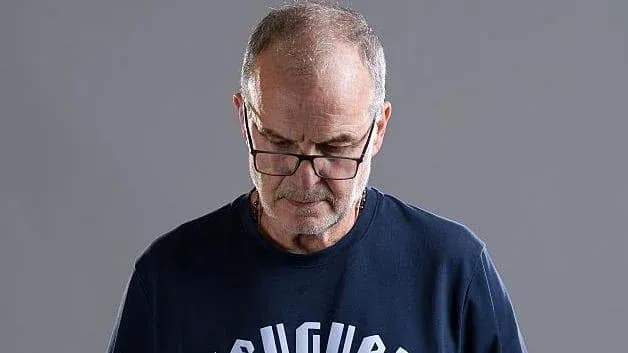
So when Fifa’s official World Cup portraits dropped and Uruguay’s 70-year-old coach appeared staring downwards, stone-faced, rather than into the camera like everyone else, the image travelled fast. Players grinned, managers posed, some clearly enjoying their moment. Bielsa looked like a man dragged away from a tactics session.
It did not take long for the questions to arrive.
After Uruguay’s opening 1-1 draw with Saudi Arabia in Miami on Monday, reporters pressed him on the photograph, hinting at some kind of silent protest or statement. Bielsa bristled.
“I don't have to give any explanation, the picture was taken the way it was taken,” he said. “I'm not a model.”
That line summed him up. A coach nicknamed ‘El Loco’ for his intensity and quirks – the man who sits on an ice box during games, who famously obsesses over video analysis and detail – was not about to play along with the circus.
Fifa’s portrait sessions have become part of the modern World Cup furniture, packaged and shared as content in the build-up to tournaments. For most, it is a harmless piece of fun. For Bielsa, it is clearly an intrusion into a world he prefers to keep stripped back and functional.
The Argentine, one of the most respected coaches of his generation, is now leading his third national team at a World Cup after previous spells with Argentina and Chile. His reputation was built on intensity, principles and a near-manic devotion to preparation. Image has always come a distant second.
So when a different question came his way in the news conference, Bielsa still had the portrait on his mind and circled back to it, pushing back against what he saw as needless scrutiny.
“There is a limit in terms of what we need to explain,” he said. “If I'm wearing glasses, why am I wearing glasses?
You look somebody in the eye, why do you do that?
There is nothing wrong about wearing glasses or looking into somebody's eyes or looking down.”
It was classic Bielsa: terse, logical, and utterly uninterested in playing the media game. Where others might have laughed it off or turned it into a light-hearted moment, he treated the subject with the same seriousness he brings to a defensive shape or pressing trigger.
His stance underlines a familiar theme. Bielsa has always tried to strip football back to its essence: players, ideas, work. At Leeds, supporters saw the same traits – the hours of video, the forensic preparation, even the famous litter-picking exercise to teach his squad about the value of effort and respect. The quirks became part of the mythology, but for him they were never performance. They were process.
Now he has Uruguay to shape in his image, and the margins at this World Cup will not be decided by how a coach looks in a photograph. They will be decided on the pitch, where Bielsa’s intensity still burns.
Next up is Cape Verde on Sunday at 23:00 BST, a meeting with the tournament’s surprise package. The cameras will be there again, of course. The lights, the angles, the portraits.
Bielsa will be thinking about something else entirely.