.svg&w=384&q=75 "GoalGist logo")
Manchester United's Dominance at Old Trafford – A 5-2 Statement
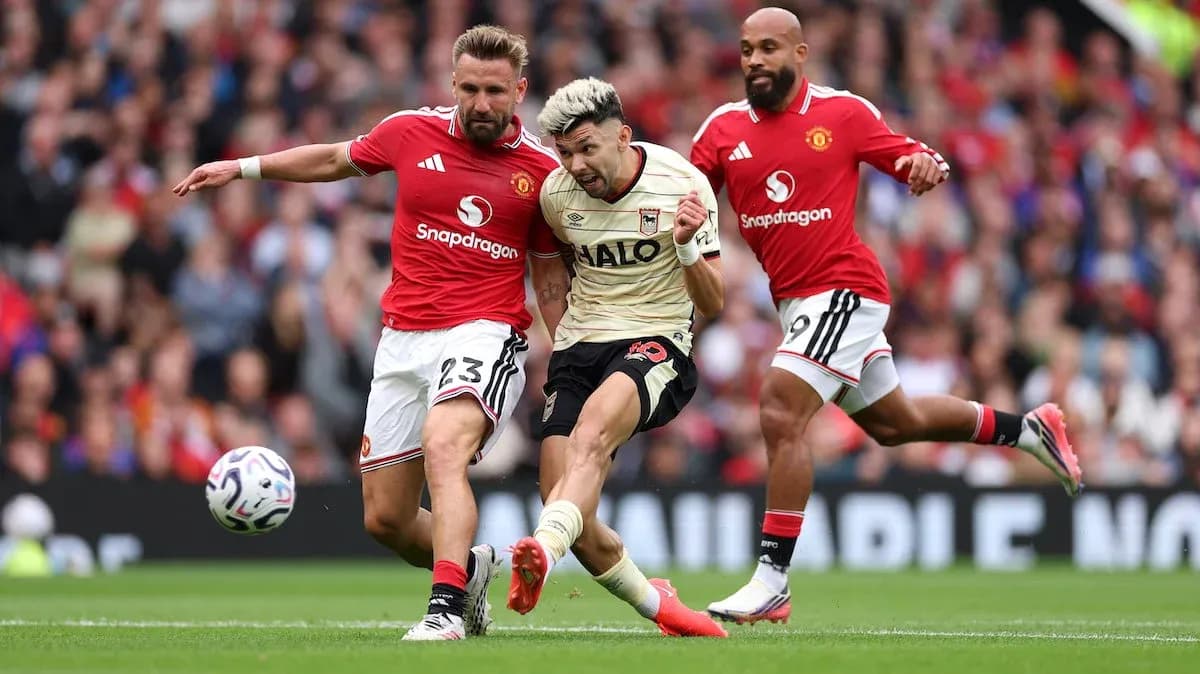
Old Trafford under late‑August sun felt less like a theatre and more like a proving ground. Manchester United, stung by an opening away defeat, walked out into the Premier League’s “Regular Season - 2” round knowing this was already a character check. Ipswich, fresh from a home win, arrived with optimism and a clear identity. Ninety minutes later, the scoreboard read 5-2 to United, and the early‑season table had been sharply reshaped.
Following this result, United sit 10th with 3 points from 2 matches. Overall this campaign they have scored 5 and conceded 4; the goal difference of +1 is modest, but the narrative behind it is anything but. At home, they have been explosive: 5 goals for and 2 against in a single outing, an average of 5.0 scored and 2.0 conceded at Old Trafford. Ipswich, now 12th with 3 points from 2, have discovered the cost of naivety on their travels. Away, they have scored 2 but shipped 5, an away average of 2.0 for and 5.0 against, feeding into an overall goal difference of -2 from 4 scored and 6 conceded.
I. The Big Picture – Carrick’s Structure, United’s Statement
Michael Carrick kept faith with a 4-2-3-1 that already feels like this side’s seasonal DNA. S. Lammens in goal sat behind a back four of D. Dalot, H. Maguire, L. Martinez and L. Shaw. In front of them, the double pivot of Y. Tielemans and K. Mainoo was the hinge on which everything turned, freeing a devastating trio: B. Mbeumo wide, B. Fernandes central, M. Rashford drifting in from the left, all supporting M. Cunha as the lone forward.
The structure mattered. United’s season statistics underline a team that wants to dominate the ball and territory. Overall they average 2.5 goals scored per match and 2.0 conceded, with no clean sheets yet and a willingness to commit numbers forward. Their biggest win so far is precisely this 5-2 at home; their biggest defeat, a 2-0 loss away. The contrast between Old Trafford and their travels is stark, but in front of their own crowd, the attacking patterns already look rehearsed and ruthless.
Ipswich mirrored the 4-2-3-1, Gary O’Neil trusting K. Scherpen behind a line of D. O’Shea, I. Diop, J. Greaves and L. Davis. S. Lukic and M. Nunez formed the double pivot, with I. Fatawu and D. Maeda flanking J. Enciso behind Emersonn. It is a shape that, in theory, offers control and counter‑threat. In practice at Old Trafford, it was stretched and exposed by United’s rotations.
II. Tactical Voids – Injuries and Discipline
Both squads came into this fixture with key absences that subtly bent the tactical landscape. Manchester United were without C. Baleba (ankle injury), A. Diallo, T. Heaton, M. Mount (foot injury), M. Ugarte (knee injury) and M. de Ligt (back injury). The missing spine pieces – particularly Ugarte and de Ligt – explain why Carrick leaned into a possession‑heavy, front‑foot plan rather than a conservative one: he simply lacked his most natural destroyer and one of his premier box defenders.
Ipswich’s own voids were equally defining. Florentino was inactive, while A. Matusiwa, J. Philogene and J. Taylor (knee injury) all missed out. Without Matusiwa’s ball‑winning and Taylor’s energy, O’Neil had to trust a more technical but less destructive midfield. Against a United side whose yellow cards this season have been concentrated in the 31-45 and 91-105 minute ranges (50.00% each of their bookings in those two windows), Ipswich might have hoped to draw them into reckless challenges. But United kept their discipline here; the real story was Ipswich’s inability to protect their own back line.
Across the season, Ipswich have yet to keep a clean sheet, with 6 goals conceded overall and a particularly brutal away average of 5.0 against. Their yellow card distribution – 66.67% between 31-45 minutes and 33.33% between 46-60 – hints at a side that becomes stressed as halves approach and emerge from the break. Under sustained pressure at Old Trafford, that fragility showed in positional terms rather than in cards.
III. Key Matchups – Hunter vs Shield, Engine Room Battles
The headline duel was always going to be Bruno Fernandes against Ipswich’s defensive structure. As the league’s top‑rated player so far (rating 8.65), Bruno’s numbers across the first two games are emphatic: 3 goals and 1 assist in total, 5 shots with 4 on target, 151 passes at 84% accuracy, and 6 key passes. He is not just United’s creator; he is their finisher and tempo‑setter.
Ipswich’s “shield” – the partnership of Lukic and Nunez – had to track his movements between the lines, while Diop and Greaves were constantly being asked to step out. The more they did, the more space opened for Cunha to pin, Rashford to dart into the half‑spaces, and Mbeumo to arrive late from the right. Emersonn, one of Ipswich’s own early‑season bright sparks with 1 goal and 3 key passes overall, was forced too deep to threaten consistently in transition.
In the engine room, Mainoo and Tielemans quietly dictated the terms. With United yet to keep a clean sheet this season and conceding an overall average of 2.0 goals per match, there is still vulnerability behind them. But against Ipswich, their ability to recycle possession early prevented O’Neil’s side from turning Enciso’s creativity – 2 assists, 47 passes at 85% accuracy, 11 dribble attempts with 6 successful overall – into sustained waves of attack.
On the flanks, I. Fatawu, who has 1 assist and 5 key passes so far, tried to isolate Shaw and Dalot. Yet United’s full‑backs, aided by the double pivot, were rarely left in pure one‑v‑one isolation. The result was that Ipswich’s most dangerous wide players spent more time chasing runners than attacking them.
IV. Statistical Prognosis – What This 5-2 Really Says
Following this result, the metrics paint a clear early‑season picture. United at home are an attacking avalanche: 5 goals from their only Old Trafford match, with their biggest win of the campaign already on the board. They have converted their only penalty of the season – a 100.00% record from the spot so far, with no misses – and their offensive depth is reinforced by the bench options of J. Zirkzee, B. Sesko and P. Dorgu, who brings edge in both yellow and red card leaderboards without yet crossing the dismissal line.
Ipswich, by contrast, are walking a tightrope. Overall they average 2.0 goals scored per match, a healthy return for a newly tested side, but they concede 3.0 on average, and the away figure of 5.0 against is unsustainable. Their biggest win (2-1 at home) and biggest defeat (5-2 away) tell the story of a team whose game model is currently venue‑dependent: brave and effective at home, too open and stretched on their travels.
From a tactical lens, this 5-2 is less a freak scoreline than a logical outcome of the underlying trends. United’s 4-2-3-1, powered by Bruno’s form and a high‑ceiling front four, will continue to generate high xG at Old Trafford, even if their clean‑sheet count remains at zero for now. Ipswich’s own 4-2-3-1 has promise in possession, but until the shielding in front of Scherpen tightens and the away defensive average drops, their matches – especially away – will tilt towards chaos.
In the early light of the 2026 season, Old Trafford has reasserted itself as a venue where United can overwhelm visitors. For Ipswich, this defeat is a sharp, data‑backed reminder: in the Premier League, style without structure is a luxury you cannot afford, especially on your travels.