.svg&w=384&q=75 "GoalGist logo")
Manchester City's Transition: The Future Without Rodri
Manchester City stand at a crossroads, not a continuation.
A decade of Pep Guardiola has given way to Enzo Maresca, and with it the sense that an era is not just ending, but being dismantled piece by piece. This is not a gentle refresh. It is surgery on a Treble-winning side.
Four pillars of that 2022-23 team – Manuel Akanji, Nathan Ake, Bernardo Silva and John Stones – have gone in the same summer. In their place, City have pushed £116m across the table for Elliot Anderson and handed the keys of their future to 17-year-old Jeremy Monga. That is not like-for-like. That is a reset.
And the biggest question of all still hangs in the air: what happens with Rodri?
Rodri, the spine – and the shadow of Madrid
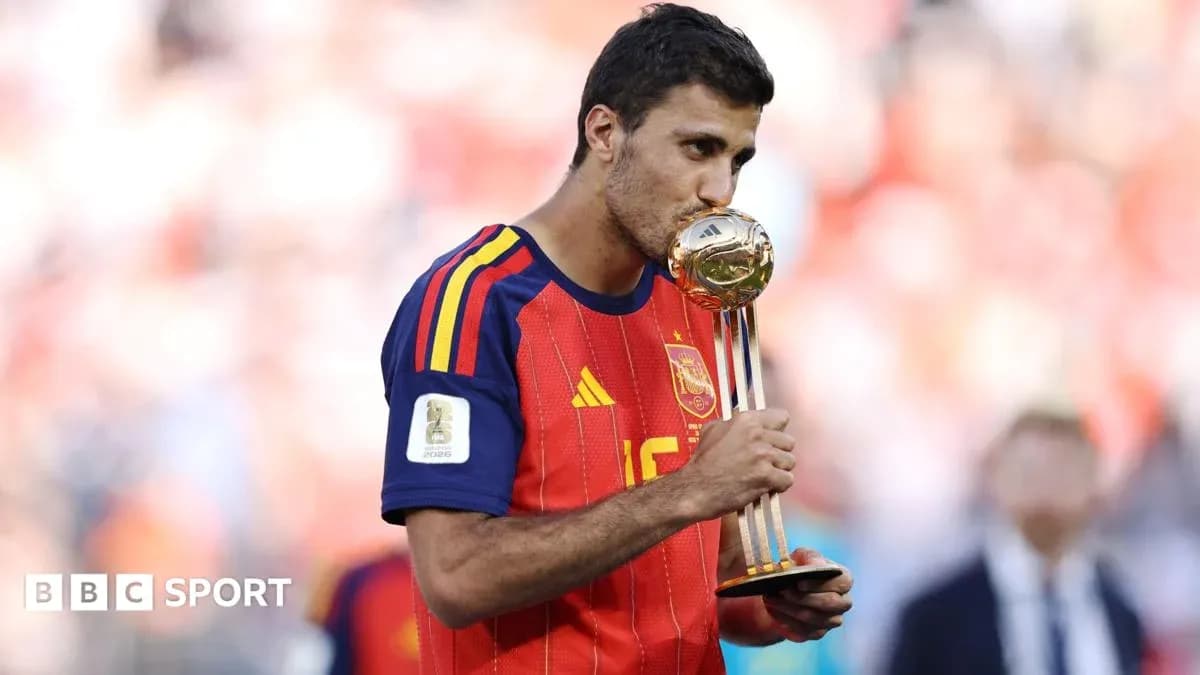
Fresh from lifting the World Cup as Spain’s captain and walking away with the Golden Ball, Rodri should be basking in the glow of his peak years. Instead, he goes under the knife on Monday for back surgery with just 12 months left on his contract and Real Madrid circling.
Reports in Spain say Madrid are “operating on the basis” that he will eventually join them. City, publicly at least, are not playing along.
Maresca, in his first news conference as City manager, didn’t hesitate.
“I think every manager wants to have Rodri because he is a top player,” he said. “But now, surgery on Monday... he needs a holiday... he needs to rest and recover and then he will be back with us.”
Clear enough. The new man wants his midfield general. The club’s plan, on paper, is to retain one of the finest players in world football, not cash in on him.
Yet the calendar and the market do not care about intentions. A 30-year-old with one year left, recovering from surgery, while the biggest club in Spain quietly plans around his arrival. City must decide: do they double down on Maresca’s stance when he returns to fitness, or take the painful, pragmatic route and sell?
Whatever the answer, they cannot be caught unprepared.
Maresca’s board, Maresca’s pieces
To understand why Rodri matters so much to this project, you have to understand how Maresca wants his team to play.
He sees football as positional play, as strategy, as a kind of living chess. He has said as much himself.
“There are a lot of similarities,” Maresca explained. “The most important is positional play and strategy. For a coach, it's important to have the mentality of a chess player: develop a plan, study counter-moves, choose the arrangement of the pieces.”
On the pitch, that translates into a familiar pattern for those who watched City’s Treble run closely. His sides defend in one shape and attack in another, with players sliding into new zones as the ball moves. The structure he leans on most looks like a 3-2-2-3 in possession.
Under Guardiola, when Maresca worked as an assistant, John Stones became the emblem of that evolution. City often defended as a 4-4-2. Then, when they built attacks, Stones stepped out from centre-back to form a double pivot with Rodri, morphing the team into that 3-2-2-3. It was one of the tactical shifts that underpinned the Treble.
At Chelsea, Maresca took the same idea and twisted it. He used Moises Caicedo as a right-back out of possession, then asked him to slide into midfield when Chelsea had the ball. Again, a back four became a 3-2-2-3, this time from a different starting point.
The pattern is obvious: Maresca is constantly searching for players who can jump between lines, who can occupy one role without the ball and another with it. Few in world football do that better than Rodri.
Why Rodri is different
During the World Cup, Spain’s shape showcased exactly why he is so central to Maresca’s thinking. When Aymeric Laporte pushed up with the ball, Rodri calmly dropped into the back line. When Spain needed a shield in front of the defence, he anchored midfield. When a gap opened higher up, he stepped forward to exploit it.
He read the game like a grandmaster reads a board: always two moves ahead, always aware of risk and reward.
That understanding did not arrive overnight. At City, he needed seasons under Fernandinho’s wing to adjust to the speed, the angles, the demands of Guardiola’s positional game. Once he did, he became the fulcrum of everything – the man who decided the tempo, the height of the line, the level of risk.
Maresca knows that Anderson, and any future signing such as 18-year-old Lille midfielder Ayyoub Bouaddi – a standout for Morocco at the World Cup – will need time to reach that level of nuance. They might have the legs. They might have the talent. What they do not yet have is Rodri’s internal map of the pitch.
City, with Rodri, can play Maresca’s positional game at full speed from day one. Without him, they are learning on the job.
Life after Rodri – if it comes to that
So City plan as if he will stay, but they cannot ignore the possibility that he goes.
That is where Maresca’s track record offers a sliver of comfort. He has repeatedly shown an eye for repositioning players into roles they had never fully explored: Stones into holding midfield, Caicedo into full-back, Marc Cucurella into attacking midfield. He looks at a squad and sees not just what players are, but what they could be.
If Rodri departs, that instinct becomes vital. Anderson could anchor the midfield or share the role with a converted defender. A young signing like Bouaddi could be eased into one of the deeper slots in that 3-2-2-3. Another full-back might be pushed inside. The solutions will not be perfect at first, but Maresca has never been shy about moving his pieces.
There is another important shift on the horizon. Unlike Guardiola, who preferred to work with a lean group, Maresca wants more options. More pieces on the board, more ways to build the same structure.
That change in philosophy matters. With a larger squad, he can test combinations, rotate roles, and refine the system without breaking the team every time he makes a tweak. It gives him a better chance of stumbling upon a new Stones, a new hybrid role, a new way to reach that 3-2-2-3 without Rodri as the constant.
A new City, whether they like it or not
This is the reality facing Manchester City. The club that once prided itself on continuity now finds itself in a state of controlled chaos: a new manager, key Treble winners gone, a generational midfielder recovering from surgery and sitting on a ticking contract.
Maresca will hope the answer is simple – that Rodri returns, signs, and leads this next version of City as he did the last. That his brain and his boots guide a new cast through an old script, only with fresh twists.
But if Madrid get their way and the spine of this team walks out, the question changes.
Not whether City can replace Rodri like-for-like. They cannot.
It becomes whether Maresca’s eye for reinvention, and a deeper, more flexible squad, can turn a looming loss into the moment his own City truly begins.