.svg&w=384&q=75 "GoalGist logo")
Manchester City's Crossroads: Rodri's Future and Maresca's Vision
Manchester City stand at a crossroads, and for once it has nothing to do with a title race.
A decade of Pep Guardiola has given way to Enzo Maresca, and the handover is anything but gentle. The Treble-winning machine has been opened up, key parts removed, new components dropped in. Stability has been swapped for surgery.
Four pillars of that 2022-23 side – Manuel Akanji, Nathan Ake, Bernardo Silva and John Stones – have gone in one summer. In their place, City have pushed £116m on to the table for Elliot Anderson and handed a shirt to 17-year-old Jeremy Monga. It is not a refresh. It is a reset.
Rodri, Real Madrid and a looming decision
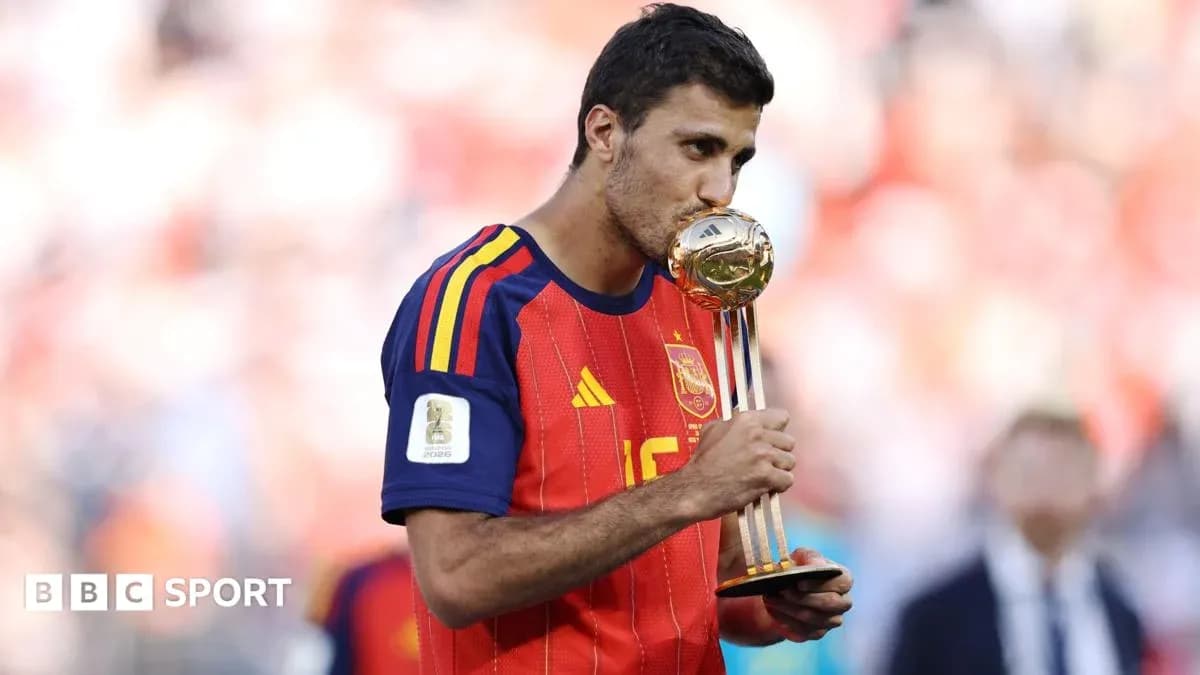
Rodri, fresh from captaining Spain to World Cup glory and collecting the Golden Ball as the tournament’s outstanding player, goes under the knife on Monday for back surgery. He has a year left on his contract. The speculation has already moved on from whispers to working assumptions elsewhere: reports in Spain say Real Madrid are “operating on the basis” that Rodri will join them.
City, officially, are not.
Maresca made his position clear in his first news conference. No ambiguity, no dressing it up.
“I think every manager wants to have Rodri because he is a top player,” he said. “But now, surgery on Monday... he needs a holiday... he needs to rest and recover and then he will be back with us.”
That is the internal line: Rodri as cornerstone, not cash-out. Keep the best holding midfielder in the world and build around him, rather than bank a fee and start again.
Yet the clock is ticking. A 30-year-old on a one-year deal, an operation, and the biggest club in Spain circling. At some point, the theory of keeping him meets the reality of a contract and a balance sheet. Do City ride it out and risk losing him for nothing, or sell once he proves his fitness?
Maresca wants a board to play on. The board may decide one of his queens has to go.
The chess coach and his pieces
To understand why City are so desperate to hold on, you have to understand Maresca’s football.
He sees the game like a grandmaster sees a board. Not as 11 individuals, but as a web of positions, patterns, and pre-planned moves. He has said it himself: there are “a lot of similarities” between his work and chess. Positional play. Strategy. Anticipating counter-moves. Choosing where each piece starts so the plan can unfold.
On the ball, his teams morph into a 3-2-2-3. Not a static formation, but a living shape. Lines of three, two, two, three, constantly rotating, creating and closing spaces. The brilliance lies not in the numbers but in how quickly players slide between them.
Rodri is made for that world.
During the World Cup, he often dropped into Spain’s back line when Aymeric Laporte carried the ball forward, then stepped back into midfield once the play settled. Most of his work came in that familiar holding role, screening and recycling, but when gaps opened he had the timing and calm to step into them. Always in the right square. Always one move ahead.
Maresca’s City, at their best, will live off those rotations. The 3-2-2-3 is the end product; how they get there is the trick. Under Guardiola, with Maresca as assistant, John Stones became the most striking example of that thinking. City defended in a 4-4-2, then Stones would stride from centre-back into midfield alongside Rodri to create the two in front of the back three. A defender on the team sheet, a playmaker in possession.
At Chelsea, Maresca pushed the idea further. Moises Caicedo started at right-back in a back four, then stepped inside to form one of the holding roles in the 3-2-2-3. Same shape, different route. Same structure, new piece.
This is where Rodri’s value explodes. He does not just hold a zone. He understands the whole map – positioning, tempo, risk. That took him years to learn under Fernandinho’s guidance. It will take Anderson, and any new arrivals, time as well.
Life with Rodri, life without him
For now, the plan is to build with him. City have Anderson in the building, a £116m investment who can slot into those midfield lanes, and they are tracking Lille’s 18-year-old Ayyoub Bouaddi after his eye-catching World Cup displays for Morocco. The idea is clear: more pieces, more flexibility, more ways to create that same 3-2-2-3 skeleton.
With Rodri anchoring it, Maresca can be aggressive. The Spaniard can drop into the back three, step into the double pivot, or surge beyond it. He becomes the hinge that lets others rotate – Anderson pushing higher, full-backs tucking in, centre-backs stepping out.
Without him, the model does not collapse, but it changes. Suddenly Anderson, or a player like Bouaddi, would have to learn not just a role but a language. When to drop, when to hold, when to gamble. Those are instincts honed over seasons, not weeks.
This is where Maresca’s track record offers City some comfort. He has repeatedly spotted new positions for players before anyone else dared: Stones into holding midfield, Caicedo into full-back, Marc Cucurella into attacking midfield. He sees potential pathways, then tests them in real time. If Rodri goes, he will not simply replace him like-for-like. He will redraw the map.
A bigger squad, a different City
Guardiola’s City thrived on a tight group. He liked control, trusted lieutenants, and a relatively small squad he could drill to perfection. Maresca is likely to work with more pieces. That alone changes the rhythm of the season.
More options mean more possible combinations, more tactical wrinkles, more room for experiments. They also mean more decisions, more management, more chances to be wrong before he gets it right.
Rodri sits at the heart of all of this. Keep him, and Maresca can accelerate his vision with a world-class reference point in the middle of the pitch. Lose him, and the project becomes bolder, riskier, more uncertain – but perhaps more in keeping with a club already tearing up the old blueprint.
Manchester City are not just changing manager. They are changing shape, squad, and, potentially, soul.
Whether Rodri walks back into that dressing room as City’s fulcrum or as a short-term asset on the way to Madrid will say everything about what kind of club they intend to be in this new era.