.svg&w=384&q=75 "GoalGist logo")
Liverpool vs Nottingham Forest: A Tactical Analysis of the 2-2 Draw
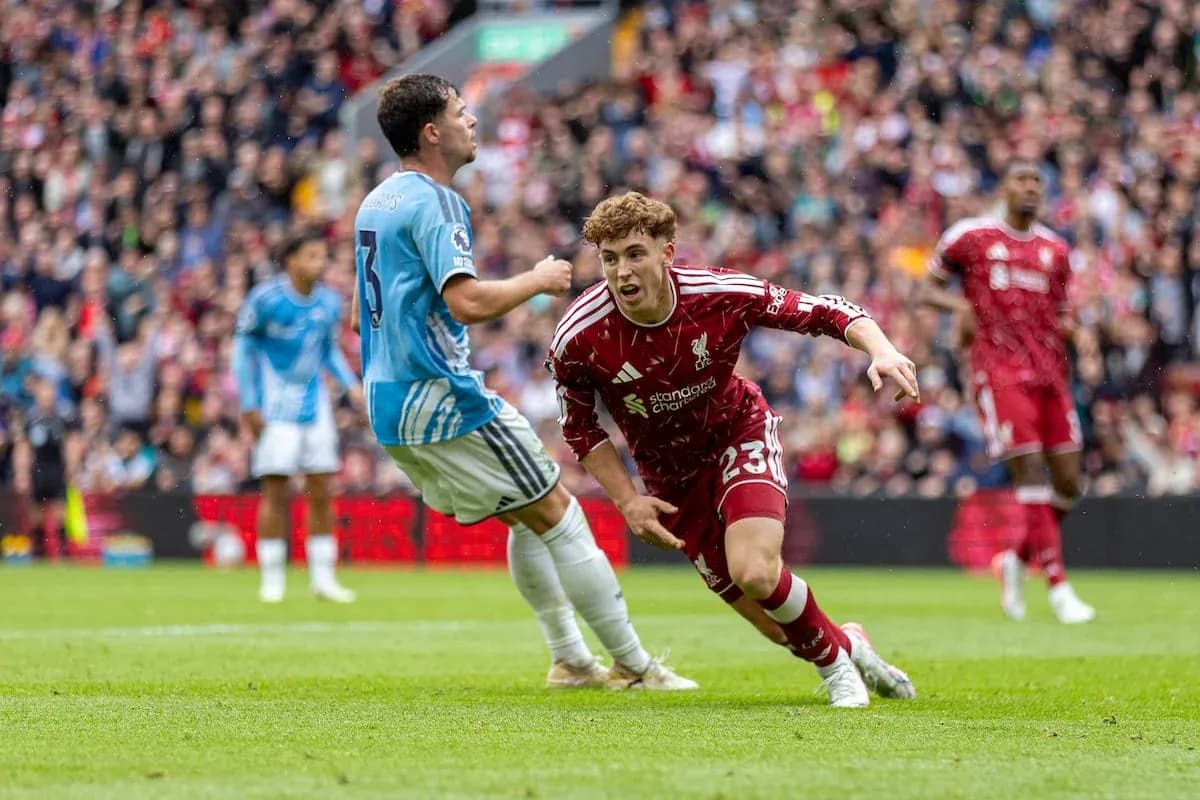
Anfield felt restless at full time. Liverpool had chased the game from a goal down, turned it around, and still watched Nottingham Forest escape with a 2-2 draw. For Andoni Iraola, the story of this Liverpool side after two Premier League rounds is clear: high-tempo, structurally ambitious, but still learning how to control chaos. For Oliver Glasner, Forest leave Merseyside with a point and a clearer sense of how their new 3-4-2-1 can trouble bigger sides.
I. The Big Picture – Early-Season Identities
Following this result, Liverpool sit 13th with 2 points from 2 matches, their overall goal difference locked at 0 after scoring 4 and conceding 4. At Anfield, they have played 1 league game, drawing it 2-2, and their attacking profile is obvious: 2.0 goals per game at home and 2.0 on their travels, but the same 2.0 conceded in both dimensions. They are an open game waiting to happen.
Forest, 15th with 1 point, are more brittle but no less dangerous. Overall they have scored 2 and conceded 3 in 2 league matches, an overall goals-against average of 1.5. At home they have failed to score and conceded 1, while on their travels they have already hit 2 and let in 2. Away from the City Ground, Forest are prepared to trade blows.
Both sides remain without a win, yet the shapes on the pitch told different stories. Liverpool’s 4-2-3-1 is already ingrained – it is the only formation they have used across their 2 league fixtures. Forest mirror that tactical consistency with their 3-4-2-1, also used in both games. This is not experimentation; it is two coaches bedding in long-term structures.
II. Tactical Voids – Who Was Missing and What It Meant
Liverpool’s squad sheet carried a long list of absentees. In midfield, the absence of Stefan Bajcetic (hamstring) and the more physical presence of Joe Gomez (injury) limited Iraola’s ability to rotate his defensive core and add extra protection in front of Virgil van Dijk and J. Jacquet. The injuries to F. Chiesa (back), H. Ekitike (Achilles tendon) and G. Leoni (knee), plus the coach’s decision to leave out H. Elliott, trimmed Liverpool’s options between the lines and in wide areas. It forced greater responsibility onto the creative trio of C. Gakpo, Florian Wirtz and Víctor Muñoz, with Alexander Isak as the lone reference point.
Forest were without I. Sangare (calf) and N. Savona (knee), a double blow in central zones. Without Sangare’s ball-winning presence, the burden of screening the back three fell heavily on X. Schlager and J. McAtee, and it showed in phases when Liverpool’s midfield rotations dragged them into uncomfortable areas.
Disciplinary trends added another layer. Heading into this game, Liverpool had not received a red card in the league, but their yellow-card profile is spiky: 2 bookings in the 16-30 minute window, 2 between 46-60, 1 between 61-75 and 2 more from 76-90. It is a team that tends to live on the edge in the middle and late stages of each half. Forest’s yellows cluster earlier: 1 between 16-30, 1 between 31-45 and 2 between 46-60. The pattern suggests that both sides can be baited into fouls when the tempo spikes, but Liverpool’s risk profile stretches deeper into the closing quarter-hour.
III. Key Matchups – Hunter vs Shield, Engine Room vs Enforcer
The “hunter” for Liverpool is increasingly Gakpo. With 1 goal and 1 assist in 2 league appearances, 5 key passes and a rating of 7.25, he is the creative fulcrum from the left or half-space. His duel with Forest’s defensive structure was as much about how he attacked the gaps around N. Milenkovic and Murillo as it was about his combination play with Isak. Forest’s overall defensive record – 3 conceded in 2 games, with 2 of those on their travels – suggests that once you get them turning, they wobble.
Isak, with 1 goal from 5 shots (3 on target) and 14 duels contested, is the pure “hunter” archetype. His battle with Milenkovic in the air and Murillo on the cover line framed much of Liverpool’s vertical threat. Milenkovic’s role as the central pillar of the back three is to manage depth and deny Isak clean runs; every time Forest’s wing-backs, O. Aina and N. Williams, were pinned back by Frimpong and Kerkez, the Serbian was exposed to direct service.
In the “engine room”, A. Mac Allister and Dominik Szoboszlai faced Schlager and McAtee. Mac Allister’s metronomic passing, paired with Szoboszlai’s willingness to break lines, aimed to pull Forest’s double pivot out of shape. Conversely, Schlager’s job was to slow Liverpool’s transitions and protect the central corridor in front of the back three. Any time he was dragged wide to deal with Muñoz or Wirtz drifting inside, Forest’s structure looked vulnerable.
Further ahead, the creative duel between Wirtz and Morgan Gibbs-White defined the game’s rhythm. Wirtz, already on 1 assist with 85 passes at 81% accuracy, is Liverpool’s subtle surgeon between the lines. Gibbs-White, with 1 goal, 1 assist and 8 successful dribbles from 8 attempts, is Forest’s swaggering playmaker. His combinations with D. Ndoye and Igor Jesus in the half-spaces were Forest’s best route out of Liverpool’s press.
On the flanks, the confrontation between Jeremie Frimpong and O. Aina was a collision of aggression. Frimpong’s 4 key passes and relentless overlaps push opponents back, but he also carries 1 yellow card and a tendency to commit fouls. Aina, with 2 yellow cards already and no reds, is both Forest’s outlet and their disciplinary risk. His 7 dribble attempts and 4 successes show how willing he is to carry the ball out, but every lost duel against Muñoz or Wirtz risked Liverpool flooding his channel.
IV. Statistical Prognosis – What the Numbers Whisper
From a pure numbers lens, Liverpool’s profile is that of a side whose attacking xG would likely be strong: 2.0 goals scored per game overall, no games without scoring, and a penalty record that is flawless so far (1 taken, 1 scored, none missed). Forest’s penalty record is also perfect – 1 scored, none missed – but their overall attacking output is more modest, with 1.0 goal per game overall and 0.0 at home.
Defensively, Liverpool’s concession rate of 2.0 goals per game in total, with no clean sheets, underlines their main weakness: structural risk in exchange for attacking volume. Forest concede 1.5 goals per game overall, and 2.0 on their travels, which suggests that in open, transition-heavy matches like this one, they will always give up chances.
Put together, the tactical and statistical picture paints Liverpool as the side more likely to generate sustained pressure and higher xG, especially at Anfield. But Forest’s capacity to strike through Gibbs-White and Ndoye, and their willingness to attack space in behind, ensures that even when Liverpool are on top, the game never feels secure.
Following this result, both coaches leave with confirmation of their teams’ identities. Liverpool are a high-ceiling, high-variance side still searching for defensive control. Forest are a counter-punching outfit whose 3-4-2-1 can hurt anyone on their travels, but whose defensive shield still leaks under sustained pressure. In a long Premier League season, this 2-2 at Anfield feels less like a one-off and more like a preview of the storylines to come.