.svg&w=384&q=75 "GoalGist logo")
Lise Klaveness Challenges FIFA: A Call for Change
In a sport still ruled by old networks and older habits, Lise Klaveness has become something football is not used to handling: a persistent, principled problem for those at the very top.
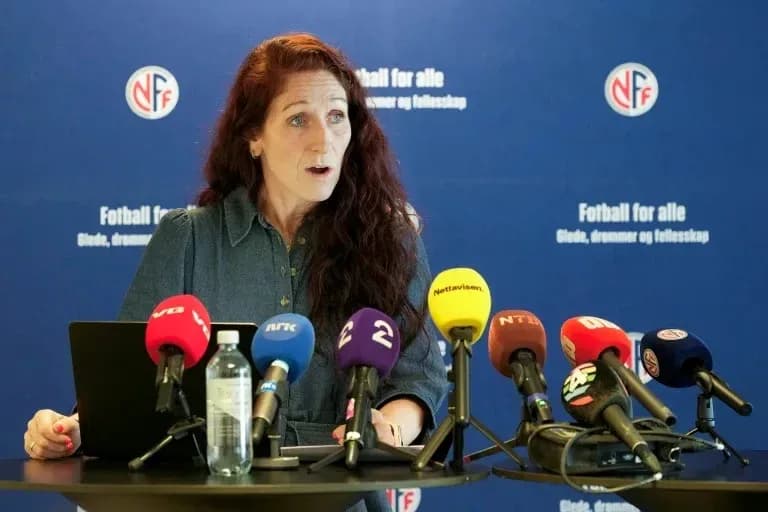
The president of the Norwegian Football Federation, a 45-year-old lawyer and former international with 73 caps, has spent years needling FIFA from the margins. This week, she went further than ever. She called for Gianni Infantino to resign.
From reform hopes to open revolt
When Infantino swept into power in 2016, Klaveness was among those willing to believe in his pitch.
He arrived on a reform ticket, promising good governance and a break from the murk of the Blatter era. That, she told AFP, was the candidate the football world thought it was getting.
Then, in her view, the whole project fell apart.
"Things quickly deteriorated," she said, describing a slide from promised distance to full-blown proximity to political power, and a growing dependence on heads of state and influential figures, particularly in World Cup host nations. The reformer, in her eyes, had become another operator.
Klaveness did not stay quiet for long. Appointed head of the Norwegian federation in 2022, she chose Doha, on the eve of the World Cup, as the stage for her first major challenge to FIFA.
From the heart of the tournament, she condemned the way Qatar had been awarded the World Cup, lamenting that human rights, equality and democracy – “the core interests of football” – had not even made the starting XI. It was a direct shot at the organisation’s leadership, delivered in their own showcase event.
Norway followed up with action. In 2023, the federation refused to back Infantino’s re-election, a symbolic but pointed refusal to fall in line.
“She was in a way the first standard-bearer for much of this criticism that many others now share when it comes to the way Infantino runs FIFA,” said Mina Finstad Berg, a sports commentator for Norwegian broadcaster TV2. Berg describes Klaveness as someone fiercely attached to rules and decisions actually being respected, not just written down.
Trump, Balogun and the breaking point
The list of grievances has grown longer and sharper.
In recent months, Klaveness has watched FIFA hand a “Peace Prize” to former US President Donald Trump, a leader with whom Infantino has maintained a conspicuously close relationship. She has watched the suspension of US player Folarin Balogun for the 2026 World Cup be lifted after an intervention from Trump. And she has watched Infantino’s attempt to open FIFA competitions, including the World Cup, to private investors collapse under fierce resistance.
The plan to invite private money into the heart of FIFA’s showpiece events was rejected last week. For Klaveness, it was another red flag in a series that could no longer be ignored.
Norway has now decided to take all three issues – the Peace Prize, the Balogun decision and the investors project – to FIFA’s Ethics Committee. It is a direct challenge to the president’s judgement and the culture around him.
Her words carry more weight now than when she first spoke out. Norway, long on the outside looking in at major tournaments, put together an impressive run at this year’s World Cup before falling to England in the quarter-finals. The team’s performances have given her federation fresh credibility on the international stage.
Abroad, commentators have started to describe Klaveness as a figure with a “strong moral compass” and, crucially, as a serious contender to replace Infantino should he step aside. That remains hypothetical. Infantino is standing for a fourth and final term next March and, for now, is the only declared candidate.
Still, the idea is out there. Former FIFA president Sepp Blatter, himself disgraced by corruption scandals, has even taken to social network X to argue that she was the only one who consistently took a clear stand and refused to drift with the mainstream. He added that the time was right for a woman to lead FIFA.
Coming from Blatter, the irony is hard to miss. The message, though, underlines how far Klaveness has cut through.
Not a “Game of Thrones” – but a ballot box battle
Klaveness, for her part, has tried to pull the conversation away from the drama of personalities and palace intrigue.
She has insisted the crisis in world football cannot be reduced to a “Game of Thrones” contest for the throne in Zurich. For her, the issue is structural: governance, transparency, independence.
“For us, it has never been a personal issue against Gianni Infantino,” she told AFP. “The problems go beyond the person of the president.”
She knows her name is now being floated as a possible successor. She admits she has “registered” that talk. Then she brushes it away. “We’re not there yet,” she says when asked if she is a candidate.
There are reasons for that caution, and they are not only political.
“In addition to being seen as extremely radical in many places, especially outside Europe, she is a woman. That is also likely to count against her in many regions of the world,” Berg pointed out. The global football map is not drawn with reformers, or women, in mind.
Even within UEFA, where one might expect her to find her natural base, the path has been rocky. Klaveness failed to win election to the Executive Committee in 2023. She only joined in 2025, and then only as the sole candidate for the seat reserved for women.
The symbolism is stark: a figure talked up as a potential leader of the world game struggled to win a contested vote in her own confederation.
Former Norway goalkeeper and now commentator Erik Thorstvedt put the question bluntly: if she finds it this hard to be elected in Europe, how is she supposed to convince voters in Africa or South America?
That is the reality facing any insurgent in FIFA politics. Reformers do not just have to beat the incumbent; they have to navigate a landscape built to keep challengers at arm’s length.
For now, Klaveness stands where she has stood from the start: outside the inner circle, firing in questions that many inside would rather not hear. Whether those questions ever carry her to the top job is unclear. What is certain is that, as Infantino pushes for one last term, the most persistent voice against him is no longer whispering from the sidelines – it is demanding a different way of running the world’s game.