.svg&w=384&q=75 "GoalGist logo")
Lecce vs AS Roma: A Tale of Two Teams in Serie A
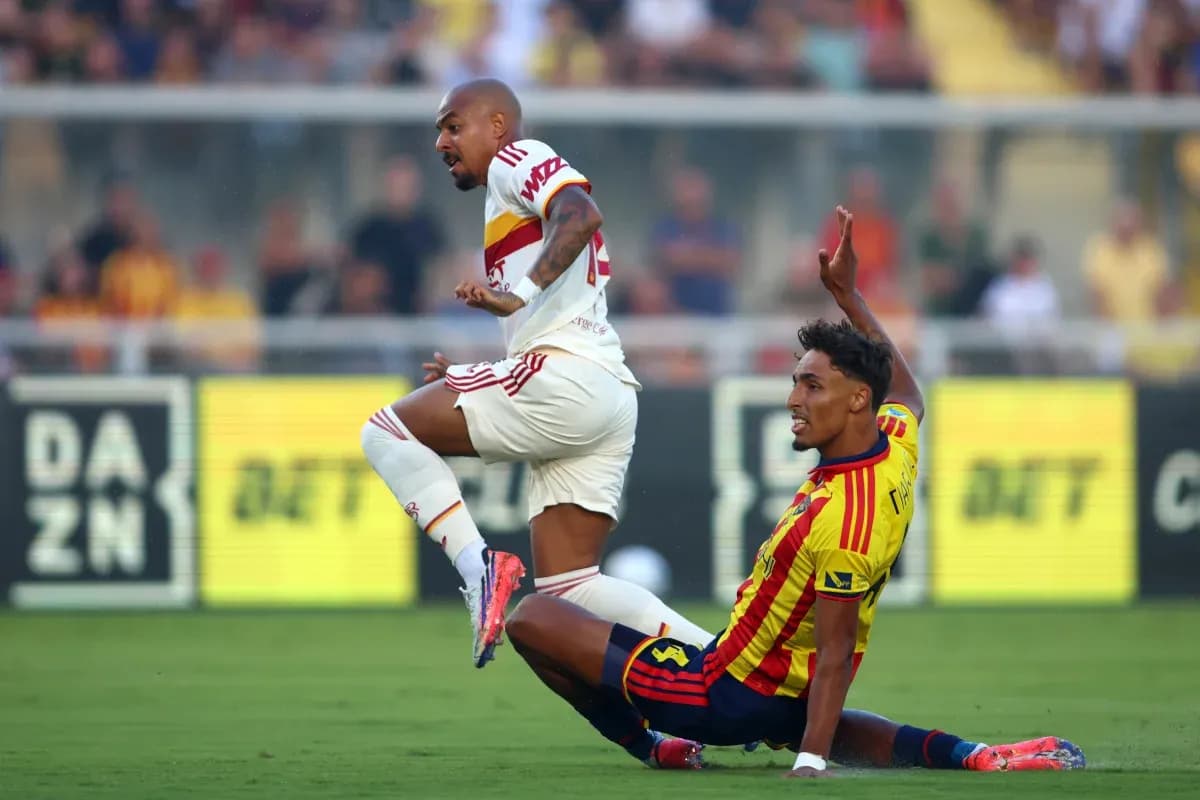
Under the late-summer light at Stadio Via del Mare, this was billed as an early test of Lecce’s new shape against the most ruthless machine of the opening Serie A weeks. By full time, the scoreboard – 0-4 to AS Roma – told a brutal story of where these two sides currently live in the league’s food chain.
I. The Big Picture – Two Matchdays, Two Realities
Following this result in Regular Season - 2, the standings snapshots tell you everything about the divergent trajectories. Lecce sit 13th with 3 points from 2 matches, their overall goal difference at -2, correctly mirroring 2 goals scored and 4 conceded. The pattern is stark: on their travels they have been sharp and efficient, winning 2-0, but at home they have now played 1, lost 1, scored 0 and conceded 4. Via del Mare, for the moment, is not a fortress but a fault line.
Roma, by contrast, leave Lecce as early pace-setters. They top Serie A in 1st place with 6 points from 2 games, having scored 8 overall and conceded none – a monstrous overall goal difference of +8. The symmetry is chilling for the rest of the league: at home they have won 4-0, and on their travels they have now produced another 4-0. The 3-4-2-1 that Piero Gasperini Gian has locked in across both league outings is already functioning like a seasoned system, not a new-cycle experiment.
II. Tactical Voids and Structural Choices
Eusebio Di Francesco’s decision to go 3-5-2 was a clear attempt to match Roma’s back three and crowd central zones. Wladimiro Falcone sat behind a trio of J. Siebert, K. Gaspar and Tiago Gabriel, with a broad five-man band of D. Veiga, L. Coulibaly, O. Ngom, O. Gorter and C. Ndaba tasked with both screening and supplying. Up front, S. Pierotti and W. Geubbels were meant to stretch Roma’s line and offer counters into the channels.
But the structural idea collided with Roma’s intensity and quality. Lecce’s season data underlines the fragility: overall they average 1.0 goal for per game but 2.0 goals against. At home that imbalance becomes extreme – 0.0 goals scored per game against 4.0 conceded. The 3-5-2, which has now been used once alongside an earlier 4-3-3, still looks like an unfinished sketch rather than a stable blueprint.
Roma had their own absences to navigate. M. Bah (knee injury), L. Pellegrini (thigh injury) and D. Rensch (muscle injury) were all ruled out as Missing Fixture. On paper, that strips creativity, control and depth. In practice, the system and squad depth masked the gaps. M. Svilar anchored a back three of D. Ghilardi, G. Mancini and M. Hermoso; ahead of them, a mobile four of E. Lulli, M. Kone, B. Cristante and Wesley Franca gave Roma both width and central presence. P. Dybala and M. Soule floated behind D. Malen, the league’s most devastating early-season finisher.
Disciplinary patterns added another layer. Lecce’s yellow cards this season are spread evenly across the game: 25.00% of their bookings come in each of the 0-15, 46-60, 61-75 and 76-90 minute windows. It suggests a side that can be forced into fouls at any stage, especially when chasing. Roma, meanwhile, cluster their cautions in the first hour – 33.33% in each of 0-15, 31-45 and 46-60 – reflecting an aggressive front-foot press that risks cards early but rarely loses control late.
III. Key Matchups – Hunter vs Shield, Engine Room vs Engine Room
The headline duel was always going to be D. Malen versus Lecce’s defensive block. Malen arrives as Serie A’s leading scorer, with 5 goals in 2 appearances, from 9 shots and 6 on target, and an overall rating of 8.75. He is not just finishing volume; he is finishing efficiently and repeatedly. Against a Lecce side that, overall, concedes 2.0 goals per match and at home has already shipped 4 in a single outing, the matchup was brutally lopsided. Tiago Gabriel, who features among the early-season scorers with 1 goal and a solid defensive profile (5 duels overall, 4 won, 2 tackles, 2 interceptions), found himself more in survival mode than on the front foot.
Behind Malen, Roma’s creative trident tilted the balance. P. Dybala, the league’s top assister so far with 3 assists in 2 games and 7 key passes, orchestrates from the half-spaces. Wesley Franca adds another 1 assist and 4 key passes, while also contributing 6 tackles and 21 duels overall, 12 of them won. Together they form a dual threat: if you sit off, they pick passes; if you step out, they drive through you.
Lecce’s midfield, anchored by L. Coulibaly and flanked by O. Ngom and O. Gorter, was asked to both compress space around Dybala and screen the runs of Wesley and M. Kone. The problem was numerical and qualitative. Roma’s 3-4-2-1 creates overloads in the half-spaces: Cristante and Kone can step up, Wesley tucks inside, and Dybala roams. Without a true specialist destroyer dominating those lanes, Lecce’s five became a line that could be pulled apart rather than a block that could suffocate.
In the engine room duel, M. Kone quietly underpinned Roma’s control. Across the season he has completed 110 passes with 92% accuracy, adding 4 key passes and 4 tackles, plus 14 duels overall with 8 won. His ability to recycle possession and break lines ensured Roma’s attacks kept coming in waves, pinning Lecce deep and denying them the transitions that a 3-5-2 thrives on.
IV. Statistical Prognosis – A Ruthless Roma, a Searching Lecce
Even without explicit xG numbers, the underlying metrics point clearly. Roma’s overall attacking output – 8 goals in 2 matches, averaging 4.0 goals for both at home and on their travels – is backed by defensive perfection: 0.0 goals against in any context, home or away, and 2 clean sheets in 2 games. This is not a hot finishing streak alone; it is a structurally dominant side conceding almost nothing in terms of chances.
Lecce’s profile is the mirror image. Overall they have 2 goals in 2 games (1.0 per match), but their defensive record is fragile: 4 conceded overall, all of them at home, for an overall average of 2.0 goals against per game and a home average of 4.0. They have managed 1 clean sheet, but only on their travels, and have already failed to score once – again, at home.
Discipline does not offer a hidden edge. Roma’s yellow-card pattern – 3 bookings spread evenly across the first hour – speaks to controlled aggression, and their leading figures like Malen and Kone each carry just 1 yellow card with no reds. There are no penalties taken or missed on either side this season; no set-piece volatility to tilt the odds.
Overlaying all of this, Roma’s biggest wins – 4-0 at home and 0-4 on their travels – are not outliers but a repeating scoreline. The system is stable, the personnel are producing, and even key absences have not slowed them. Lecce, alternating between 4-3-3 and 3-5-2, are still searching for a defensive platform that can survive against elite attacks.
From a tactical and statistical lens, this match at Via del Mare played out exactly as the numbers warned. Roma’s hunter – Malen – and their creative axis of Dybala and Wesley operated against a home side whose shield is not yet hardened, especially on this ground. Until Lecce can translate their away solidity into home resilience, nights like this against the league leaders will remain less a shock and more an inevitability.