.svg&w=384&q=75 "GoalGist logo")
Kinsky's Redemption: From Madrid Wreckage to Elland Road Glory
Antonin Kinsky walked off in Madrid like a man being ushered out of his own career.
Hooked after 17 minutes, two errors, two goals, and a 2-0 deficit to Atletico in a Champions League last‑16 tie, the 23-year-old trudged towards the touchline with the kind of spotlight no goalkeeper wants. On CBS Sports, Peter Schmeichel — a man who knows the darkness and the glory of the position better than almost anyone — predicted that this would be the moment forever attached to Kinsky’s name.
Loris Karius was the obvious reference point. A Champions League night that scars so deeply it seems to end the story rather than shape it.
Tottenham head coach Igor Tudor insisted Kinsky would play again, maybe even this season. It sounded like the sort of thing managers have to say. Even the most hopeful Spurs supporters weren’t exactly circling a date for his redemption.
Kinsky had other ideas.
From Madrid wreckage to Elland Road defiance
Since stepping back in for the injured Guglielmo Vicario against Sunderland last month, Kinsky has been quietly stitching his reputation back together. There were good signs: sharp stops, clean handling, composed distribution. The late free-kick save in the 1-0 win over Wolves stood out in particular.
But this was still rehab work, not resurrection. Madrid lingered. It takes more than a handful of tidy performances to flush that kind of trauma from the subconscious — his and everyone else’s.
Against Leeds United on Monday night, in a fraught 1-1 draw that could yet define Tottenham’s season, he finally produced the night he needed.
Not once. Twice.
The second save will make the highlight reels and the survival montages. The first deserves just as much attention.
Questions over Kinsky’s command of his box had been fair. His jittery Carabao Cup display at Newcastle in October, when he twice failed to deal with crosses in a 2-0 defeat, left a mark. Corners and wide deliveries looked like an exposed seam in his game.
So when Brenden Aaronson swung in a cross in the 21st minute at Elland Road and Joe Rodon, once of Spurs, attacked it at the far post, the script almost wrote itself. Rodon’s header was low, angled towards Kinsky’s bottom-left corner, the sort that often sneaks under a scrambling keeper.
Kinsky didn’t scramble. He exploded.
He dived low, got a strong hand to the ball, then clawed it back into his grasp before any rebound could fall kindly. A full, three-part save: reaction, recovery, control. It was, by any standard, world-class.
And it was only the warm-up act.
A season on a glove
Deep into stoppage time, with Tottenham clinging to a point that keeps them just ahead of West Ham in the relegation scrap, Elland Road braced itself.
Leeds worked the ball into the box. A pass slid in behind. The crowd inhaled.
This is where many goalkeepers lose themselves — charging out, narrowing angles, committing early. Kinsky stayed calm. Stayed connected to the ground. Short, precise steps. A subtle slide towards his near post, always aligned with the ball, trusting Micky van de Ven’s recovery run to take away part of the danger.
Sean Longstaff arrived eight yards out and let fly. Power, close range, rising.
Kinsky’s response was a study in control under chaos.
“As the ball was played in behind, he resisted the natural temptation to rush out and close the angle, and instead stayed connected to the ground with short, controlled steps,” explains Matt Pyzdrowski, former professional goalkeeper, coach and The Athletic’s goalkeeping analyst. “With Micky van de Ven recovering across, Kinsky understood his responsibility was not to overcommit but to remain balanced and prepared for the shot.”
The technique behind the save was as impressive as the drama.
“Technically, his set position was outstanding,” Pyzdrowski continues. “He stayed neutral through his body shape — feet shoulder-width apart, chest slightly over his knees and hands held around waist height — which allowed his hands to stay free and reactive.
“Crucially, that positioning naturally placed his hands in the ideal zone to protect the upper half of the goal while leaving his legs available to seal the lower portion, very similar to the way David de Gea so often operated at his peak for Manchester United.”
Longstaff’s strike demanded more than reflex. It demanded perfect mechanics at full speed.
“Had Kinsky dropped lower or widened his base, he would have likely lost the explosive push needed to reach the shot while simultaneously locking his hands’ pathway to the ball,” Pyzdrowski says. “Instead, his compact, upright shape reduced the distance his hands needed to travel and allowed his reactions and coordination to take over.
“What was incredible was how quickly he managed to line his hands up with the ball and, frankly, how ridiculous it was that he could still generate the power to drive his right hand upward to make the save — which is not something every goalkeeper would have been capable of producing in that moment.”
The ball cannoned off his glove, crashed against the crossbar and stayed out. Tottenham’s lead over West Ham in the survival fight stayed at two points.
Not every goalkeeper makes that save. Kinsky did.
Not just a shot-stopper, but a survivor
This is what separates a decent technician from a top-level goalkeeper: not just the hands, but the head.
Kinsky’s ability with the ball at his feet already fits the modern template. He can pass short, go long, play under pressure. His distribution is tailor-made for a coach like Roberto De Zerbi, who demands brave, precise build-up from the back.
But plenty of goalkeepers can ping passes. Not many come back from a night like Madrid this quickly, this emphatically.
A Champions League humiliation was supposed to define him. Instead, it sharpened him.
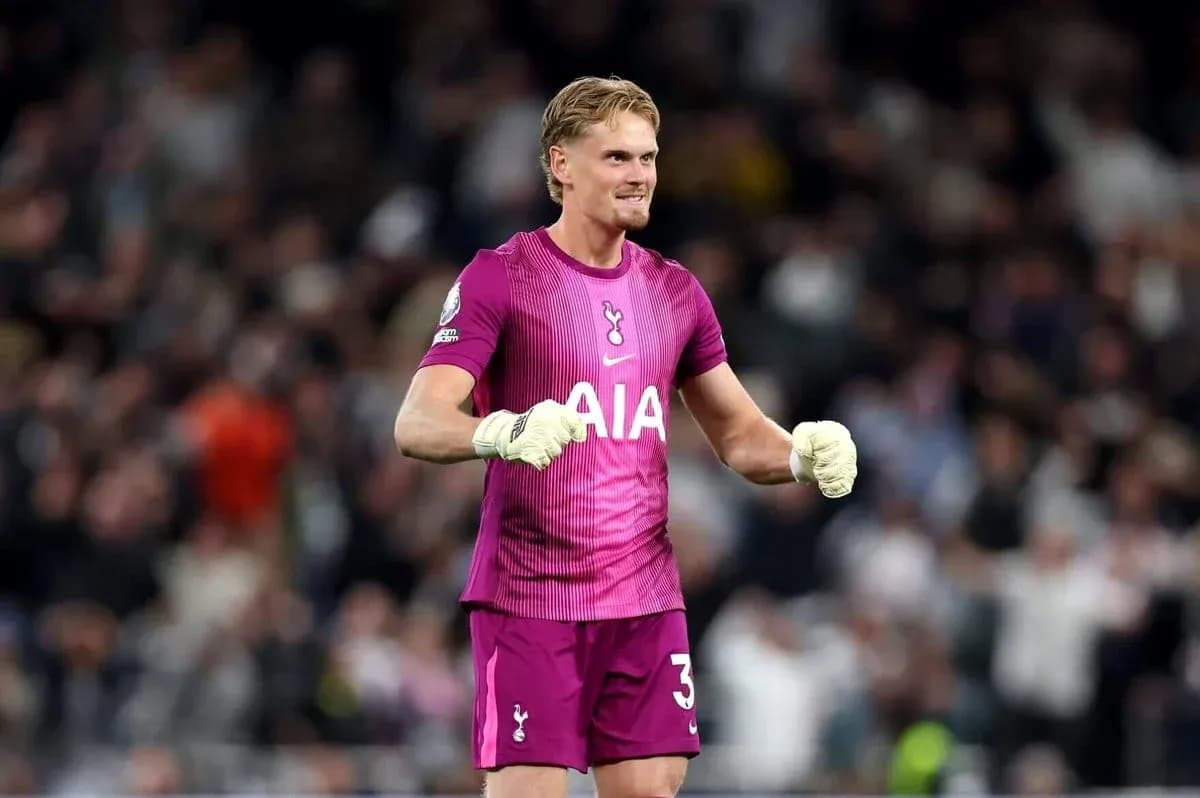
At the final whistle at Elland Road, Kinsky stood in front of the away end, taking in the applause from supporters who, a few weeks ago, might have wondered if they’d ever trust him again. He looked like what he has quietly become over the past month: one of Tottenham’s most reliable performers in their most fragile moment.
Tel’s turn to respond
Spurs fans will have imagined this game playing out very differently once Mathys Tel curled them into the lead with a superb finish. It was the sort of goal that should settle a tense night, not open the door to more drama.
Then Tel found himself on the wrong side of the story. Deep in his own box, facing his own goal, he opted for an overhead-kick clearance that belonged in a training-ground blooper reel, not a relegation fight. He missed. Chaos followed. Dominic Calvert-Lewin buried the penalty for Leeds’ equaliser.
Tel had gone from match-winner to culprit in the space of a few wild seconds.
Tudor knows what that can do to a young player. After the game, he said he would give Tel “a big hug and a big kiss” to help him process the mistake and move on. Kinsky has just provided the perfect blueprint: a brutal low, then a defiant climb back.
Tottenham still sit only two points ahead of West Ham, who travel to Newcastle on Sunday with their own fate and Spurs’ anxiety in their hands. The margins are thin, the pressure suffocating.
Kinsky’s redemption arc may already feel complete, but the season is not. There are still trips to Chelsea and Everton to come, still nights when one decision, one step, one outstretched glove could decide everything.
Spurs will hope Madrid was the making of him, not the end — and that this is not the final chapter of his story, just the moment it truly began.

