.svg&w=384&q=75 "GoalGist logo")
Juventus vs Parma: A Serie A Statement Match
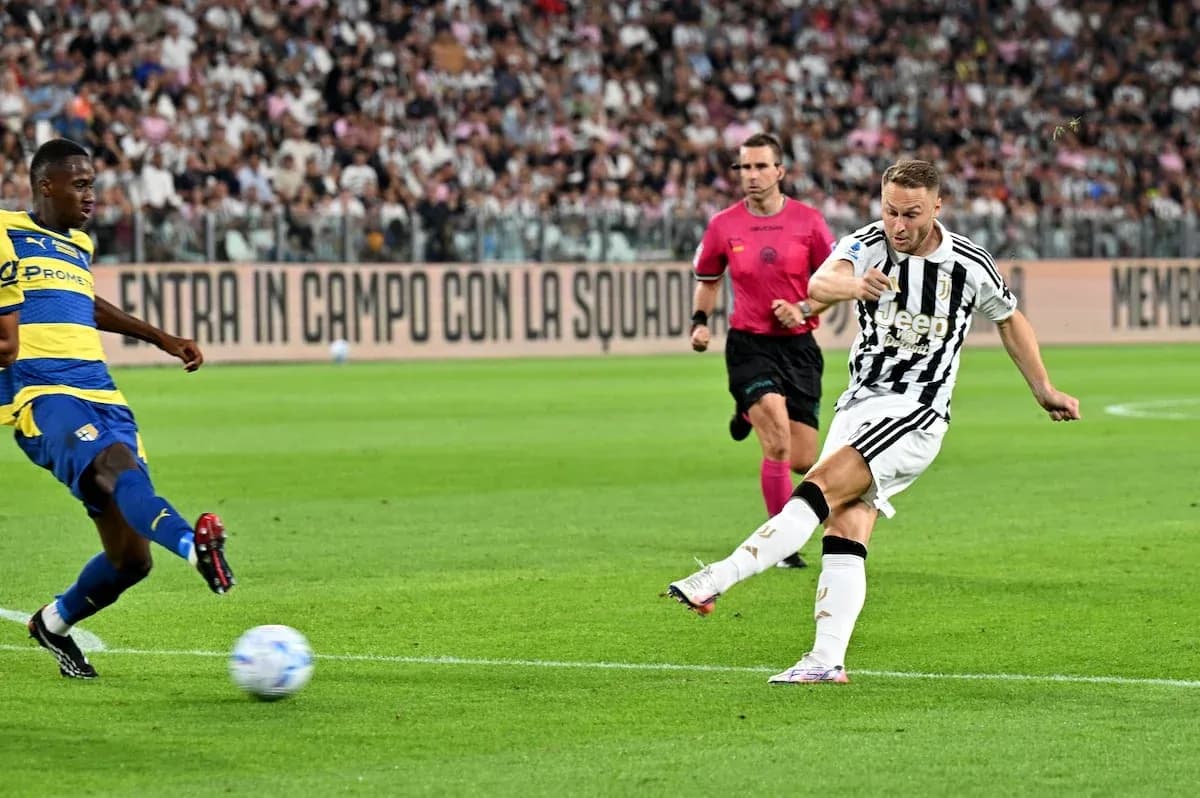
Under the Turin lights at Allianz Stadium, this Serie A night had the feel of a statement rather than a simple second-round fixture. Juventus, already humming under Luciano Spalletti, arrived with a perfect record, a clean defensive sheet, and a new, more vertical identity. Parma, guided by Carlos Cuesta, came as early-season strugglers: no points, no goals scored, and a back line still adjusting to top-flight tempo. The 2–0 full-time scoreline did more than separate the sides; it crystallised where each squad stands in its evolution.
Heading into this game, the numbers painted a stark contrast. Overall this campaign, Juventus had taken 6 points from 2 matches, scoring 3 and conceding none. That goal difference of +3 was built on balance: at home they had scored 2 and conceded 0, away they had scored 1 and again conceded 0. Parma, by contrast, sat 16th with 0 points, 0 goals scored and 3 conceded overall, split as 1 against at home and 2 away, for a goal difference of -3. One team was playing to confirm Champions League ambitions; the other was trying to prove it belonged.
Tactical Overview
Spalletti’s choice of a 4‑4‑2 was revealing. In goal, Guglielmo Vicario provided calm distribution. The back four of P. Kalulu, Bremer, J. Lucumi and Z. Çelik was built for aggression on the front foot: both centre-backs comfortable stepping into midfield, both full-backs capable of pinning Parma’s wide men deep. Ahead of them, the midfield quartet of Francisco Conceição, M. Locatelli, Douglas Luiz and J. Boga gave Juventus a rare blend of control and chaos: Locatelli and Douglas Luiz to orchestrate and screen, Conceição and Boga to attack space and isolate defenders.
Up front, R. Kolo Muani and J. David formed a strike partnership tailored to Spalletti’s vertical game. David’s movement between lines and Kolo Muani’s ability to stretch the pitch meant Parma’s centre-backs, M. Troilo and D. Drobnic, were constantly being asked to defend facing their own goal.
Cuesta mirrored the shape with a 4‑4‑2 of his own, but the personnel told a different story. E. Corvi in goal was shielded by a back line of E. Delprato, Troilo, Drobnic and E. Valeri. In midfield, S. Britschgi, C. Ordonez, A. Bernabe and M. Keita were tasked with compressing central spaces, while S. Lontani and E. B. Toure led the line. It was a structure more concerned with survival than assertion, understandable given Parma had failed to score in both their matches so far and had yet to keep a clean sheet.
Injuries and Discipline
The tactical voids were most obvious in the absences. Juventus were without W. McKennie (muscle injury), K. Thuram (knee injury), K. Yildiz (foot injury) and E. Zhegrova (muscle injury). That stripped Spalletti of dynamism and depth in midfield and wide areas, forcing him to lean heavily on Locatelli’s metronomic passing and Conceição’s one‑v‑one threat. For Parma, the loss of H. Nicolussi Caviglia to a groin injury removed a potential stabiliser in the middle of the park, leaving Bernabe as the primary conduit between defence and attack.
Discipline added another layer. Overall this season, Juventus’ yellow cards have been distributed with a clear late‑pressure profile: 25.00% of their cautions between 0–15 minutes, 50.00% between 46–60, and another 25.00% in the 76–90 window. It is the pattern of a side that defends aggressively at the start of each half and then again as they close games out. Players like A. Cambiaso and Çelik, both already booked once this season, embody that front-foot edge when they come on or start.
Parma’s cautions tell a different story: 33.33% of their yellows between 46–60 minutes, 33.33% between 76–90, and 33.33% deep into 91–105. That spread hints at a team that arrives late into challenges as intensity rises and legs tire, a dangerous trait against a Juventus side that keeps accelerating into the final third of each half.
Key Players
Within that landscape, the “Hunter vs Shield” duel was clear. For Juventus, Teun Koopmeiners, already on the scoresheet this season from midfield, loomed as a late-game weapon from the bench. His 1 shot, 1 on target, and 1 goal so far underline his efficiency. On the other side, Parma’s shield was Troilo, who has completed 145 passes at 91% accuracy, with 2 successful blocks and 1 interception. His task was to hold the line against the movement of David and the late-arriving midfield runs that Juventus now specialise in.
In the engine room, Locatelli’s influence was decisive. With 159 passes overall at 90% accuracy, 5 key passes and 7 interceptions this season, he is the hinge of Spalletti’s structure. His duel with Bernabe and the hard‑working Abdou Konate, who has already made 3 tackles and 2 interceptions for Parma, defined whether the visitors could break Juventus’ rhythm or would be forced to chase shadows.
Statistical Outlook
The statistical prognosis before a ball was kicked leaned heavily towards the hosts. Overall this campaign, Juventus were averaging 1.5 goals scored per match and 0 conceded, with clean sheets both home and away and not a single failure to score. Parma, by contrast, were averaging 0 goals scored and 1.5 conceded overall, with failures to score in both their fixtures and no clean sheets. Neither side had taken nor missed a penalty, so there was no hidden efficiency to tilt the balance.
On the night, the 2–0 result at home simply confirmed the trajectory the numbers suggested. Juventus’ structure, even without several key squad members, was too mature, too controlled. Parma’s 4‑4‑2, still in its formative stage at this level, could not generate enough threat to disturb a defence that has yet to be breached this season.
Following this result, Juventus remain a side built on defensive perfection and measured attacking thrust, their +3 goal difference fully earned across 2 clinical performances. Parma leave Turin with the same questions they brought: where will the goals come from, and how quickly can their young spine grow into the demands of Serie A?