.svg&w=384&q=75 "GoalGist logo")
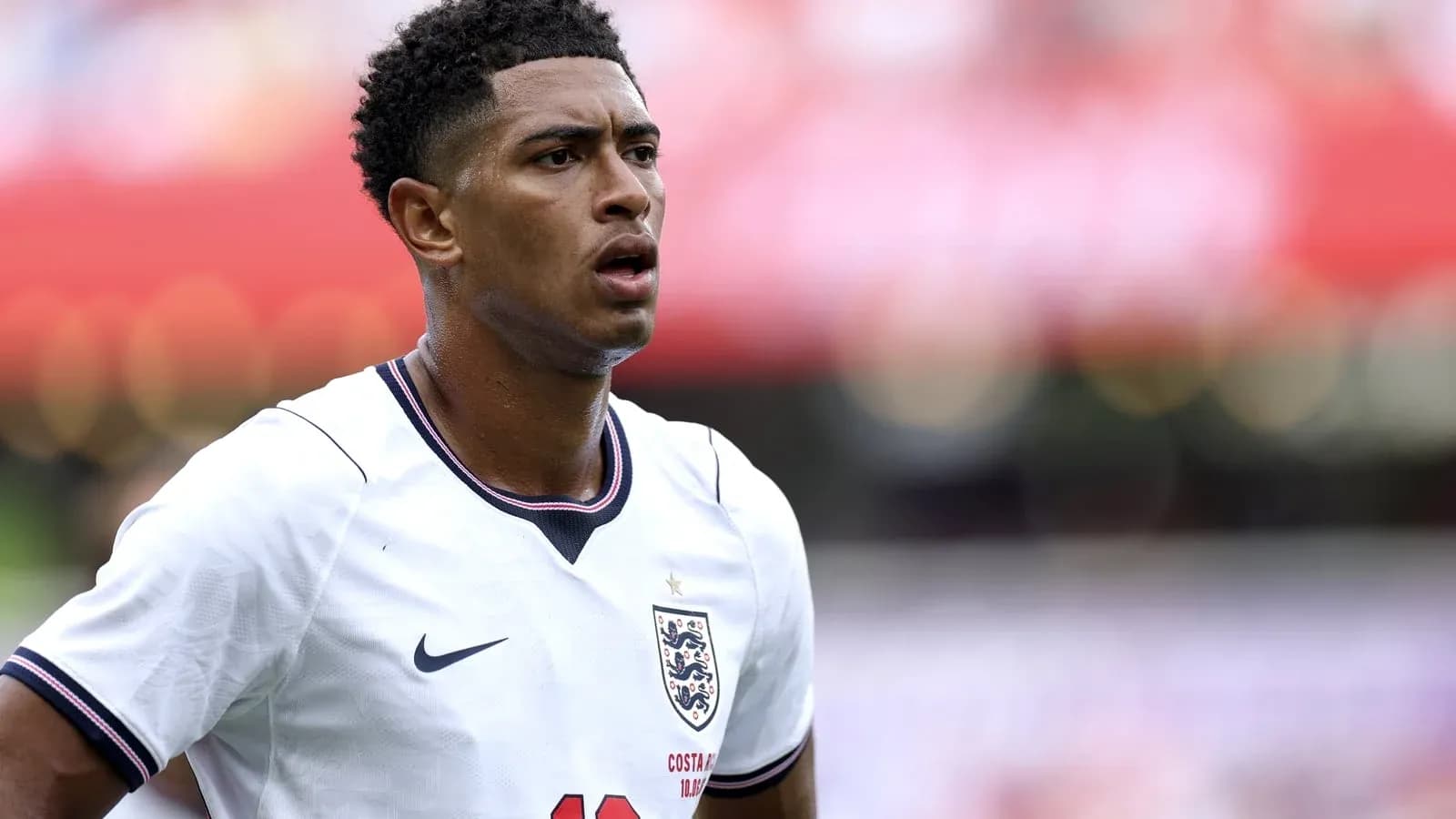
Jude Bellingham Reflects on England's Euro 2024 Journey
Jude Bellingham doesn’t bother dressing it up. England reached the Euro 2024 final, but behind the run to Berlin, something felt broken.
Speaking from the team’s World Cup base in the United States, the Real Madrid midfielder lifted the lid on a camp that never truly clicked in Germany – and on a summer that still makes him uneasy, even when he thinks about that overhead kick.
“We got a few things wrong”
With Thomas Tuchel now talking about building a “brotherhood” as he chases the World Cup in the coming weeks, Bellingham drew a sharp contrast with the mood two years ago.
“At the Euros I think we got a few things wrong off the pitch, I don’t feel the group connected as well as it could have for a number of reasons,” he said.
England arrived at Euro 2024 carrying the weight of expectation. They were widely viewed as one of the two or three favourites to win the tournament. The performances never matched the billing.
“We weren’t playing well, which doesn’t help, so even when we were winning, we didn’t get the feeling that we were as happy as we should be,” Bellingham admitted.
The campaign became a grind. Slovakia pushed them to the brink in the last 16. Switzerland dragged them through penalties in the quarter-finals. The Netherlands almost took them to extra time in the semi-final before a late winner spared them.
Each escape came with more relief than joy. The football never loosened up. Neither, it seems, did the atmosphere.
A wonder goal that still stings
Bellingham’s stoppage-time overhead kick against Slovakia is already lodged in England’s tournament folklore, replayed endlessly as one of the great rescue acts in recent memory. For the player himself, the memory is far more complicated.
“I still remember how I was feeling at the time. It always makes me feel a bit uncomfortable because it was such a bad situation,” he said.
“We weren't playing well. I remember as a kid watching World Cups and Euros where we crashed out against teams we shouldn’t have gone out to and I remember thinking, ‘Wow, I’m about to be a part of one of those moments’. It shakes up the whole of English football.”
The goal changed the narrative of that night and, briefly, the tournament. England survived. They advanced. Yet the moment, as Bellingham tells it, came wrapped in dread, not delight.
It underlines just how fragile that Euro run felt from inside the dressing room, no matter how deep they went.
Tuchel’s England and a new contest at No.10
Now the setting is different. New continent, new manager, new stakes. Tuchel has spoken repeatedly about forging a tighter unit, about that “brotherhood” he believes is essential if England are to go one step further and win the World Cup.
Bellingham, though, is not guaranteed centre stage.
He faces a straight fight with Morgan Rogers for the No.10 role in Wednesday’s World Cup opener against Croatia, with Tuchel effectively casting the pair in direct competition for the same spot.
On paper, it looks ruthless. In reality, it’s layered with history.
The two grew up in the same part of the West Midlands, played junior football together and have stayed close. Now they are duelling for the most glamorous creative role in the side.
Bellingham strengthened his claim with a commanding display in the final warm-up win over Costa Rica on Wednesday, a performance that reminded everyone why he has become one of the game’s leading midfielders before his 23rd birthday.
Yet he insists there is no bitterness in the battle.
“As a person, he is a top guy, he can get along with anyone, can have conversations with anyone,” Bellingham said of Rogers. “He can be a bit loud. We have debates that turn into arguments a lot. But we get on like brothers, to be fair.”
Tuchel has not hidden the stakes.
“The manager has made it very clear in a lot of the times where he has spoken that we are playing for the same position,” Bellingham explained. “I know that has eased up a bit more now that he sees me playing more positions and Morgs playing more positions, but I honestly have no ill feelings when he is playing and I’m not playing.”
So the dynamic is set: two friends, one shirt, and a manager determined to sharpen competition without fracturing the group.
Two years ago, England rode talent and moments through a fractured tournament, only to fall short. Now they go to a World Cup with scars, lessons and a manager obsessed with unity.
The question is whether this version of England can finally marry their quality with the connection Bellingham felt was missing – and whether he will be the one at the heart of it when the ball rolls against Croatia.