.svg&w=384&q=75 "GoalGist logo")
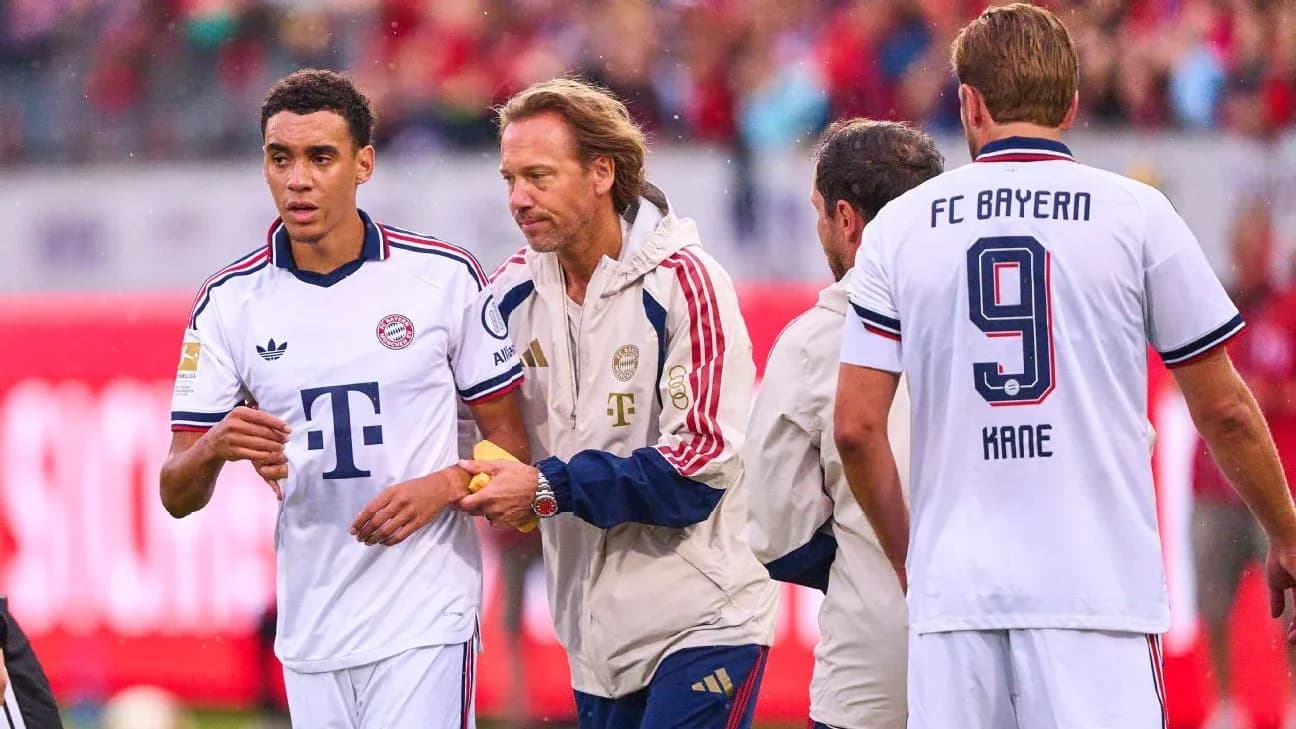
Jamal Musiala Addresses Health Concerns After Collapsing on Pitch
Jamal Musiala has revealed he is living with treatable absence seizures after collapsing on the pitch for the second time in four days – but insists there is no long-term threat to his health or his career.
The Bayern Munich midfielder went down just eight minutes after coming on as a substitute in a preseason friendly against FC Heidenheim on Tuesday night, a worrying repeat of the incident that saw him collapse during Saturday’s match against RB Leipzig.
This time, he decided to speak.
On Wednesday, the 23-year-old addressed the situation directly, explaining his condition and attempting to calm the growing concern around him.
“I understand that many of you are worried. I would like to put those concerns to rest today and explain the situation: I have been diagnosed with brief, temporary — but treatable — absence seizures resulting from a neurological dysfunction,” he wrote on Instagram.
“These can lead to the kind of incidents seen recently, such as during the match against Leipzig or the game in Heidenheim.
“I know they might look alarming at first glance, but for me, they are currently part of my everyday life. I am receiving excellent medical care and remain very optimistic. FC Bayern and my personal support network are right by my side, helping me through this.”
The episodes, short lapses in awareness, have now twice played out in front of cameras and crowds. The images jarred, especially for a player who only returned to top-level football at the start of 2026 after breaking his leg in the Club World Cup against Paris Saint-Germain last summer.
This time, though, the message from Musiala and from Bayern is clear: the condition is understood, monitored and, crucially, treatable.
After the Heidenheim friendly, Bayern sporting director Max Eberl was asked why Musiala had been on the pitch again so soon after collapsing against Leipzig. Eberl hinted then that the midfielder would soon address the matter himself and stressed that the club was fully informed.
“We knew about it and we are aware of the situation,” Eberl said.
Musiala has now filled in the blanks. He stressed that he has been working closely with specialists and that continuing to play is not a reckless gamble, but a decision taken with full medical backing.
“Importantly, there is no further health risk involved,” he wrote. “In close consultation and regular contact with the experts, it was my personal wish to face this challenge; with the medical clearance of the neurologists, I want to continue doing what helps my recovery most: simply living my life and pursuing my passion for playing football.
“I have taken full responsibility for this decision. Overall, I feel very positive and am on the right track.”
He also admitted he had hoped to keep the diagnosis out of the public eye.
Musiala said it had been his “wish to keep this matter private, sharing it only with my closest circle, the club, and the medical experts,” but two on-pitch collapses in four days left little room for silence.
The midfielder’s importance to both Bayern and Germany only magnifies the spotlight. After his long layoff with a broken leg, he returned in the Bundesliga at the start of 2026 and quickly re-established himself. At the 2026 World Cup, he was a key figure for Julien Nagelsmann’s Germany, who were shockingly knocked out in the round of 32 by Paraguay.
Now the conversation around him shifts again: from comeback stories and tactical roles to health, risk and resilience.
Musiala, though, has drawn his own line. He wants to be treated not as a medical case, but as a footballer who happens to be dealing with a neurological condition — one he believes he can manage while still playing at the highest level.
The next time he steps onto the pitch, the questions will return. So will the cameras. The real answer, though, will come from how long he stays on his feet, how often he gets on the ball, and how far he can still carry Bayern and Germany in the seasons ahead.