.svg&w=384&q=75 "GoalGist logo")
Jamal Musiala's Collapse: Understanding His Condition
Jamal Musiala steadied himself, then crumpled.
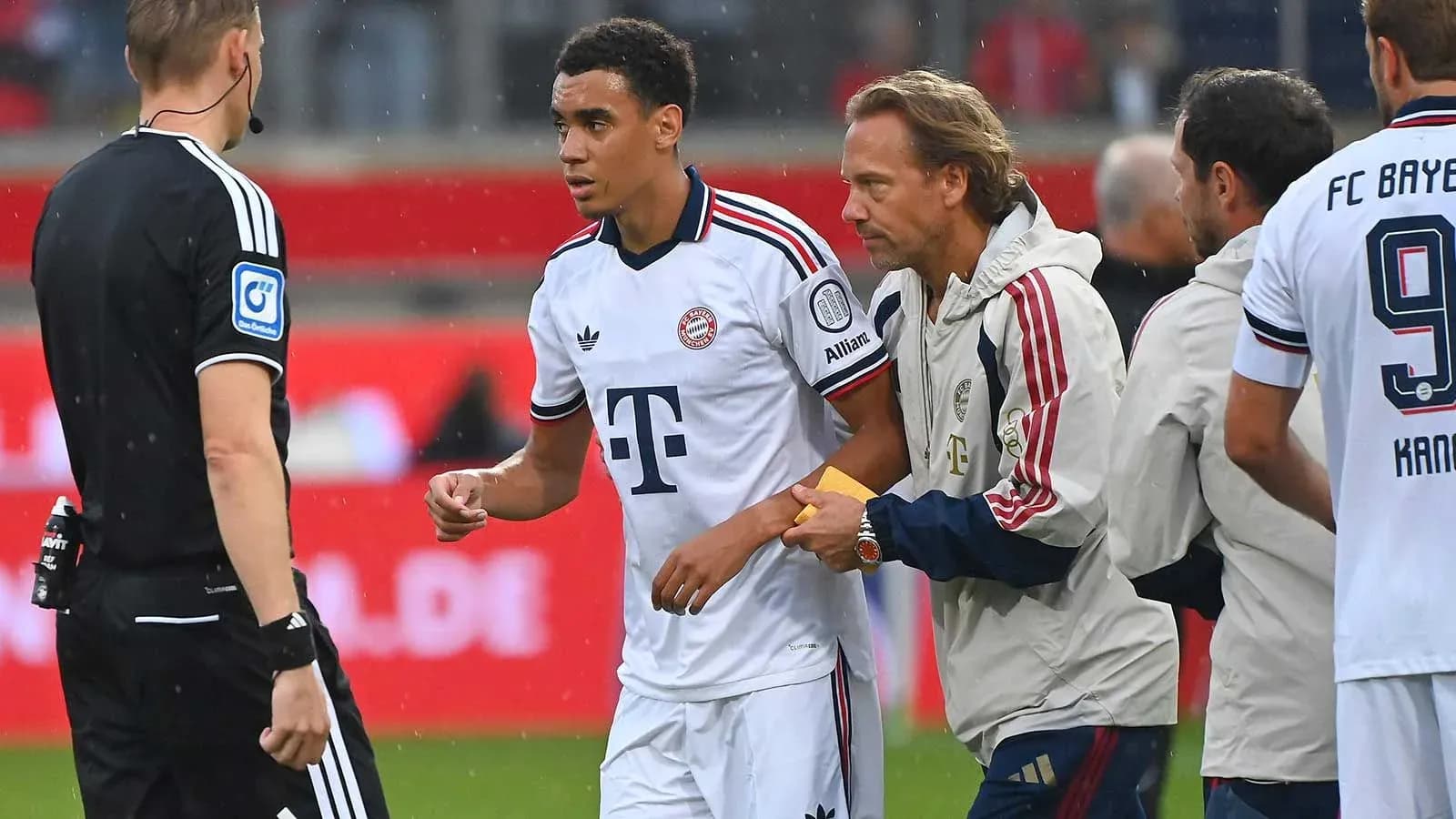
It was the 67th minute in Heidenheim, a routine pre-season run-out that suddenly didn’t feel routine at all. Vincent Kompany had just sent him on in the 61st minute for new signing Ismael Saibari, a planned cameo for Bayern’s gifted attacker. Six minutes later, Musiala went down in midfield. No challenge. No contact. Just a collapse that instantly dragged memories back to the Leipzig friendly.
Jonathan Tah and Harry Kane sprinted towards him. Players from both sides rushed in, forming a protective circle as emergency doctors charged onto the pitch. The Voith-Arena fell into that uneasy silence football knows too well.
After treatment, Musiala slowly rose. Supported by a member of staff, he staggered towards the touchline, clearly disorientated. A few metres on, he turned, then headed for the tunnel on the opposite side, disappearing from sight as the crowd found its voice again. His name rang out from the stands. When the stadium announcer confirmed he was being replaced by Cassiano Kiala, the response was loud, relieved applause.
Eberl stays calm, Musiala explains
In the mixed zone after Bayern’s 4-2 win, board member for sport Max Eberl tried to cool the anxiety.
“Jamal will speak about it himself in the foreseeable future. We knew and know about it,” he said when asked about the 23-year-old’s condition. And in that moment, at least, there was no drama. “He’s in the dressing room, he’s getting changed, he’s having a shower.”
Musiala did exactly what Eberl had hinted at a short time later. On Instagram, he addressed the scenes that had unsettled fans twice in a matter of days.
“First things first – I’m fine,” he wrote in a long post. “I understand that many of you are worried. I would like to take that worry away from you today and explain it to you: I have been diagnosed with temporary, briefly occurring but easily treatable absences, which are due to a neurological dysfunction.”
He didn’t sugarcoat the optics.
“These can lead to the moments that have happened recently, like against Leipzig or now here in Heidenheim. I know that at first glance they look scary – but for me they are currently part of everyday life. I am receiving the best possible medical treatment for this and am very optimistic.”
Crucially, he added that, according to his doctors, there is “no further health risk beyond that”.
What Musiala is dealing with
“Absences” is the clinical term. In practice, they are brief, sudden lapses of consciousness, usually a form of epileptic seizure. They tend to last only five to 15 seconds. The person stares blankly, doesn’t react, then comes back quickly with no memory of what just happened. The condition, doctors say, can be controlled and cured with medication.
On a football pitch, though, those few seconds feel like an eternity.
Musiala had already gone down shortly before the end of Saturday’s friendly against RB Leipzig, a 3-1 Bayern win. He then skipped the team presentation at the Campus on Monday, working individually instead. Against that backdrop, his appearance in Heidenheim was unexpected. His collapse, a jolt.
Goals overshadowed by concern
The scoreboard told one story: Bayern 4, Heidenheim 2. Felipe Chavez, Arijon Ibrahimovic, Luis Diaz and new signing Nathaniel Brown all found the net for Kompany’s side in a lively test match. On almost any other day, that attacking spread and another win would dominate the headlines.
Not this time. The result slipped into the background the moment Musiala hit the turf.
Bayern now head to Borussia Dortmund for the Supercup on Saturday, a fixture that usually crackles with early-season statement energy. This week, the bigger question in Munich is different: how quickly can one of their most gifted players turn a frightening diagnosis into just another hurdle on a career already marked by painful setbacks?
More than a year ago, Musiala broke his fibula at the Club World Cup and badly damaged his ankle joint. He returned in January, but the old explosiveness has yet to fully return. Right after a disappointing World Cup, he had a metal plate removed from his left foot. Each time, the expectation was the same: he’ll come back, he’ll be the old Jamal again.
Now, with a neurological issue to manage and a fanbase watching every step, the challenge is sharper. The treatment plan is clear, the optimism is there. The next time he steps onto the pitch, all eyes will be on more than just his first touch.