.svg&w=384&q=75 "GoalGist logo")
Jamal Musiala's Absence Seizures: Bayern's Concerns Grow
Jamal Musiala had barely broken sweat when the worry returned.
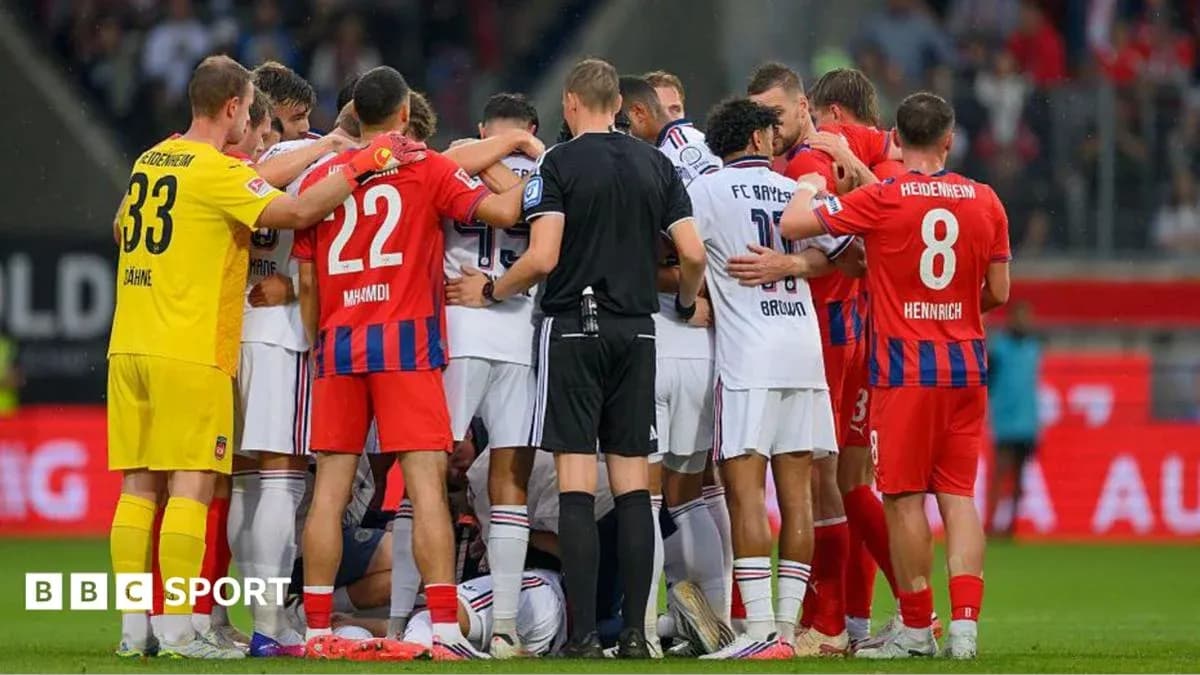
Eight minutes after coming on as a second-half substitute in Bayern Munich’s pre-season friendly against Heidenheim on Tuesday, the 23-year-old went down again – collapsing for the second time in four days and sending a fresh jolt of anxiety through the club.
The images were eerily familiar. Just as in Saturday’s game against RB Leipzig, team-mates rushed over, with Harry Kane among the first to comfort him. This was no routine pre-season knock; this was something Bayern already knew lingered in the background.
Musiala has since explained publicly that he is suffering from “easily treatable absence seizures”, caused by what he described as a type of “neurological dysfunction”. The phrase is clinical. The reality on the pitch is anything but.
Bayern knew – but now everyone can see it
Inside the club, this is not a new story.
Bayern have confirmed that signs of Musiala’s condition were present even before the World Cup. Until last weekend, though, it had never interrupted a match or played out in front of a stadium and television cameras.
“We have been aware of the problems for some time,” honorary president Uli Hoeness told Sky Sports. “But last weekend against Leipzig was the first time it happened on the pitch and was visible to everyone.”
Leipzig was supposed to be an isolated scare. Medication, they believed, would keep it that way.
“We thought that if it didn't happen again so quickly, the medication he is taking would help,” Hoeness said. “But when it happened again four days later, in the same way, I was stunned.”
The reaction from supporters was instant and fierce. Why was Musiala on the pitch again so soon after he had fainted? Had Bayern gambled with one of their most valuable players?
The club moved quickly to push back against that accusation.
“We've already taken precautions,” Hoeness stressed. “The doctors treating him, the neurologists and specialists, have provided us with written confirmation – because this was absolutely essential for us – that, in their view, there are no concerns regarding Jamal taking part in high-performance sport.
“Without that, we would have been acting negligently. Since we've had this written confirmation, we've been sleeping a little more soundly.
“But I must say, I'm rarely at a loss for words or without a clear solution. We'll have to feel our way through this new situation first.”
Kane: “He is going through something not everyone goes through”
Inside the dressing room, the response has been emotional as much as medical.
“Jamal is obviously going through a bit of a difficult moment right now,” Kane told BBC Sport. “I know he posted on social media about the small condition he has and from our point of view it is just about supporting Jamal.
“He is going through something that not everyone goes through, but there are also people who have dealt with it before and he is doing everything possible to be his best version.”
Kane, who has seen enough injuries and setbacks in his own career, made it clear the squad is rallying around one of its most gifted talents.
“He is a great player, extremely talented,” he said. “He is a big part of our team. We feel really sorry for him and frustrated for him when things happen like they do in the last couple of games.
“He has the full support from everyone here at Bayern and his friends and family, and we will be there to help him deal with it.
“He came off the back of a tough injury last season, I know how much he works behind the scenes and on the training pitch. From our point of view it is just to be there to support him and not just from my point of view, but the whole team as well.”
After Tuesday’s collapse, Musiala took control of the narrative himself. In a statement on Instagram, he said the seizures have become part of his everyday life – a stark admission for a player still at the start of what should be his peak years.
What are absence seizures – and what do they mean for an elite footballer?
Strip away the emotion and a clear medical picture emerges.
Absence seizures are a form of generalised seizure that most commonly affect children and young adults. They come in two types: typical and atypical.
Dr Meneka Sidhu, a consultant neurologist at the National Hospital for Neurology and Neurosurgery in London, explained that typical absence seizures usually last only a few seconds. To an onlooker, the person may simply look as though they are daydreaming or staring blankly.
In that moment, there is a varying degree of loss of awareness. Balance can go, responses can stop. Then it can be over as quickly as it started.
“It can be very short-lasting, and the person can continue like nothing happened,” Dr Sidhu said.
Atypical absences can last longer and look different. Automatic movements might appear – fidgeting with the hands, eyelid fluttering, lip smacking. “Some people may fall,” she added.
Repeated absence seizures over more than 24 hours can point towards epilepsy, though medication can control the episodes.
“For anybody affected by epilepsy, it is important to try to identify triggers,” Dr Sidhu said. For athletes, those triggers can include hyperventilation and dehydration – both common in elite sport, especially in intense training or matches.
The crucial line for Musiala and Bayern is this: “When effectively treated, there is no reason absence seizures should stop anyone playing sport.”
He is not alone at the top level. Rugby player Tommy Freeman began having absence seizures at 14, was later diagnosed with epilepsy, and now manages the condition with tablets while playing for Northampton and England.
Another setback in a brutal 18 months
For Musiala, this diagnosis drops into an already punishing recent history.
His 2024-25 campaign ended in early April because of injury. Just over a week later, he was involved in a serious traffic accident. It could easily have derailed far more than his season.
He still fought his way back to feature at the Fifa Club World Cup two months later. That return, too, brought fresh pain. In the quarter-final against Paris St-Germain he suffered a broken leg and a dislocated ankle after a collision with Gianluigi Donnarumma. The damage kept him out for 196 days.
When he did finally come back, it was with a metal plate in his foot, which he played with from January through to the end of this summer’s World Cup in North America, where he made four appearances for Germany.
The plate was only removed in July. That operation restricted his pre-season training and meant the new campaign was always going to start with a physical catch-up.
“Musiala hasn't been much of a factor in the past 18 months,” German football expert Constantin Eckner said. “He came back for the Club World Cup but suffered a broken leg when he collided with Gianluigi Donnarumma.
“It took him months to recover from that. He just had a metal plate removed from his left foot so he played with that for half a year and had to deal with ankle issues.
“Naturally, his performances left much to be desired. The start to the upcoming season would have been difficult anyway, because he didn't take part in team training for some time due to the surgery in which the plate was removed. Now, there's another stumbling block.”
Bayern’s planning – and a brutal reality
Bayern have not built their squad blindly around the idea that Musiala will be available every week.
Eckner pointed to the £43m summer signing of Morocco attacking midfielder Ismael Saibari as a strategic move, at least in part, to protect the club against Musiala’s fitness problems.
“Musiala is Bayern's top earner alongside Harry Kane, but his contribution hasn't been anywhere close to Kane's,” Eckner said. “He is still young and things can change again.
“He has a release clause in his contract that could be triggered next summer, but the fee would be in the nine digits. It is unrealistic that any club would be willing to pay that for him at the moment.”
That is the hard edge of the story: a generational talent, a huge contract, a towering valuation – and, right now, a body that keeps throwing obstacles in his way.
The medical specialists say absence seizures can be controlled. Bayern have written assurances that he can compete at the highest level. His team-mates stand firmly behind him.
The question now is not whether Jamal Musiala can play football again. It is how often, and for how long, Bayern will be able to see the version of him they built their future around.