.svg&w=384&q=75 "GoalGist logo")
Jagiellonia vs Rangers: Tactical Analysis of a 2-1 Victory
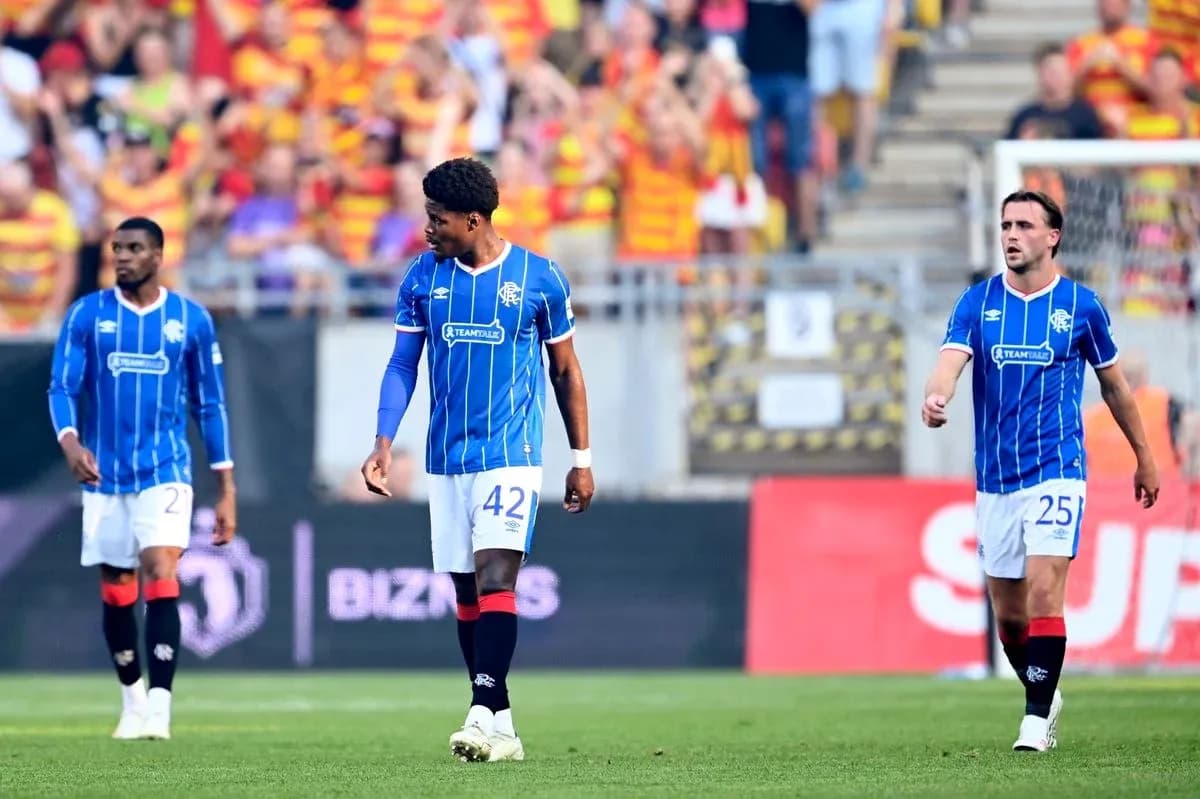
Jagiellonia’s 2-1 win over Rangers at Chorten Arena was built on structural clarity and superior use of territory rather than overwhelming volume. Adrian Siemieniec’s 4-3-3 imposed itself early, and despite the bizarre double own-goal sequence, the Polish side controlled key zones, tilted the shot profile in their favour, and then managed the game with a disciplined mid-block once ahead.
Out of possession, Jagiellonia’s 4-3-3 behaved almost like a 4-1-4-1. T. Romanczuk anchored in front of the back four, with S. Lozano and R. Conceicao initially completing a compact triangle that screened Rangers’ double pivot of D. Neil and T. Chukwuani. The pressing trigger was predictable but effective: as soon as Rangers tried to build through the full-backs, Jagiellonia’s wide midfielders K. Szmyt and J. Imaz jumped aggressively to the outside, while N. Prelec curved his runs to block the passing lane into the near pivot. That pattern forced Rangers to play longer, low-percentage balls towards Chermiti, who was routinely outnumbered by the centre-back pairing of A. Konstantopoulos and Y. Kobayashi.
In possession, Jagiellonia leaned heavily on their right side. N. Wojtuszek pushed high to almost winger height, with Szmyt coming inside into the right half-space. This created a 2-3-5 in attack: full-backs wide, Romanczuk holding, Lozano stepping to the left interior lane and Conceicao tucking in on the right to stabilise rest defence. The 7 shots on goal from Jagiellonia against just 3 for Rangers underline how effectively they converted this territorial structure into clean looks, even if overall shot volume is not fully captured in the data.
The early own goal by G. Montoia could have destabilised the home back line, but structurally Jagiellonia responded by compressing distances between the centre-backs and Romanczuk rather than chasing the game in a chaotic high press. That compactness limited Rangers to 3 shots on target despite 5 corners and more fouls won (Jagiellonia committed 11 fouls to Rangers’ 15). The low blocked-shots figure for Jagiellonia (0) suggests Rangers rarely managed to shoot through crowds; most of their efforts either missed the target or were taken under pressure before the block could arrive.
Rangers’ 4-2-3-1 never quite solved the problem of progression through the middle. With only 48% possession, they were not completely starved of the ball, but their use of it was reactive. The double pivot of Neil and Chukwuani often received with their back to play, forced sideways by Jagiellonia’s narrow front three. When the ball did break lines into the three behind Chermiti — D. Yokota, T. Aasgaard and M. Diomande — it was usually wide and static, rather than arriving on the move between the lines.
Derek McInnes’ triple change at 46' was a clear attempt to rewire that midfield dynamic. C. Devlin (IN) came on for T. Chukwuani (OUT), N. Raskin (IN) for D. Neil (OUT), and F. Curtis (IN) for D. Yokota (OUT), effectively introducing more energy and verticality in central areas. Raskin in particular offered more forward intent, but Jagiellonia responded by slightly lowering their block and protecting the central lane even more zealously. The effect was that Rangers circulated the ball more, but without significantly increasing their shot threat; the shot-on-goal count remained at 3.
On Jagiellonia’s side, the 65' double change — J. Agbonifo (IN) for R. Conceicao (OUT) and A. Klynge (IN) for S. Lozano (OUT) — refreshed the midfield legs and preserved the intensity of their pressing in the half-spaces. Later, at 80', D. Drachal (IN) for J. Imaz (OUT) and Y. Sylla (IN) for N. Prelec (OUT) shifted the focus from creation to transition defence. With fresher forwards, Jagiellonia could continue to threaten on the break while still closing down Rangers’ first pass after turnovers.
Defensively, Jagiellonia’s back four were conservative in their positioning once in front. G. Montoia, despite his early own goal, stayed narrower and deeper after the interval, clearly instructed to prioritise covering the channel runs of Rangers’ wingers over overlapping. On the opposite side, Wojtuszek’s earlier adventurous positioning was moderated, with the full-back stepping out only on clear triggers and with midfield cover in place. This caution contributed to the low number of clear Rangers chances and helped protect the 2-1 lead that had been established before half-time.
Rangers’ attacking structure deteriorated as the match wore on. The 76' introduction of V. Dragojevic (IN) for T. Aasgaard (OUT) and the 85' swap of L. Shankland (IN) for R. McCrorie (OUT) were aimed at injecting direct threat and penalty-box presence, but they also disrupted the already fragile balance in the first phase of build-up. With McCrorie leaving the back line, Rangers lost a key outlet in progressing play from deep, and Jagiellonia were able to defend more of the match in front of their own box without being stretched horizontally.
Discipline also tells part of the tactical story. Rangers collected 3 yellow cards to Jagiellonia’s 1, a spread consistent with a side chasing the game and arriving late in duels. The higher foul count (15) reflects how often Jagiellonia’s midfielders and wide players were able to receive between the lines or spin away from pressure, forcing Rangers into tactical fouls to slow transitions.
Statistically, the match tilts narrowly in Jagiellonia’s favour in possession (52% to 48%) but more decisively in shot quality, as indicated by the 7-3 advantage in shots on goal. Rangers’ 5 corners to Jagiellonia’s 1 show that the Scottish side did generate set-piece platforms, yet they failed to translate these into sustained pressure or second-ball dominance. The absence of recorded goalkeeper saves and xG data limits the granularity of evaluation, but the available numbers align with the eye-test implied by the events: Jagiellonia created clearer chances from open play, managed the central spaces better, and used their substitutions to preserve structural integrity, while Rangers’ adjustments increased energy without resolving their fundamental progression issues.