.svg&w=384&q=75 "GoalGist logo")
Iran's World Cup Journey Amid Political Tension
The World Cup usually offers escape. For Iran, it has become an extension of the frontline.
Rarely has a team walked into a tournament carrying this much political weight. Until this week, the host nation, the United States, was at war with Iran. On Sunday, an agreement to halt hostilities and reopen the Strait of Hormuz finally emerged, easing fears of escalation. It did not ease the tension around this team.
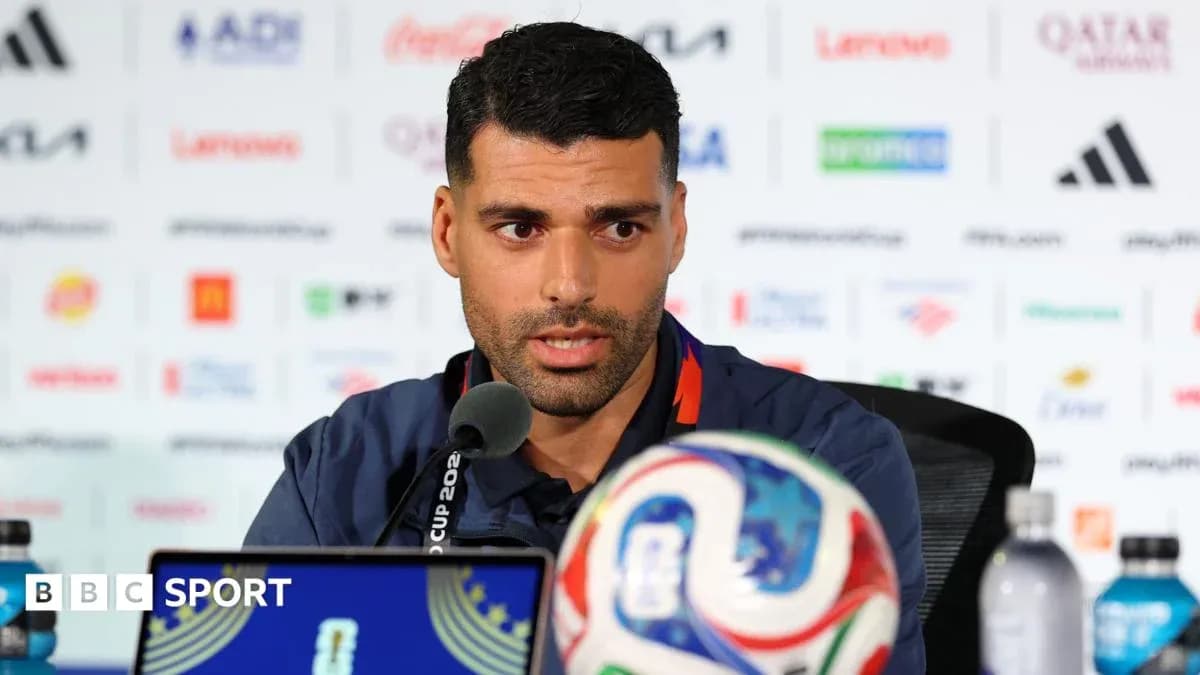
You can hear it in Mehdi Taremi’s voice.
“This kind of tension undermines the joy of the World Cup,” the striker said. “I felt the tension from the first moment we arrived. The tension started even before we got here.”
He is not exaggerating. Iran’s preparation has unfolded like a logistical obstacle course. The squad first based itself in Tucson, Arizona, only to uproot and shift its World Cup camp to Tijuana, on the Mexican border, after months of uncertainty over visas, security and a political climate that grew more charged by the week.
The disruption has left a mark.
“Without any doubt, this kind of behaviour has impacted the spirit of football,” manager Amir Ghalenoei told the BBC. “Football is supposed to bring nations and cultures together. It is about bringing joy. These conditions have affected our focus, but I have tried to make sure the players concentrate on strategy and performance.”
They arrived late. They have had little time to adjust. Ghalenoei knows the cost of that in a tournament where details decide careers.
“But I know how committed these players are to performing,” he added.
Now they land in Los Angeles, a city that has long carried another name: “Tehrangeles”. The nickname drew smiles from both Taremi and Ghalenoei in the news conference, a brief moment of lightness in a week heavy with politics.
On Monday at SoFi Stadium, Iran open their World Cup campaign against New Zealand. The stands will be packed with one of the world’s largest Iranian diasporas. Many will come in shirts, scarves and colours.
Many will come to protest.
Fifa has banned the pre-revolutionary Lion and Sun flag, a powerful emblem for Iranians abroad, especially those who left after the 1979 revolution. The ruling has hit a nerve.
“You don’t come to Los Angeles and tell us we can’t fly the Lion and Sun flag,” said activist Arezo Rashidian, one of the organisers of demonstrations planned outside the stadium. “This is the largest Iranian community outside Iran. Many of us came here after the revolution. We’re opposing Fifa’s ban and standing in solidarity with the people of Iran.”
For a sizeable section of the diaspora, the national team is not a neutral symbol. It is seen, fairly or not, as an arm of the Islamic Republic.
“It’s unfortunate that the regime turns athletes into mouthpieces,” Rashidian said. “We want athletes to remain athletes.”
Yet even among those who fiercely oppose the regime, the bond with the shirt and the country endures. Many protesters still plan to go inside, to watch, to feel that familiar tug when the anthem plays.
“We understand the pressure they’re under,” Rashidian said. “We’ll carry our colours. We’ll cheer for Iran – the country – held captive by the Islamic Republic.”
So outside SoFi, flags and chants. Inside, a squad trying to cling to the idea that this is still just football.
“As players of the national team, we play for every single Iranian, whether in the diaspora or in Iran,” Taremi said. “In every country people have different opinions. We are here to unite people and bring joy. Everyone is entitled to their opinion. We don’t get involved in politics.”
That is the ideal. The reality is harsher.
“There is no winning for Iran’s team,” said investigative football journalist Samindra Kunti. “Given the circumstances, the political pressure, the location of the matches and the diaspora in Los Angeles, they’re under enormous pressure. It’s impossible to avoid the politics. Everything becomes a reminder of their situation.”
Pressure from home, where every gesture is watched. Pressure from the host nation, fresh from conflict. Pressure from a diaspora determined to make itself heard.
All of it converges on one squad, one dressing room, one walk down the tunnel in Los Angeles.
And all of it hits before a ball has even been kicked.