.svg&w=384&q=75 "GoalGist logo")
Iran’s World Cup Opener: Football Amidst Political Turmoil
In Los Angeles, Iran’s World Cup opener against New Zealand is supposed to be about football. It will be anything but.
This is a match wrapped in barbed wire. A World Cup game played in a host nation at war with one of its participants. A team caught between a governing regime at home and a furious diaspora abroad. A stadium where the anthem may be drowned out by boos, where a flag banned by Fifa could become the central image of the night.
Mehdi Taremi can feel it all.
“I have felt the tension from the first moment we arrived at this World Cup,” the Iran captain said, laying bare a mood that has stalked his squad since landing in North America. Their preparations have been shredded by geopolitics: a late move of their base to Mexico, visa problems for members of the delegation, travelling fans stripped of match tickets.
“This kind of tension, it undermines that joy and it undermines the message of Fifa and our people, which is that football brings about peace,” Taremi said. “I feel like this World Cup could have provided a better atmosphere than it has.”
Instead, SoFi Stadium is braced for a collision.
A team under orders, a crowd in open revolt
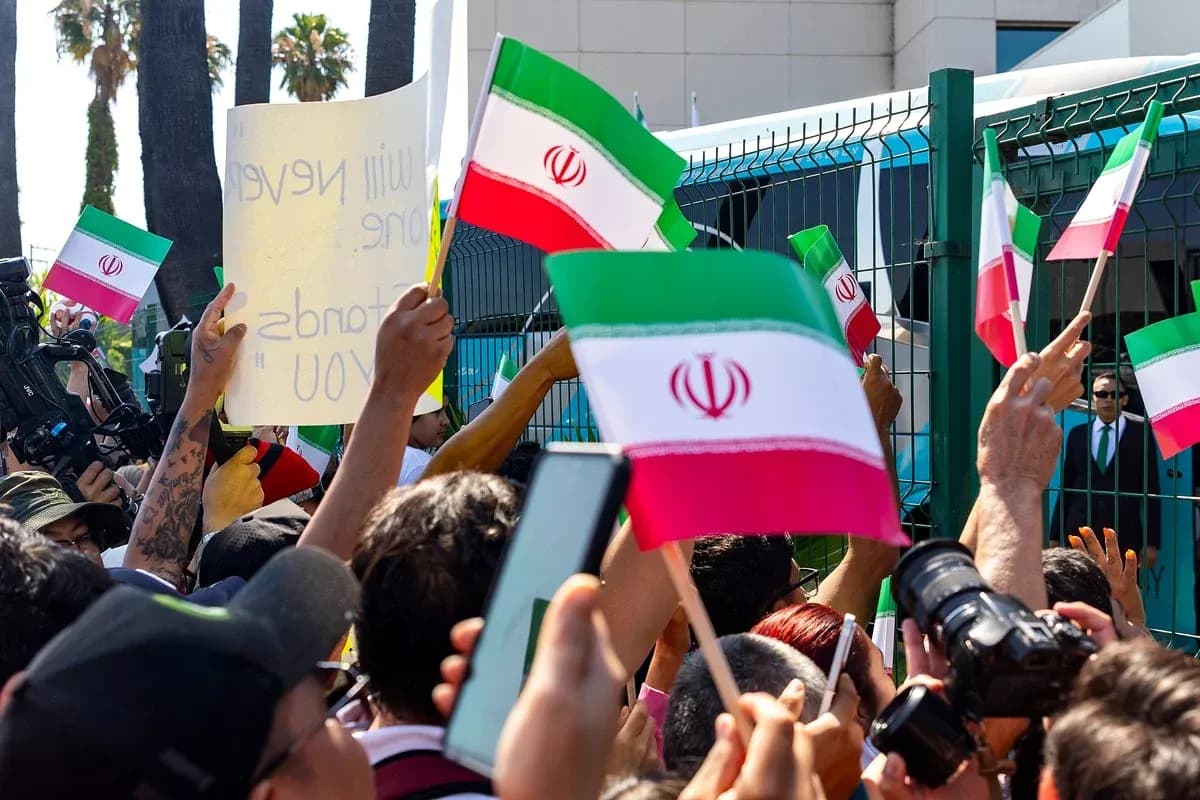
Iranian protesters, many of them long settled in the United States, have promised to turn the game into a visible, audible act of defiance against the regime. Their plans are blunt: boo the anthem, turn their backs to the pitch, and reveal the pre-revolutionary flag that Fifa has prohibited inside stadiums.
“We’re going to make it hell,” one activist told the Daily Mail, describing buses organised from San Diego, Orange County and across Los Angeles to converge on the venue. The aim is simple: to strip away any illusion of unity between team and state.
“We’re going to boo the anthem that is going to play. We're going to turn our backs during the anthem so we will have our flags showing,” she said. “I know Fifa banned it but we will make a way to get it in. So we're going to see this flag, not the terrorist regime’s flag.”
That is the backdrop to a surreal instruction delivered to Iran coach Amir Ghalenoei: if pre-revolutionary flags are brandished or if anti-regime chanting is clearly heard, he has been told by the government to stop the match.
The idea that a national coach might be expected to walk his players off the pitch in the middle of a World Cup game feels unprecedented. Yet that is the possibility hanging over Iran’s campaign.
Ghalenoei, for his part, tried to steer the conversation away from the stands when he faced the media.
“We don’t pay attention to any of the hype and anything that goes on around us,” he said. “We are here to represent the respectful people of Iran, be it the Iranians inside Iran or the Iranian diaspora.
“We are not political people... football is separate from politics.”
That line will be tested the moment the anthem starts.
The most fragile of World Cup stages
This is the first time in the World Cup’s 96-year history that a host nation is at war with one of the competing teams. It is an uncomfortable truth that hangs over every minute Iran spend on American soil.
Tonight’s game against New Zealand, on paper, is a group-stage opener. In reality, it is a pressure cooker. Protesters outside the ground, protesters inside the ground, and a squad who know that every gesture, every silence, every glance during the anthem will be dissected far beyond the result.
The players have already felt the cost of the conflict. Their relocation to Mexico disrupted training rhythms. Visa issues have hampered logistics. Supporters who planned for years to follow them have seen tickets withdrawn. Taremi’s frustration is not abstract; it has played out in travel plans, hotel bookings, and empty seats that were supposed to be filled by Iranian voices.
The atmosphere in Los Angeles is likely to be fractured. Sections of the crowd will roar for the team. Others will roar against the regime and use the match as a stage to do it. Fifa’s stadium regulations, from flag bans to messaging controls, will be stretched to their limit.
And somewhere in the middle, a referee may find himself confronted with a decision no official wants: what to do if a coach, under instruction from his government, tries to halt a World Cup game in full view of the world.
Football tries to carry on
Across the continent, the tournament rolls forward with its usual swirl of storylines. England’s build-up to their meeting with Croatia in midweek has been dominated by talk around Jude Bellingham, and Jordan Henderson stepped in firmly to back his teammate.
“I know a lot gets written in the media and I really find it hard to read sometimes because I just know how big an influence he is on this team, how good a teammate he is off the field,” Henderson said. “And what he gives us is just something really special, he really gives us the X-factor in our team. We all know what he can do, and how much we all love him inside the camp, and I suppose that’s the main thing.”
Croatia, meanwhile, have been studying Harry Kane. Defender Duje Caleta-Car called the Bayern Munich striker a “master of the game”, still haunted by Kane’s movement and positioning from their Euro 2020 meeting, even on a day he did not score.
Transfers tick along around the edges. Marc Cucurella has completed a £52m move from Chelsea to Real Madrid, a six-year deal that keeps the Spain defender at the Bernabeu until 2032. Eberechi Eze, still processing a missed penalty in Arsenal’s Champions League final defeat, insists he will step up again if England need him in a shootout at this World Cup. “Why wouldn’t I take it?” he said. “All the big players have missed big penalties.”
There are the oddities that every World Cup throws up. Sweden boss Graham Potter joked about “someone” biting his ear amid the wild celebrations of a 5-1 win over Tunisia. Fifa’s discrimination monitor has called for the removal of VAR official Shaun Evans after he appeared to make a hand gesture associated with white supremacist symbolism during Germany’s match against Curaçao. A Mexican fan has lost his job after making a racist gesture towards a Korean influencer in the stands at a game in Guadalajara.
Even the stadium naming rules have a lighter edge: Levi’s, stripped from the title of Levi’s Stadium by Fifa’s clean-venue policy and replaced with the bland “San Francisco Bay Area Stadium”, responded by changing their Instagram profile picture in a pointed bit of corporate humour.
The circus, in all its forms, goes on.
But nothing else at this World Cup sits on the same fault line as Iran v New Zealand in Los Angeles. A team under orders. A crowd ready to rebel. A governing body trying to insist football is separate from politics while the sport’s biggest stage becomes an arena for both.
When the anthem begins and the first boos, or cheers, or silences roll around SoFi Stadium, the question will not be who kicks off. It will be whether this match can stay a football game at all.

