.svg&w=384&q=75 "GoalGist logo")
Ipswich vs Liverpool: Tactical Analysis of Premier League Clash
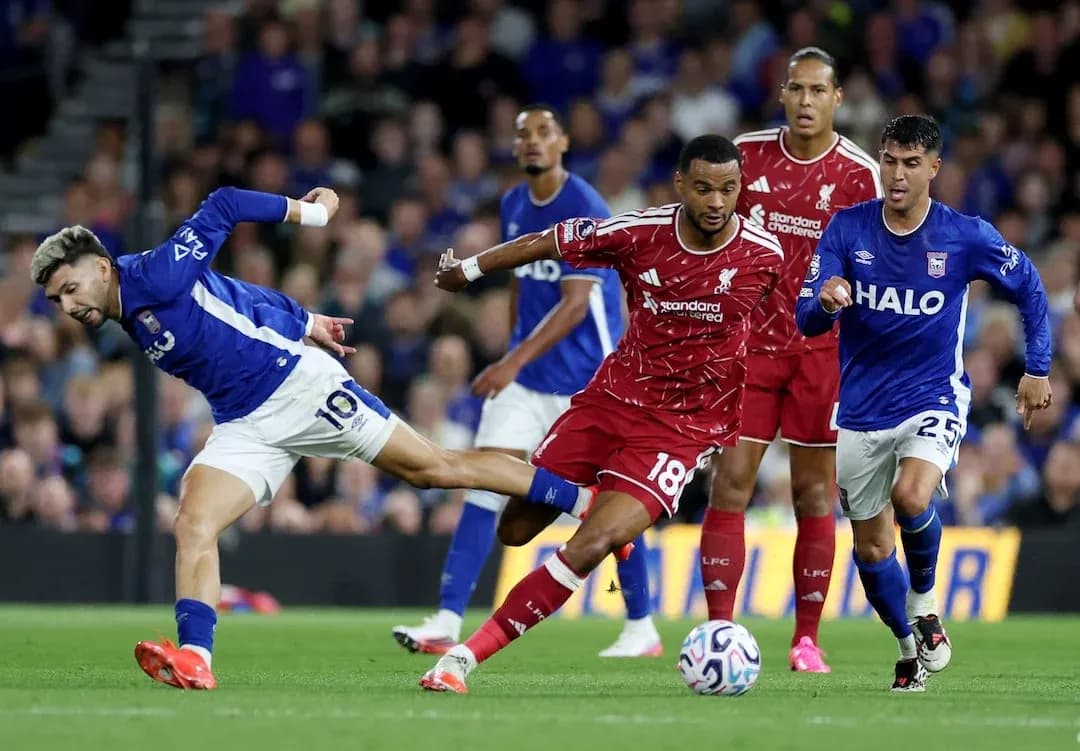
Portman Road under the Friday night lights offered a telling snapshot of where these two projects stand in the early weeks of the 2026 Premier League season. Ipswich, back among the elite and learning on the job, fell 0–2 at home to a Liverpool side that already looks structurally advanced under Andoni Iraola. Following this result, Ipswich sit 14th with 3 points from 3 matches, their overall goal difference at -4 (4 scored, 8 conceded). Liverpool, unbeaten and now up to 6th with 5 points, carry an overall goal difference of +2 (6 scored, 4 conceded) and the sense of a team whose underlying mechanisms are starting to hum.
I. The Big Picture – Systems and Seasonal DNA
Both managers trusted a 4-2-3-1, but the shapes told different stories once the whistle went.
Ipswich’s version was orthodox and honest. K. Scherpen behind a back four of L. Davis, J. Greaves, I. Diop and D. O’Shea; a double pivot of S. Lukić and E. Palacios; a fluid band of three with A. Fatawu right, J. Enciso central, D. Maeda left; and Emersonn as the lone forward. It is the same formation they have used in all three league fixtures so far, a nod to G. O’Neil’s desire for continuity as his side adjust to Premier League tempo. But the numbers underline the fragility: overall, Ipswich concede 2.7 goals per game, with 1.5 goals against at home and a bruising 5.0 on their travels. There are no clean sheets in total this campaign, and at Portman Road they average just 1.0 goal for per match.
Liverpool’s 4-2-3-1 is a more aggressive, possession-heavy interpretation. Alisson Becker anchors a back line of M. Kerkez, V. van Dijk, J. Jacquet and R. Araújo. Ahead of them, D. Szoboszlai and A. Mac Allister form a high-class double pivot, feeding an attacking trio of Víctor Muñoz, F. Wirtz and C. Gakpo behind A. Isak. Across the season so far, Liverpool score 2.0 goals per game overall, both at home and on their travels, while conceding only 1.3 overall. There is just one clean sheet in total, but the defensive metrics suggest a side whose structure is fundamentally sound and improving.
II. Tactical Voids – Absences and Discipline
Ipswich came into this match stripped of some of their central ballast. A. Matusiwa, J. Philogene and J. Taylor were all ruled out, robbing O’Neil of rotation options in midfield and wide areas. With a small core already stretched, that absence of fresh legs told in the final third, where Ipswich’s pressing intensity faded and the transitions became longer and more hopeful.
Liverpool’s absentee list was longer on paper but lighter in structural impact. C. Bradley, F. Chiesa, H. Ekitike, J. Gomez and G. Leoni all missed out, yet Iraola still fielded a back four of full internationals and a forward line with both pace and guile. The depth on the bench – L. Koumas, B. Barcola, R. Ngumoha, W. Endo and R. Gravenberch among others – meant Liverpool could manage game states without compromising the system.
Disciplinarily, the season patterns are clear. Ipswich’s yellow cards are heavily front-loaded into the 31–45 minute window, with 75.00% of their cautions coming just before half-time. That reflects a team often chasing, forced into late-half interventions as shape and concentration waver. Liverpool’s bookings, by contrast, are spread more evenly, but with a peak between 46–60 minutes (40.00% of their yellows). Iraola’s side press hard after the interval, accepting tactical fouls as the price of territorial dominance. Notably, Liverpool have yet to receive a red card this season, while Ipswich also remain without dismissals.
III. Key Matchups – Hunter vs Shield, Engine Room
The “Hunter vs Shield” duel in this fixture is epitomised by A. Isak against an Ipswich defence that has already conceded 8 goals overall. Isak, the league’s leading scorer so far with 3 goals in 3 appearances, has taken 7 shots with 5 on target and carries an impressive rating of 7.77. His movement between the lines and ability to finish early in attacks is a direct test of a back four that, at home, concedes 1.5 goals per game and has yet to keep a clean sheet.
For Ipswich, the creative responsibility falls heavily on J. Enciso and A. Fatawu. Enciso has 2 assists in total this campaign, with 11 shots and 4 key passes, and a 7.0 average rating. Fatawu, with 1 assist and 7 key passes, is a relentless dribbler, attempting 15 take-ons and winning 21 of 44 duels. Their challenge is to exploit the one soft underbelly in Liverpool’s profile: on their travels, Liverpool concede 1.0 goal per match, and their single away clean sheet suggests that with accurate final balls, they can be opened.
Yet standing in their way is a formidable “Shield”. V. van Dijk’s presence alongside J. Jacquet and the aggressive full-back pairing of Kerkez and Araújo gives Liverpool height, recovery pace and aerial dominance. Kerkez in particular is combative: 6 tackles, 3 successful blocks and 2 yellow cards in 3 games underline a defender who defends on the front foot and is not shy of contact. Araújo adds another layer of physicality, with 19 duels contested and 13 won, plus 2 blocked shots.
In the “Engine Room”, the contrast is stark. S. Lukić and E. Palacios must screen a defence that already leaks chances while progressing the ball to Enciso and Fatawu. Across the season, Ipswich’s midfield has not yet produced a scorer, and with the team failing to score in 1 of their 3 matches overall, the burden on their double pivot is as much creative as destructive.
Liverpool, by contrast, can lean on a multi-layered creative structure. A. Mac Allister and D. Szoboszlai orchestrate from deep, but the true hub is C. Gakpo. With 3 assists and 1 goal in total this campaign, 8 key passes and 88 completed passes at 84% accuracy, Gakpo is both Liverpool’s top assister and a high-volume ball progressor. His work without the ball is just as influential: 6 tackles, 1 blocked shot and 5 interceptions show a midfielder who collapses passing lanes as well as he opens them.
IV. Statistical Prognosis – Where the Numbers Point
Following this result, the trajectories diverge. Ipswich’s overall attacking average of 1.3 goals per game is respectable for a newly returned side, but their defensive average of 2.7 conceded overall is unsustainable. At home, 1.0 goal for and 1.5 against per match hints at narrow margins that will often tilt towards more experienced visitors.
Liverpool’s metrics, by contrast, are those of a side with a high floor. They score 2.0 goals per match overall and concede 1.3, with a balanced away record of 4 goals scored and 2 conceded across 2 games. They have converted their only penalty of the season, underlining a clinical edge in high-leverage moments.
Overlaying the tactical structures on the numbers, Liverpool’s superior control in midfield and the cutting edge of Isak and Gakpo make them the more reliable proposition in similar fixtures going forward. Ipswich’s 4-2-3-1 has the attacking talent to hurt teams – especially through Enciso and Fatawu – but until the defensive block tightens and the card-heavy late first-half phases are tamed, they will continue to live on a knife-edge against the division’s elite.