.svg&w=384&q=75 "GoalGist logo")
Guardiola's Warning to Man City: The Reality of Young Talent
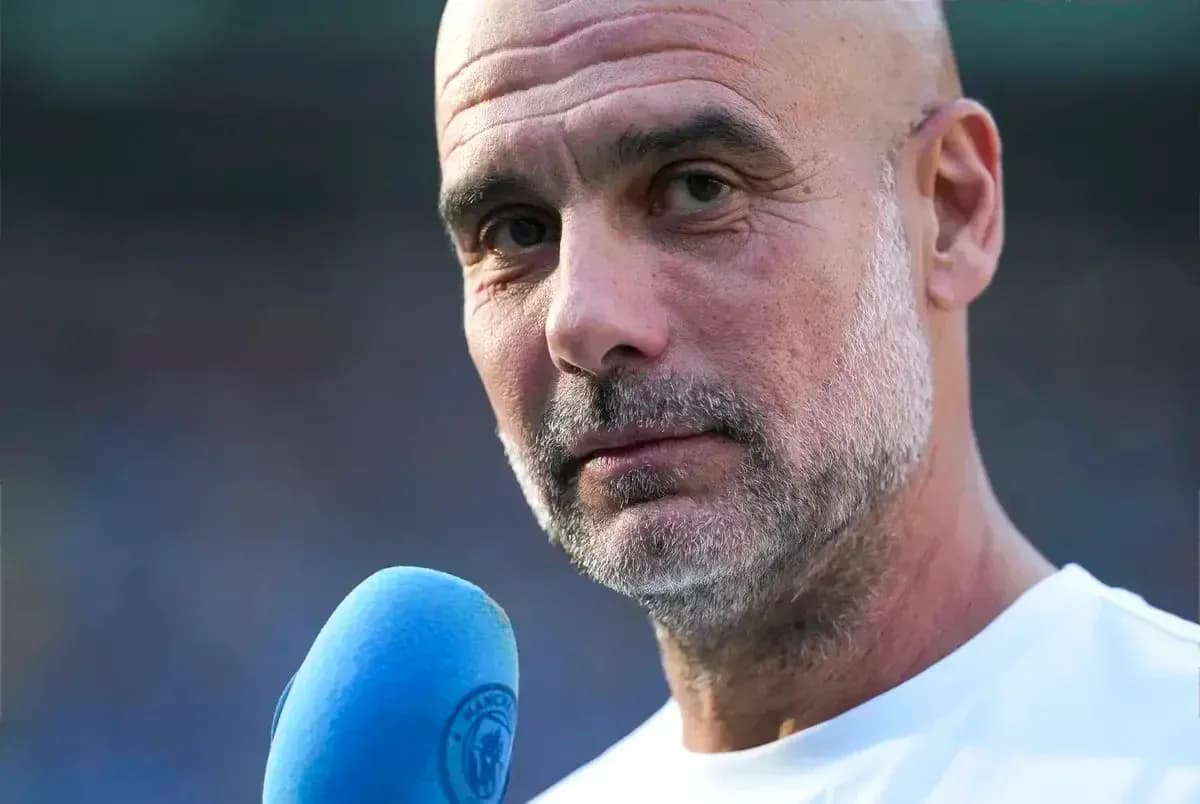
Pep Guardiola has never been one for gentle euphemisms. A decade of control at Manchester City, four straight Premier League titles, three FA Cups and the club’s first Champions League give him the right to talk plainly about what comes next. This week, he did exactly that.
In a new interview with OKX, the former City manager offered pointed advice to sporting director Hugo Viana and new head coach Enzo Maresca on the most delicate job in elite football: building a squad that can win now, without losing the future.
It was less a nostalgic reflection on his Etihad years and more a cold, hard briefing on the storm that awaits his successors.
The myth of the “young core”
Guardiola lifted the lid on a comforting idea that every ambitious club likes to sell to itself: assemble a group of talented young players and you’re set for three or four years.
He doesn’t buy it. He’s lived the opposite.
“I spoke many times with the Manchester City sporting director(s) (former) Txiki Begiristain and (current) Hugo Viana, and said, ‘Now we have a young team for the next three or four years!’” Guardiola recalled.
Then he cut straight through the illusion.
“It's not true. You don't know why, but it doesn't work. A lot of players, young players, don't play and say, ‘I want to leave! I'm here in cold Manchester, not playing, I want to leave!’ And you have to replace those guys.”
That line – “cold Manchester, not playing, I want to leave” – will land with uncomfortable force inside the training ground as Maresca begins his first pre-season and Viana oversees one of the most significant rebuilds in City’s modern history. The reality Guardiola is describing isn’t theoretical. It is already shaping this summer.
Young, ambitious players will not sit quietly in the shadows of a superclub. Not anymore. Not when careers move faster, contracts are shorter, and the market for emerging talent is this aggressive. If they don’t see a pathway, they walk.
And City, as Guardiola knows better than anyone, are uniquely vulnerable to that churn: a global powerhouse, a brutal competition for minutes, and a city that doesn’t always sell itself to those who rarely see the pitch.
Recruitment as a collective test
Guardiola’s message to Viana wasn’t a private whisper. He named names. Txiki Begiristain. Hugo Viana. The CEO. The manager. The hierarchy.
“But the big task is how the club, organisation, sporting director, manager, CEO, hierarchy recruit the right players you need – everyone makes mistakes, but make as few as possible. That's the key point.”
That is classic Guardiola: an obsession with process over comfort, with decisions over excuses. He is not talking about one big transfer blunder; he is talking about accumulation. A squad eroded by a series of almost-right signings, by young players who never quite get on the pitch, by gaps that have to be fixed a year earlier than planned.
He frames recruitment not as a one-man show, but as a shared responsibility that runs from the boardroom to the dugout. At a club like City, that alignment is non-negotiable. One misread on a player’s mentality. One misjudgement on how a youngster will react to limited minutes. One signing who blocks a pathway. The effects ripple for years.
Maresca now steps into that ecosystem with his own ideas, but under the same ruthless pressure: win immediately, refresh constantly, and keep a restless dressing room engaged.
City’s present problem, laid bare
Guardiola’s comments land at a moment when several City players are already understood to be weighing their futures. The pattern is familiar: limited minutes, fierce competition, a sense that careers might stall if they wait too long for a starting role that may never come.
That is the tension Viana must manage this summer. Not just the glamour of headline arrivals, but the grind of decisions on loans, sales and new contracts. Who stays to fight? Who goes to play? Who can be convinced that their time will come in Manchester, and who needs to move for everyone’s sake?
The challenge is sharper in a city that can feel unforgiving to those on the fringes. It is one thing to be a star in Manchester. Quite another to be 21, unused, and watching your peers play every week somewhere warmer, somewhere easier.
Guardiola has seen it all before. He lived through the awkward conversations, the players knocking on the door, the agents calling. His warning is simple: don’t assume a young squad today will still be your young squad tomorrow.
You have to keep replacing. And you have to get those replacements right.
Elliot Anderson and the margin for error
On that front, Guardiola’s line about “make as few mistakes as possible” hangs over every move City make in this window.
The clearest example so far is the club-record £116 million signing of Elliot Anderson from Nottingham Forest. This is not a panic buy. It is a player City have tracked, studied and finally moved for at a price that underlines how convinced they are.
In Guardiola’s world, this is what “as few mistakes as possible” looks like: long-term scouting, a clear role, a profile that fits the manager’s demands and the club’s wider plan. Not a reaction to a bad result or a noisy week in the market.
For Viana, every major outlay must now carry that same weight of certainty. Every decision on a young player’s future has to be rooted in hard judgment, not sentiment. Keep the wrong one and you block a pathway. Sell the wrong one and you strengthen a rival or lose a future starter.
Guardiola’s decade at City was defined by relentless control and almost flawless squad evolution. The bar he set is brutal. His message to those following him is even harsher: there is no such thing as a settled young core, only a moving target.
Maresca and Viana now have to hit it.